Strategy summary lessons
Week 1: Introduction and External Analysis
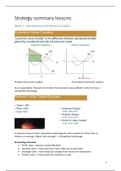
Producer/Consumer surplice No producer/consumer surplice
As an organization the goal is to create more economic value added in order to have a
competitive advantage.
Companies measure their competitive advantages by ratios relative to other firms or
industry on average. Higher than average? -> Competitive advantage
Accounting measures:
• Profit ratios – Revenue and profitability
• Liquidity ratios – How easily short-term debt can be paid back
• Leverage ratios – How easily you can get more money for investments
• Activity ratios – How quickly the inventory is used
1
,Economic measures:
• Weighted average cost of capital (WACC) – Average of all the foreign money that you
have and the money investors wants back in %.
ROA >WACC -> Competitive advantage.
WACC<ROA<Ind.Avg.ROA = Below average.
Why external analysis?
• Discover opportunities and threats (should be trends)
• Analyze potential for profits
• Understand the nature of competition
Levels of analysis (in general)
• General environment
• Industry (part of task environment, e.g. people living close to the Efteling)
• Strategic group – Plus/Appie and Lidl/Aldi -> mobility barriers.
• Individual firm (internal/competitor)
2
,Pestle/Destep → Outside layer. General environment, not industry specific
Technological change: A shift in the frontier of technological possibilities and the underlying
infrastructure.
Demographic trends: Age, sex, marital status incomes, all numbers. (often a result of other
trends)
Cultural trends: Values, beliefs and norms that guide behaviour in society.
Economic climate: The overall health of economic system within a firm operates. Recession
Legal/Political conditions: The law and legal system’s impact on business.
Specific international events: Events like (civil) wars, political coup, terrorism.
The trend should impact the performance of a firm and explain why.
Coca cola: (carbonated) Soft drink industry or beverages industry? Milk would be in the
beverages industry too. Grey area, but different production process. Argumentation is key.
Greek tappa’s store: No other Greek store around so no competition? Too narrow, actual
competitors are substitutes.
The Structure-Conduct-Performance model (SCP)
• Developed to spot anti-competitive conditions for anti-trust purposes
• Came to be used to assess the possibilities for above normal profits for firms within
an industry → 5 forces model.
3
, Use the lists in order to answer whether there is a large threat.
More competition means a threat from direct competitors. Differentiation and scale
advantages are important.
Organisations that are not yet active in your industry. Who might enter? Do not have to be
new companies, can also be existing (big) companies that are closely related.
The lower the entry barriers, the easier it is for companies to enter the industry. You want to
have an industry with high entry barriers
The more expensive your product becomes, the more attractive substitutes become.
Every product has got substitutes. “The person or group that spends their money, what else
could they spend the same money on?”
4
Week 1: Introduction and External Analysis
Producer/Consumer surplice No producer/consumer surplice
As an organization the goal is to create more economic value added in order to have a
competitive advantage.
Companies measure their competitive advantages by ratios relative to other firms or
industry on average. Higher than average? -> Competitive advantage
Accounting measures:
• Profit ratios – Revenue and profitability
• Liquidity ratios – How easily short-term debt can be paid back
• Leverage ratios – How easily you can get more money for investments
• Activity ratios – How quickly the inventory is used
1
,Economic measures:
• Weighted average cost of capital (WACC) – Average of all the foreign money that you
have and the money investors wants back in %.
ROA >WACC -> Competitive advantage.
WACC<ROA<Ind.Avg.ROA = Below average.
Why external analysis?
• Discover opportunities and threats (should be trends)
• Analyze potential for profits
• Understand the nature of competition
Levels of analysis (in general)
• General environment
• Industry (part of task environment, e.g. people living close to the Efteling)
• Strategic group – Plus/Appie and Lidl/Aldi -> mobility barriers.
• Individual firm (internal/competitor)
2
,Pestle/Destep → Outside layer. General environment, not industry specific
Technological change: A shift in the frontier of technological possibilities and the underlying
infrastructure.
Demographic trends: Age, sex, marital status incomes, all numbers. (often a result of other
trends)
Cultural trends: Values, beliefs and norms that guide behaviour in society.
Economic climate: The overall health of economic system within a firm operates. Recession
Legal/Political conditions: The law and legal system’s impact on business.
Specific international events: Events like (civil) wars, political coup, terrorism.
The trend should impact the performance of a firm and explain why.
Coca cola: (carbonated) Soft drink industry or beverages industry? Milk would be in the
beverages industry too. Grey area, but different production process. Argumentation is key.
Greek tappa’s store: No other Greek store around so no competition? Too narrow, actual
competitors are substitutes.
The Structure-Conduct-Performance model (SCP)
• Developed to spot anti-competitive conditions for anti-trust purposes
• Came to be used to assess the possibilities for above normal profits for firms within
an industry → 5 forces model.
3
, Use the lists in order to answer whether there is a large threat.
More competition means a threat from direct competitors. Differentiation and scale
advantages are important.
Organisations that are not yet active in your industry. Who might enter? Do not have to be
new companies, can also be existing (big) companies that are closely related.
The lower the entry barriers, the easier it is for companies to enter the industry. You want to
have an industry with high entry barriers
The more expensive your product becomes, the more attractive substitutes become.
Every product has got substitutes. “The person or group that spends their money, what else
could they spend the same money on?”
4