Summary of the book Consumption and life-styles: a short introduction, written by Dieter Bögenhold & Farah Naz
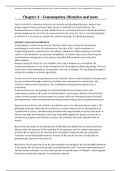
Chapter 4 – Consumption, lifestyles and taste
There is no direct connection between one’s income and spending behaviour. Instead, how
people organize leisure and spend their income is imbedded in social behaviour. The
fundamental issue revolves around whether there is a correlation between cultural phenomena
and the design and the structure of economic facts in the sense of a “one-to-one determination”,
or whether it is necessary to consider the relative autonomy of cultural phenomena.
Lifestyles and social stratification
Georg Simmel, a classic social scientist, describes rather more closely the mechanisms
underlying the social order. He elaborates on “the style of life”, which contributes to
complicating human communication. According to Simmel, the differentiations of everyday
culture reveal themselves in a growing “multiplicity” of cultural styles and in their frequent
transformation, leading hum to the concept of parallel differentiation and consecutive
differentiation.
Simmel portrayed society in a very dualistic form, where humans too are dualistic. He
considered dualism to be one of the driving forces of development, influencing change. The very
central idea of interdependence corresponds to the idea of dualism. The way Simmel thought in
categories is similar to network approaches.
Society used to be seen as a geometry of social relations, where social formation is characterized
by and constituted through continuous repetition. One’s placement in a social order, aka
‘network’, indicates their disposition. The combination of dispositions indicated one’s
personality.
Social structures are conceptualized as relational links between human actors and
organizations. Society is the result of interdependence. According to Simmel even accidental
contact between people can be portrayed as society, which are elementary forms of societal
interdependence. These interdependencies keep society working, this is a permanent process.
Simmel was involved in a lot of topics, on which he wrote a lot. His most famous work is The
philosophy of money, which discusses money as a mirror of the process of rationalization in
capitalist life. It, money, simultaneously documents the impersonality of society and causes it.
Simmel also talks about lifestyles and social rationalities against the money economy. He is
critical about progress and freedom to choose. He underlines the social embeddedness of
money.
Much of the discussion on the pluralization of lifestyles and milieus has revolved around the
dispute about the question of the variability of circumstances and the relative autonomy of
practical life as opposed to the material basis of mankind. Categories like age and gender
contribute to increasing differentiation. Because of this, people are seen as what they do
professionally, instead of who they are.
Max Weber tried to get away from the dual semantics by pointing at the internal differentiations
of the classes. He saw the status groups as an impediment to the “consistent implementation of
the bald market principle”. As such, status groups are specific types of “lifestyle” which organize
themselves around the principle of consumption of goods.
Chapter 4 – Consumption, lifestyles and taste
There is no direct connection between one’s income and spending behaviour. Instead, how
people organize leisure and spend their income is imbedded in social behaviour. The
fundamental issue revolves around whether there is a correlation between cultural phenomena
and the design and the structure of economic facts in the sense of a “one-to-one determination”,
or whether it is necessary to consider the relative autonomy of cultural phenomena.
Lifestyles and social stratification
Georg Simmel, a classic social scientist, describes rather more closely the mechanisms
underlying the social order. He elaborates on “the style of life”, which contributes to
complicating human communication. According to Simmel, the differentiations of everyday
culture reveal themselves in a growing “multiplicity” of cultural styles and in their frequent
transformation, leading hum to the concept of parallel differentiation and consecutive
differentiation.
Simmel portrayed society in a very dualistic form, where humans too are dualistic. He
considered dualism to be one of the driving forces of development, influencing change. The very
central idea of interdependence corresponds to the idea of dualism. The way Simmel thought in
categories is similar to network approaches.
Society used to be seen as a geometry of social relations, where social formation is characterized
by and constituted through continuous repetition. One’s placement in a social order, aka
‘network’, indicates their disposition. The combination of dispositions indicated one’s
personality.
Social structures are conceptualized as relational links between human actors and
organizations. Society is the result of interdependence. According to Simmel even accidental
contact between people can be portrayed as society, which are elementary forms of societal
interdependence. These interdependencies keep society working, this is a permanent process.
Simmel was involved in a lot of topics, on which he wrote a lot. His most famous work is The
philosophy of money, which discusses money as a mirror of the process of rationalization in
capitalist life. It, money, simultaneously documents the impersonality of society and causes it.
Simmel also talks about lifestyles and social rationalities against the money economy. He is
critical about progress and freedom to choose. He underlines the social embeddedness of
money.
Much of the discussion on the pluralization of lifestyles and milieus has revolved around the
dispute about the question of the variability of circumstances and the relative autonomy of
practical life as opposed to the material basis of mankind. Categories like age and gender
contribute to increasing differentiation. Because of this, people are seen as what they do
professionally, instead of who they are.
Max Weber tried to get away from the dual semantics by pointing at the internal differentiations
of the classes. He saw the status groups as an impediment to the “consistent implementation of
the bald market principle”. As such, status groups are specific types of “lifestyle” which organize
themselves around the principle of consumption of goods.