NURS 3056 Final Info Test 2_Integumentary – Ch. 11,22,23 Anatomy Review Study Guide.
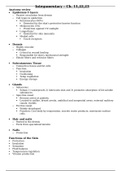
Integumentary – Ch. 11,22,23 Anatomy review ⦁ Epidermis-5 layers ⦁ Passive circulation from dermis ⦁ Cell types in epidermis ⦁ Keratinocytes (90%) ⦁ Essential for the skin’s protective barrier function ⦁ Melanocytes (5%) ⦁ Protection against UV sunlight ⦁ Langerhans’ ⦁ Essential for skin immunity ⦁ Merkel cells ⦁ Touch receptors ⦁ Dermis ⦁ Highly vascular ⦁ Collagen ⦁ Critical in wound healing ⦁ Responsible for skin’s mechanical strength ⦁ Elastic fibers and reticular fibers ⦁ Subcutaneous Tissue ⦁ Connective tissue and fat cells ⦁ Function: ⦁ Insulation ⦁ Cushioning ⦁ Temp regulation ⦁ Energy storage ⦁ Glands ⦁ Sebaceous ⦁ Sebum 1) waterproofs 2) lubricates skin and 3) promotes absorption of fat-soluble substances ⦁ Apocrine sweat ⦁ Become active at puberty ⦁ Located in axillae, breast areola, umbilical and anogenital areas, external auditory canals, eyelids ⦁ Eccrine sweat ⦁ Widely distributed ⦁ Function: Cool body by evaporation, excrete waste products, moisturize surface cells ⦁ Hair and nails ⦁ Rooted in the dermis ⦁ Form from specialized keratin ⦁ Nails ⦁ Protection Functions of the Skin ⦁ Protection ⦁ Insulation ⦁ Sensation ⦁ Fluid balance ⦁ Temperature regulation ⦁ Vitamin production ⦁ Immune response function ⦁ Can act as a delivery system for drugs Primary vs. Secondary Lesions ⦁ Primary lesions ⦁ Develop on previously unaltered skin ⦁ Macule ⦁ Circumscribed, flat area with a change in skin color, 0.5cm diameter. If lesion is 0.5cm, it’s a patch ⦁ Ex. Freckles, petechiae, measles, flat mole (nevus), café-au-lait spots, vitiligo (complete depigmentation) ⦁ Papule ⦁ Elevated, solid lesion, 0.5cm diameter. If 0.5cm diameter it’s a nodule ⦁ Ex. Wart (verruca), elevated moles, lipoma, basal cell carcinoma ⦁ Vesicle ⦁ Circumscribed, superficial collection of serous fluid. 0.5cm diameter ⦁ Ex. Varicella (chickenpox), herpes zoster (shingles), second-degree burn ⦁ Plaque ⦁ Circumscribed, elevated, superficial, solid lesion. 0.5cm diameter ⦁ Ex. Psoriasis, seborrheic and actinic keratoses ⦁ Wheal ⦁ Firm, edematous, irregularly shaped area, diameter variable ⦁ Ex. Insect bite, urticaria ⦁ Pustule ⦁ Elevated, superficial lesion filled with purulent fluid ⦁ Ex. Acne, impetigo ⦁ Secondary skin lesions ⦁ Change with time ⦁ Occur because of secondary factors (scratching, infection, etc.) ⦁ Fissure ⦁ Linear crack or break from epidermis to dermis, dry or moist ⦁ Ex. Athletes foot, cracks at corner of the mouth ⦁ Scale ⦁ Excess, dead epidermal cells produced by abnormal keratinization and shedding ⦁ Ex. Flaking skin after drug reaction or sunburn ⦁ Scar ⦁ Abnormal formation of connective tissue that replaces normal skin ⦁ Ex. Surgical incision, healed wound ⦁ Ulcer ⦁ Loss of epidermis, extending into dermis, crater-like irregular shape ⦁ Ex. Pressure ulcer, chancre ⦁ Atrophy ⦁ Depression in skin resulting from thinning of the epidermis or dermis ⦁ Ex. Aged skin, striae ⦁ Excoriation ⦁ Area in which epidermis is missing, exposing the dermis ⦁ Ex. Abrasion, scratch
Document information
- Uploaded on
- January 6, 2021
- Number of pages
- 73
- Written in
- 2020/2021
- Type
- Exam (elaborations)
- Contains
- Questions & answers