1
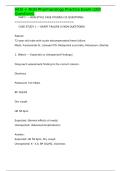
ATI RN PHARMACOLOGY 2026 – COMPLETE TEST BANK (ALL
QUESTIONS, CORRECT ANSWERS & DETAILED RATIONALES)100%
CORRECT ALREADY GRADED A+
1
A 68-year-old man with osteoarthritis receives morphine 4 mg IV for severe hip
pain. Thirty minutes later he is difficult to arouse, and respiratory rate is 6/min with
shallow respirations. The monitor shows O₂ saturation 84% on room air.
Which action should the nurse take first?
A. Administer naloxone IV per protocol.
B. Start high-flow oxygen via nonrebreather mask.
C. Notify the provider and wait for orders.
D. Place the patient in a left lateral position and stimulate to breathe.
Correct answer: A — Administer naloxone IV per protocol.
Rationale (detailed): The patient’s altered mental status plus RR 6/min and
hypoxia are classic signs of opioid-induced respiratory depression. Naloxone is the
opioid antagonist that reverses respiratory depression quickly and is the priority,
especially when life-threatening hypoventilation is present. While giving oxygen
(B) and positioning/airway support are important, naloxone directly reverses the
opioid effect and is the single best immediate intervention. Notifying the provider
(C) is appropriate but not first — treatment must not be delayed. Placing the
patient in a lateral position and stimulation (D) may help in an airway obstruction
or aspiration risk, but they do not reverse opioid respiratory depression. Nursing
considerations: administer naloxone per facility protocol, be ready for recurrent
respiratory depression (naloxone's duration may be shorter than some opioids),
monitor vital signs and pain after reversal, and anticipate agitation/pain return once
reversed.
2
A 54-year-old woman with newly diagnosed hypertension is started on lisinopril 10
mg PO daily. Two weeks later she calls the clinic reporting a persistent dry cough
that started after beginning the medication. She is not pregnant and has normal
electrolytes.
What is the most appropriate nursing recommendation?
A. Stop the lisinopril immediately and start an over-the-counter antitussive.
B. Tell the patient to continue the lisinopril; the cough will resolve on its own.
C. Advise the patient to contact the provider to discuss switching to an ARB.
D. Suggest she take lisinopril at bedtime to minimize the cough.
, 2
Correct answer: C — Advise the patient to contact the provider to discuss
switching to an ARB.
Rationale (detailed): A dry, persistent cough is a well-known adverse effect of
ACE inhibitors caused by accumulation of bradykinin. The typical nursing action
is to notify the provider; the provider will often change therapy to an angiotensin
receptor blocker (ARB), which does not commonly cause this cough. Stopping the
drug abruptly without provider input (A) is not appropriate. The cough is unlikely
to resolve while the drug is continued (B). Taking the dose at bedtime (D) does not
reliably reduce this side effect. Nursing considerations: assess severity and impact
on sleep; document onset relative to ACE inhibitor start; monitor for angioedema
signs (facial/lip/tongue swelling) and hyperkalemia; educate the patient to report
swelling or difficulty breathing immediately.
3
A 72-year-old male with chronic atrial fibrillation is prescribed warfarin. His INR
last week was 1.8 (therapeutic range 2–3). He asks the nurse whether he should
stop taking his daily aspirin 81 mg that he has taken for years for mild knee pain.
What should the nurse tell him?
A. Continue both medications — low-dose aspirin does not affect bleeding risk
with warfarin.
B. Continue aspirin, but stop warfarin on days you use aspirin.
C. Advise the patient to talk with the provider about stopping aspirin while on
warfarin.
D. Stop aspirin immediately because combining it with warfarin will always cause
severe bleeding.
Correct answer: C — Advise the patient to talk with the provider about
stopping aspirin while on warfarin.
Rationale (detailed): Combining aspirin (an antiplatelet) with warfarin increases
bleeding risk because warfarin reduces clotting factors and aspirin inhibits platelet
aggregation. Many patients on chronic anticoagulation can avoid additional
antiplatelet therapy unless there is a specific indication (e.g., recent stent). The
nurse should advise discussing with the prescriber to evaluate risks/benefits and
maybe discontinue aspirin. Statement A is incorrect — aspirin does increase
bleeding risk when combined with warfarin. B is unsafe. D is an overstatement —
not always severe bleeding, but risk is increased and requires clinical decision-
making. Nursing considerations: assess bleeding signs, review medication list for
other NSAIDs or herbal supplements (e.g., ginkgo, garlic) that increase bleeding,
ensure proper INR monitoring, educate patient to report unusual bleeding or
bruising.
, 3
4
A patient in heart failure with ejection fraction 28% is taking furosemide 40 mg PO
daily and complains of muscle cramps and fatigue. Labs show K⁺ 2.9 mEq/L
(normal 3.5–5.0). The nurse anticipates which action?
A. Increase the furosemide dose to improve fluid balance.
B. Administer oral potassium replacement and notify the provider.
C. Hold furosemide and give IV calcium gluconate.
D. Instruct the patient to avoid bananas and potassium-rich foods.
Correct answer: B — Administer oral potassium replacement and notify the
provider.
Rationale (detailed): Loop diuretics (furosemide) cause potassium loss and
hypokalemia, which can produce cramps, fatigue, and arrhythmias. The immediate
action is to replace potassium as ordered (oral if tolerated) and notify the provider
to reassess diuretic regimen and K⁺ repletion plan. Increasing the furosemide dose
(A) will worsen hypokalemia. IV calcium gluconate (C) is used for hyperkalemia
cardiac membrane stabilization — not indicated here. Advising avoidance of
potassium-rich foods (D) is opposite of what's needed. Nursing considerations:
follow facility protocol for K⁺ replacement, monitor cardiac rhythm while
correcting severe hypokalemia, educate on dietary potassium and possible K⁺-
sparing diuretics, monitor urine output and weight.
5
A hospitalized patient with type 1 diabetes receives regular insulin 8 units
subcutaneously before breakfast. His POC glucose 2 hours after breakfast is 48
mg/dL. He is tachycardic, diaphoretic, and pale but still able to swallow.
Which is the most appropriate immediate nursing action?
A. Give 4 oz (120 mL) of fruit juice by mouth.
B. Call the provider for IV dextrose.
C. Give 1 mg glucagon IM.
D. Encourage the patient to eat a protein snack.
Correct answer: A — Give 4 oz (120 mL) of fruit juice by mouth.
Rationale (detailed): The patient is conscious and able to swallow; the first-line
immediate treatment for symptomatic hypoglycemia is a fast-acting oral
carbohydrate (15–20 g), such as 4 oz of fruit juice. IV dextrose (B) or IM glucagon
(C) are appropriate if the patient is unconscious or cannot swallow. Protein snacks
(D) are useful after initial correction to prevent rebound hypoglycemia but are not
the immediate action. Nursing considerations: recheck blood glucose in 15 minutes
and repeat treatment if still low; once >70 mg/dL, provide a snack if the next meal
is >1 hour away; document the event and assess insulin dosing/timing and
carbohydrate intake.
, 4
6
A patient with newly diagnosed type 2 diabetes is started on metformin. At a
follow-up visit 2 months later, his creatinine has risen and eGFR is 28
mL/min/1.73 m². He asks about continuing metformin.
What is the best response by the nurse?
A. Continue metformin; renal impairment does not affect its use.
B. Stop metformin and inform the provider — metformin is contraindicated at
eGFR <30.
C. Decrease the dose of metformin by half and monitor renal function monthly.
D. Add a thiazolidinedione and continue metformin.
Correct answer: B — Stop metformin and inform the provider — metformin
is contraindicated at eGFR <30.
Rationale (detailed): Metformin has risk of lactic acidosis in severe renal
impairment, and most guidelines recommend stopping metformin when eGFR is
<30 mL/min/1.73 m². Therefore the nurse should notify the provider so the
medication can be discontinued and an alternative antihyperglycemic considered.
Option A is incorrect and unsafe. Simply decreasing the dose (C) is not adequate at
this level of renal dysfunction. Adding another agent (D) may be needed eventually
but first metformin should be stopped and provider informed. Nursing
considerations: educate about signs of lactic acidosis (weakness, myalgias,
respiratory distress), document renal change, coordinate med reconciliation.
7
A patient on heparin infusion for a pulmonary embolus has an aPTT drawn. The
result returns as 110 seconds (therapeutic aPTT target 60–80 sec). The nurse notes
the patient is bruising at the IV sites and reports increasing abdominal pain. Vital
signs show HR 110, BP 100/60.
Which nursing action is most appropriate?
A. Continue the infusion and recheck aPTT in 6 hours.
B. Stop the heparin infusion and notify the provider immediately.
C. Slow the infusion rate and apply warm compresses to IV sites.
D. Give protamine sulfate IV immediately without contacting provider.
Correct answer: B — Stop the heparin infusion and notify the provider
immediately.
Rationale (detailed): An aPTT significantly above therapeutic range with clinical
bleeding signs requires stopping heparin and notifying the provider. The provider
will determine whether reversal with protamine is necessary. Continuing heparin
(A) risks more bleeding. Slowing the infusion (C) is inadequate in the setting of
active bleeding and supratherapeutic labs. Administering protamine (D) should be
ATI RN PHARMACOLOGY 2026 – COMPLETE TEST BANK (ALL
QUESTIONS, CORRECT ANSWERS & DETAILED RATIONALES)100%
CORRECT ALREADY GRADED A+
1
A 68-year-old man with osteoarthritis receives morphine 4 mg IV for severe hip
pain. Thirty minutes later he is difficult to arouse, and respiratory rate is 6/min with
shallow respirations. The monitor shows O₂ saturation 84% on room air.
Which action should the nurse take first?
A. Administer naloxone IV per protocol.
B. Start high-flow oxygen via nonrebreather mask.
C. Notify the provider and wait for orders.
D. Place the patient in a left lateral position and stimulate to breathe.
Correct answer: A — Administer naloxone IV per protocol.
Rationale (detailed): The patient’s altered mental status plus RR 6/min and
hypoxia are classic signs of opioid-induced respiratory depression. Naloxone is the
opioid antagonist that reverses respiratory depression quickly and is the priority,
especially when life-threatening hypoventilation is present. While giving oxygen
(B) and positioning/airway support are important, naloxone directly reverses the
opioid effect and is the single best immediate intervention. Notifying the provider
(C) is appropriate but not first — treatment must not be delayed. Placing the
patient in a lateral position and stimulation (D) may help in an airway obstruction
or aspiration risk, but they do not reverse opioid respiratory depression. Nursing
considerations: administer naloxone per facility protocol, be ready for recurrent
respiratory depression (naloxone's duration may be shorter than some opioids),
monitor vital signs and pain after reversal, and anticipate agitation/pain return once
reversed.
2
A 54-year-old woman with newly diagnosed hypertension is started on lisinopril 10
mg PO daily. Two weeks later she calls the clinic reporting a persistent dry cough
that started after beginning the medication. She is not pregnant and has normal
electrolytes.
What is the most appropriate nursing recommendation?
A. Stop the lisinopril immediately and start an over-the-counter antitussive.
B. Tell the patient to continue the lisinopril; the cough will resolve on its own.
C. Advise the patient to contact the provider to discuss switching to an ARB.
D. Suggest she take lisinopril at bedtime to minimize the cough.
, 2
Correct answer: C — Advise the patient to contact the provider to discuss
switching to an ARB.
Rationale (detailed): A dry, persistent cough is a well-known adverse effect of
ACE inhibitors caused by accumulation of bradykinin. The typical nursing action
is to notify the provider; the provider will often change therapy to an angiotensin
receptor blocker (ARB), which does not commonly cause this cough. Stopping the
drug abruptly without provider input (A) is not appropriate. The cough is unlikely
to resolve while the drug is continued (B). Taking the dose at bedtime (D) does not
reliably reduce this side effect. Nursing considerations: assess severity and impact
on sleep; document onset relative to ACE inhibitor start; monitor for angioedema
signs (facial/lip/tongue swelling) and hyperkalemia; educate the patient to report
swelling or difficulty breathing immediately.
3
A 72-year-old male with chronic atrial fibrillation is prescribed warfarin. His INR
last week was 1.8 (therapeutic range 2–3). He asks the nurse whether he should
stop taking his daily aspirin 81 mg that he has taken for years for mild knee pain.
What should the nurse tell him?
A. Continue both medications — low-dose aspirin does not affect bleeding risk
with warfarin.
B. Continue aspirin, but stop warfarin on days you use aspirin.
C. Advise the patient to talk with the provider about stopping aspirin while on
warfarin.
D. Stop aspirin immediately because combining it with warfarin will always cause
severe bleeding.
Correct answer: C — Advise the patient to talk with the provider about
stopping aspirin while on warfarin.
Rationale (detailed): Combining aspirin (an antiplatelet) with warfarin increases
bleeding risk because warfarin reduces clotting factors and aspirin inhibits platelet
aggregation. Many patients on chronic anticoagulation can avoid additional
antiplatelet therapy unless there is a specific indication (e.g., recent stent). The
nurse should advise discussing with the prescriber to evaluate risks/benefits and
maybe discontinue aspirin. Statement A is incorrect — aspirin does increase
bleeding risk when combined with warfarin. B is unsafe. D is an overstatement —
not always severe bleeding, but risk is increased and requires clinical decision-
making. Nursing considerations: assess bleeding signs, review medication list for
other NSAIDs or herbal supplements (e.g., ginkgo, garlic) that increase bleeding,
ensure proper INR monitoring, educate patient to report unusual bleeding or
bruising.
, 3
4
A patient in heart failure with ejection fraction 28% is taking furosemide 40 mg PO
daily and complains of muscle cramps and fatigue. Labs show K⁺ 2.9 mEq/L
(normal 3.5–5.0). The nurse anticipates which action?
A. Increase the furosemide dose to improve fluid balance.
B. Administer oral potassium replacement and notify the provider.
C. Hold furosemide and give IV calcium gluconate.
D. Instruct the patient to avoid bananas and potassium-rich foods.
Correct answer: B — Administer oral potassium replacement and notify the
provider.
Rationale (detailed): Loop diuretics (furosemide) cause potassium loss and
hypokalemia, which can produce cramps, fatigue, and arrhythmias. The immediate
action is to replace potassium as ordered (oral if tolerated) and notify the provider
to reassess diuretic regimen and K⁺ repletion plan. Increasing the furosemide dose
(A) will worsen hypokalemia. IV calcium gluconate (C) is used for hyperkalemia
cardiac membrane stabilization — not indicated here. Advising avoidance of
potassium-rich foods (D) is opposite of what's needed. Nursing considerations:
follow facility protocol for K⁺ replacement, monitor cardiac rhythm while
correcting severe hypokalemia, educate on dietary potassium and possible K⁺-
sparing diuretics, monitor urine output and weight.
5
A hospitalized patient with type 1 diabetes receives regular insulin 8 units
subcutaneously before breakfast. His POC glucose 2 hours after breakfast is 48
mg/dL. He is tachycardic, diaphoretic, and pale but still able to swallow.
Which is the most appropriate immediate nursing action?
A. Give 4 oz (120 mL) of fruit juice by mouth.
B. Call the provider for IV dextrose.
C. Give 1 mg glucagon IM.
D. Encourage the patient to eat a protein snack.
Correct answer: A — Give 4 oz (120 mL) of fruit juice by mouth.
Rationale (detailed): The patient is conscious and able to swallow; the first-line
immediate treatment for symptomatic hypoglycemia is a fast-acting oral
carbohydrate (15–20 g), such as 4 oz of fruit juice. IV dextrose (B) or IM glucagon
(C) are appropriate if the patient is unconscious or cannot swallow. Protein snacks
(D) are useful after initial correction to prevent rebound hypoglycemia but are not
the immediate action. Nursing considerations: recheck blood glucose in 15 minutes
and repeat treatment if still low; once >70 mg/dL, provide a snack if the next meal
is >1 hour away; document the event and assess insulin dosing/timing and
carbohydrate intake.
, 4
6
A patient with newly diagnosed type 2 diabetes is started on metformin. At a
follow-up visit 2 months later, his creatinine has risen and eGFR is 28
mL/min/1.73 m². He asks about continuing metformin.
What is the best response by the nurse?
A. Continue metformin; renal impairment does not affect its use.
B. Stop metformin and inform the provider — metformin is contraindicated at
eGFR <30.
C. Decrease the dose of metformin by half and monitor renal function monthly.
D. Add a thiazolidinedione and continue metformin.
Correct answer: B — Stop metformin and inform the provider — metformin
is contraindicated at eGFR <30.
Rationale (detailed): Metformin has risk of lactic acidosis in severe renal
impairment, and most guidelines recommend stopping metformin when eGFR is
<30 mL/min/1.73 m². Therefore the nurse should notify the provider so the
medication can be discontinued and an alternative antihyperglycemic considered.
Option A is incorrect and unsafe. Simply decreasing the dose (C) is not adequate at
this level of renal dysfunction. Adding another agent (D) may be needed eventually
but first metformin should be stopped and provider informed. Nursing
considerations: educate about signs of lactic acidosis (weakness, myalgias,
respiratory distress), document renal change, coordinate med reconciliation.
7
A patient on heparin infusion for a pulmonary embolus has an aPTT drawn. The
result returns as 110 seconds (therapeutic aPTT target 60–80 sec). The nurse notes
the patient is bruising at the IV sites and reports increasing abdominal pain. Vital
signs show HR 110, BP 100/60.
Which nursing action is most appropriate?
A. Continue the infusion and recheck aPTT in 6 hours.
B. Stop the heparin infusion and notify the provider immediately.
C. Slow the infusion rate and apply warm compresses to IV sites.
D. Give protamine sulfate IV immediately without contacting provider.
Correct answer: B — Stop the heparin infusion and notify the provider
immediately.
Rationale (detailed): An aPTT significantly above therapeutic range with clinical
bleeding signs requires stopping heparin and notifying the provider. The provider
will determine whether reversal with protamine is necessary. Continuing heparin
(A) risks more bleeding. Slowing the infusion (C) is inadequate in the setting of
active bleeding and supratherapeutic labs. Administering protamine (D) should be