Performance
Exit
Week 10 quiz graded
Due Jul 3, 2022 by 8:59 pm
Final Score
100%
30 out of 30 questions answered correctly
Completed on Jul 1, 2022 10:15 pm
Incorrect (0)
Correct (30)
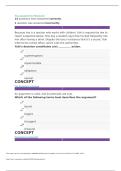
Which period reflects how much time it usually takes for a crisis to self-
resolve?
1 to 10 days
1 to 3 weeks
4 to 6 weeks
, 3 to 4 months
Rationale
At 4 to 6 weeks, the individual is making accommodations and adjustments to relieve
anxiety, and the crisis is no longer a crisis. These adjustments usually cannot be made
in less time, but taking 3 to 4 months would not be tolerable.
Test-Taking Tip: Make certain that the answer you select is reasonable and obtainable
under ordinary circumstances and that the action can be carried out in the given
situation.
pp. 332, 339
Which form of crises may occur as an individual moves from one
maturational level to another?
Reactive
Adventitious
Situational
Developmental
Rationale
Developmental crises are normal states in growth and development in which specific
new maturational tasks must be learned when old coping mechanisms are no longer
effective. An adventitious crisis is not a part of everyday life; it results from events that
are unplanned and may be accidental, caused by nature, or human-made. A situational
crisis arises from events that are extraordinary, external rather than internal, and often
unanticipated. Reactive is not a term used to identify a type of crisis.
pp. 332-333
, Which coping mechanism is commonly adopted during a crisis?
Engaging in other physical activity
Setting realistic goals
Avoiding talking with others
Avoiding eating
Rationale
During a crisis, patients use different coping techniques to cope with the situation.
Some patients may get involved in physical activity such as walking to relieve
restlessness. Because the patient has had a crisis, he or she may not be psychologically
stable and may not be able to set realistic goals. Some patients may try to cope with
the stress by talking to others. Some patients tend to overeat to cope with stress.
p. 335
Which agency has overall responsibility to coordinate responses to
disasters in the United States?
World Health Organization (WHO)
Department of Homeland Security (DHS)
Federal Emergency Management Agency (FEMA)
National Incident Management System (NIMS)
Rationale
The DHS has ultimate government responsibility for the safety of US citizens and
territories while ensuring that adequate preparedness, response, and recovery
protocols are immediately available. The WHO serves the global community. DHS
oversees operations of FEMA. NIMS helps first responders from different disciplines
and areas work together effectively when a community has exhausted its available
Exit
Week 10 quiz graded
Due Jul 3, 2022 by 8:59 pm
Final Score
100%
30 out of 30 questions answered correctly
Completed on Jul 1, 2022 10:15 pm
Incorrect (0)
Correct (30)
Which period reflects how much time it usually takes for a crisis to self-
resolve?
1 to 10 days
1 to 3 weeks
4 to 6 weeks
, 3 to 4 months
Rationale
At 4 to 6 weeks, the individual is making accommodations and adjustments to relieve
anxiety, and the crisis is no longer a crisis. These adjustments usually cannot be made
in less time, but taking 3 to 4 months would not be tolerable.
Test-Taking Tip: Make certain that the answer you select is reasonable and obtainable
under ordinary circumstances and that the action can be carried out in the given
situation.
pp. 332, 339
Which form of crises may occur as an individual moves from one
maturational level to another?
Reactive
Adventitious
Situational
Developmental
Rationale
Developmental crises are normal states in growth and development in which specific
new maturational tasks must be learned when old coping mechanisms are no longer
effective. An adventitious crisis is not a part of everyday life; it results from events that
are unplanned and may be accidental, caused by nature, or human-made. A situational
crisis arises from events that are extraordinary, external rather than internal, and often
unanticipated. Reactive is not a term used to identify a type of crisis.
pp. 332-333
, Which coping mechanism is commonly adopted during a crisis?
Engaging in other physical activity
Setting realistic goals
Avoiding talking with others
Avoiding eating
Rationale
During a crisis, patients use different coping techniques to cope with the situation.
Some patients may get involved in physical activity such as walking to relieve
restlessness. Because the patient has had a crisis, he or she may not be psychologically
stable and may not be able to set realistic goals. Some patients may try to cope with
the stress by talking to others. Some patients tend to overeat to cope with stress.
p. 335
Which agency has overall responsibility to coordinate responses to
disasters in the United States?
World Health Organization (WHO)
Department of Homeland Security (DHS)
Federal Emergency Management Agency (FEMA)
National Incident Management System (NIMS)
Rationale
The DHS has ultimate government responsibility for the safety of US citizens and
territories while ensuring that adequate preparedness, response, and recovery
protocols are immediately available. The WHO serves the global community. DHS
oversees operations of FEMA. NIMS helps first responders from different disciplines
and areas work together effectively when a community has exhausted its available