Exam
Name___________________________________
MULTIPLE CHOICE. Choose the one alternative that best completes the statement or answers the question.
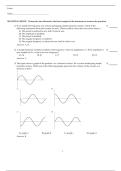
1) If we double the frequency of a system undergoing simple harmonic motion, which of the 1)
following statements about that system are true? (There could be more than one correct choice.)
A) The period is reduced to one-half of what it was.
B) The amplitude is doubled.
C) The period is doubled.
D) The angular frequency is doubled.
E) The angular frequency is reduced to one-half of what it was.
Answer: A, D
2) A simple harmonic oscillator oscillates with frequency f when its amplitude is A. If the amplitude is 2)
now doubled to 2A, what is the new frequency?
A) f/4 B) 4f C) f D) 2f E) f/2
Answer: C
3) The figure shows a graph of the position x as a function of time t for a system undergoing simple 3)
harmonic motion. Which one of the following graphs represents the velocity of this system as a
function of time?
A) graph a B) graph b C) graph c D) graph d
Answer: B
1
,4) The figure shows a graph of the velocity v as a function of time t for a system undergoing simple 4)
harmonic motion. Which one of the following graphs represents the acceleration of this system as a
function of time?
A) graph a B) graph b C) graph c D) graph d
Answer: B
2
,5) The figure shows a graph of the position x as a function of time t for a system undergoing simple 5)
harmonic motion. Which one of the following graphs represents the acceleration of this system as a
function of time?
A) graph a B) graph b C) graph c D) graph d
Answer: A
6) In simple harmonic motion, when is the speed the greatest? (There could be more than one correct 6)
choice.)
A) when the magnitude of the acceleration is a maximum
B) when the potential energy is a zero
C) when the potential energy is a maximum
D) when the displacement is a maximum
E) when the magnitude of the acceleration is a minimum
Answer: B, E
7) In simple harmonic motion, when is the magnitude of the acceleration the greatest? (There could 7)
be more than one correct choice.)
A) when the displacement is a zero
B) when the potential energy is a maximum
C) when the kinetic energy is a minimum
D) when the speed is a maximum
E) when the magnitude of the displacement is a maximum
Answer: B, C, E
3
, 8) The total mechanical energy of a simple harmonic oscillating system is 8)
A) a maximum when it passes through the equilibrium point.
B) zero as it passes the equilibrium point.
C) a non-zero constant.
D) zero when it reaches the maximum displacement.
E) a minimum when it passes through the equilibrium point.
Answer: C
9) An object attached to an ideal spring executes simple harmonic motion. If you want to double its 9)
total energy, you could
A) double both the mass and amplitude of vibration.
B) double the mass.
C) double both the amplitude and force constant (spring constant).
D) double the force constant (spring constant) of the spring.
E) double the amplitude of vibration.
Answer: D
10) An object that hangs from the ceiling of a stationary elevator by an ideal spring oscillates with a 10)
period T. If the elevator accelerates upward with acceleration 2g, what will be the period of
oscillation of the object?
A) T/4 B) T C) 2T D) 4T E) T/2
Answer: B
11) A mass on a spring undergoes SHM. When the mass passes through the equilibrium position, 11)
which of the following statements about it are true? (There could be more than one correct choice.)
A) Its kinetic energy is a maximum.
B) Its total mechanical energy is zero.
C) Its elastic potential energy is zero.
D) Its acceleration is zero.
E) Its speed is zero.
Answer: A, C, D
12) A mass on a spring undergoes SHM. When the mass is at its maximum distance from the 12)
equilibrium position, which of the following statements about it are true? (There could be more
than one correct choice.)
A) Its speed is zero.
B) Its total mechanical energy is zero.
C) Its acceleration is zero.
D) Its elastic potential energy is zero.
E) Its kinetic energy is a maximum.
Answer: A
13) An object is attached to a vertical spring and bobs up and down between points A and B. Where is 13)
the object located when its kinetic energy is a minimum?
A) one-third of the way between A and B
B) one-fourth of the way between A and B
C) midway between A and B
D) at either A or B
E) at none of the above points
Answer: D
4
Name___________________________________
MULTIPLE CHOICE. Choose the one alternative that best completes the statement or answers the question.
1) If we double the frequency of a system undergoing simple harmonic motion, which of the 1)
following statements about that system are true? (There could be more than one correct choice.)
A) The period is reduced to one-half of what it was.
B) The amplitude is doubled.
C) The period is doubled.
D) The angular frequency is doubled.
E) The angular frequency is reduced to one-half of what it was.
Answer: A, D
2) A simple harmonic oscillator oscillates with frequency f when its amplitude is A. If the amplitude is 2)
now doubled to 2A, what is the new frequency?
A) f/4 B) 4f C) f D) 2f E) f/2
Answer: C
3) The figure shows a graph of the position x as a function of time t for a system undergoing simple 3)
harmonic motion. Which one of the following graphs represents the velocity of this system as a
function of time?
A) graph a B) graph b C) graph c D) graph d
Answer: B
1
,4) The figure shows a graph of the velocity v as a function of time t for a system undergoing simple 4)
harmonic motion. Which one of the following graphs represents the acceleration of this system as a
function of time?
A) graph a B) graph b C) graph c D) graph d
Answer: B
2
,5) The figure shows a graph of the position x as a function of time t for a system undergoing simple 5)
harmonic motion. Which one of the following graphs represents the acceleration of this system as a
function of time?
A) graph a B) graph b C) graph c D) graph d
Answer: A
6) In simple harmonic motion, when is the speed the greatest? (There could be more than one correct 6)
choice.)
A) when the magnitude of the acceleration is a maximum
B) when the potential energy is a zero
C) when the potential energy is a maximum
D) when the displacement is a maximum
E) when the magnitude of the acceleration is a minimum
Answer: B, E
7) In simple harmonic motion, when is the magnitude of the acceleration the greatest? (There could 7)
be more than one correct choice.)
A) when the displacement is a zero
B) when the potential energy is a maximum
C) when the kinetic energy is a minimum
D) when the speed is a maximum
E) when the magnitude of the displacement is a maximum
Answer: B, C, E
3
, 8) The total mechanical energy of a simple harmonic oscillating system is 8)
A) a maximum when it passes through the equilibrium point.
B) zero as it passes the equilibrium point.
C) a non-zero constant.
D) zero when it reaches the maximum displacement.
E) a minimum when it passes through the equilibrium point.
Answer: C
9) An object attached to an ideal spring executes simple harmonic motion. If you want to double its 9)
total energy, you could
A) double both the mass and amplitude of vibration.
B) double the mass.
C) double both the amplitude and force constant (spring constant).
D) double the force constant (spring constant) of the spring.
E) double the amplitude of vibration.
Answer: D
10) An object that hangs from the ceiling of a stationary elevator by an ideal spring oscillates with a 10)
period T. If the elevator accelerates upward with acceleration 2g, what will be the period of
oscillation of the object?
A) T/4 B) T C) 2T D) 4T E) T/2
Answer: B
11) A mass on a spring undergoes SHM. When the mass passes through the equilibrium position, 11)
which of the following statements about it are true? (There could be more than one correct choice.)
A) Its kinetic energy is a maximum.
B) Its total mechanical energy is zero.
C) Its elastic potential energy is zero.
D) Its acceleration is zero.
E) Its speed is zero.
Answer: A, C, D
12) A mass on a spring undergoes SHM. When the mass is at its maximum distance from the 12)
equilibrium position, which of the following statements about it are true? (There could be more
than one correct choice.)
A) Its speed is zero.
B) Its total mechanical energy is zero.
C) Its acceleration is zero.
D) Its elastic potential energy is zero.
E) Its kinetic energy is a maximum.
Answer: A
13) An object is attached to a vertical spring and bobs up and down between points A and B. Where is 13)
the object located when its kinetic energy is a minimum?
A) one-third of the way between A and B
B) one-fourth of the way between A and B
C) midway between A and B
D) at either A or B
E) at none of the above points
Answer: D
4