BIOL252: Human Anatomy & Physiology II w/Lab 2025
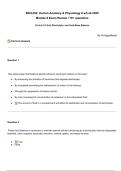
Module 8 Exam Review / 70+ questions
Module 8: Fluid, Electrolyte, and Acid-Base Balance
By PortageMaster
✅ Correct answers
Question 1
How does proper fluid balance directly influence electrolyte balance in the body?
● By enhancing the secretion of hormones that degrade electrolytes
● By completely preventing the reabsorption of sodium in the kidneys
● Through the suppression of kidney function
● By only increasing the concentration of potassium in the extracellular fluid
● ✅ The amount of fluid in a compartment will affect the distribution and concentration of electrolytes
Question 2
Proper fluid balance is necessary to maintain optimal cellular functioning by ensuring that cells are adequately
hydrated, which supports enzymatic reactions, nutrient uptake, and waste removal.
● ✅True
● False
,Question 3
Which clinical assessment for hydration status measures how long it takes for blood to re-perfuse tissue after
pressure is applied?
● Mucous membrane moisture
● Respiratory rate
● Blood pressure
● Skin turgor
● ✅ Capillary refill time
● Heart rate
Question 4
A clinician performs a full hydration assessment on a patient. The skin turgor test showed an immediate
response, mucous membranes look moist, and capillary refill is under 2 seconds. What does this indicate
about the patient’s hydration status?
● ✅Normal
● Overhydrated
● Dehydrated
, Question 5
What role do baroreceptors play when a patient is dehydrated?
● They increase blood volume by releasing fluid from tissues.
● ✅ They detect the drop in blood pressure and trigger sympathetic responses to increase heart rate.
● They stimulate parasympathetic activity to slow the heart rate.
● They directly cause blood vessels to dilate.
Question 6
Tonicity has no impact on cell integrity because it does not affect water movement into or out of the cell.
● True
● ✅ False
.
Question 7
A patient is given an oral rehydration solution that, due to a formulation error, contains a higher concentration
of solutes than normal body fluids. What type of solution was ingested and how does the resulting fluid shift
affect cells?
● Isotonic: no change to the cells
Module 8 Exam Review / 70+ questions
Module 8: Fluid, Electrolyte, and Acid-Base Balance
By PortageMaster
✅ Correct answers
Question 1
How does proper fluid balance directly influence electrolyte balance in the body?
● By enhancing the secretion of hormones that degrade electrolytes
● By completely preventing the reabsorption of sodium in the kidneys
● Through the suppression of kidney function
● By only increasing the concentration of potassium in the extracellular fluid
● ✅ The amount of fluid in a compartment will affect the distribution and concentration of electrolytes
Question 2
Proper fluid balance is necessary to maintain optimal cellular functioning by ensuring that cells are adequately
hydrated, which supports enzymatic reactions, nutrient uptake, and waste removal.
● ✅True
● False
,Question 3
Which clinical assessment for hydration status measures how long it takes for blood to re-perfuse tissue after
pressure is applied?
● Mucous membrane moisture
● Respiratory rate
● Blood pressure
● Skin turgor
● ✅ Capillary refill time
● Heart rate
Question 4
A clinician performs a full hydration assessment on a patient. The skin turgor test showed an immediate
response, mucous membranes look moist, and capillary refill is under 2 seconds. What does this indicate
about the patient’s hydration status?
● ✅Normal
● Overhydrated
● Dehydrated
, Question 5
What role do baroreceptors play when a patient is dehydrated?
● They increase blood volume by releasing fluid from tissues.
● ✅ They detect the drop in blood pressure and trigger sympathetic responses to increase heart rate.
● They stimulate parasympathetic activity to slow the heart rate.
● They directly cause blood vessels to dilate.
Question 6
Tonicity has no impact on cell integrity because it does not affect water movement into or out of the cell.
● True
● ✅ False
.
Question 7
A patient is given an oral rehydration solution that, due to a formulation error, contains a higher concentration
of solutes than normal body fluids. What type of solution was ingested and how does the resulting fluid shift
affect cells?
● Isotonic: no change to the cells