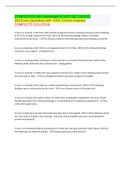
TNCC 9TH EDITION STUDY GUIDE 2025 QUESTIONS AND ANSWERS | GRADED A+
| GUARANTEED PASS!!
1.Why is it important to understand biomechanics as it relates to types of energy forces
and mechanism of injury (MOI)?
ANS: To understand and anticipate potential injuries.
2.What are common MOIs that result in trauma?
ANS: Blunt and Penetrating
3.What is the most common mechanism of blunt trauma seen at your facility? Penetrating
trauma?
ANS: Blunt- Falls
Penetrating- GSW
4.Why is it important to use a systematic approach to the initial assessment of a trauma
patient?
ANS: To maximize outcomes and reduce the risk of undiscovered injuries.
5.What is included in the preparation for a trauma patient?: - Activate the Trauma Team
and assign roles
- Prepare the room/equipment
- Don PPE
- Consider safety threats
- Decontamination
6. What information is obtained during the general impression?
ANS: - Uncontrolled hem-
orrhage
- Unresponsiveness/Apnea
,- Need to reprioritize C-ABC
-
7. What does the A-J mnemonic stand for?
ANS: A** Alertness (A1) and Airway (A2)
B** Breathing and Ventilation
C** Circulation and Control of Hemorrhage
D** Disability (Neurologic Status
E** Exposure (E1) and Environmental Control (E2)
F- Full Set of Vital Signs (F1) and Family Presence (F2)
G- Get Adjuncts (G1) and Give Comfort (G2) [L-P]
H- History (H1) and Head-to-Toe (H2)
I- Inspect Posterior Surfaces
J- Just keep reevaluating (VIPP)
8. Why is alertness included with the airway assessment?
ANS: To evaluate the Pts ability to protect their airway
AVPU
- Alert and Orientated
- Verbal (responds to)
- Pain (responds to)
- Unresponsive
9. When an intervention is taken during the primary survey, what must the nurse do after
the intervention?
ANS: Reassess effectiveness and move on to the next component
10. What are the components of the secondary survey?
ANS: H- History and Head to Toe
I- Inspect Posterior
J- Just Keep reevaluating (VIPP)
, 11. What laboratory tests are commonly utilized for trauma patients?
ANS: VBG/ABG
Lactic
CMP/CBC
Type Screen
Clotting Factors
UA
12. What should the nurse reevaluate while the patient is in their care?
ANS: VIPP
V- Vital
I- Injuries/Interventions
P- Primary Survey
P- Pain
13. What are the differences between ventilation, diffusion, and perfusion?
ANS: Ventilation- movement of air
Diffusion- movement of gases from high concentration to lower concentration, alveolar-
capillary membrane exchange
14. What are possible causes of airway obstruction in the trauma patient? What
interventions address these causes of airway obstruction?
ANS: Tongue
Blood, vomit, secretions
Altered LOC
Trauma
Obesity
| GUARANTEED PASS!!
1.Why is it important to understand biomechanics as it relates to types of energy forces
and mechanism of injury (MOI)?
ANS: To understand and anticipate potential injuries.
2.What are common MOIs that result in trauma?
ANS: Blunt and Penetrating
3.What is the most common mechanism of blunt trauma seen at your facility? Penetrating
trauma?
ANS: Blunt- Falls
Penetrating- GSW
4.Why is it important to use a systematic approach to the initial assessment of a trauma
patient?
ANS: To maximize outcomes and reduce the risk of undiscovered injuries.
5.What is included in the preparation for a trauma patient?: - Activate the Trauma Team
and assign roles
- Prepare the room/equipment
- Don PPE
- Consider safety threats
- Decontamination
6. What information is obtained during the general impression?
ANS: - Uncontrolled hem-
orrhage
- Unresponsiveness/Apnea
,- Need to reprioritize C-ABC
-
7. What does the A-J mnemonic stand for?
ANS: A** Alertness (A1) and Airway (A2)
B** Breathing and Ventilation
C** Circulation and Control of Hemorrhage
D** Disability (Neurologic Status
E** Exposure (E1) and Environmental Control (E2)
F- Full Set of Vital Signs (F1) and Family Presence (F2)
G- Get Adjuncts (G1) and Give Comfort (G2) [L-P]
H- History (H1) and Head-to-Toe (H2)
I- Inspect Posterior Surfaces
J- Just keep reevaluating (VIPP)
8. Why is alertness included with the airway assessment?
ANS: To evaluate the Pts ability to protect their airway
AVPU
- Alert and Orientated
- Verbal (responds to)
- Pain (responds to)
- Unresponsive
9. When an intervention is taken during the primary survey, what must the nurse do after
the intervention?
ANS: Reassess effectiveness and move on to the next component
10. What are the components of the secondary survey?
ANS: H- History and Head to Toe
I- Inspect Posterior
J- Just Keep reevaluating (VIPP)
, 11. What laboratory tests are commonly utilized for trauma patients?
ANS: VBG/ABG
Lactic
CMP/CBC
Type Screen
Clotting Factors
UA
12. What should the nurse reevaluate while the patient is in their care?
ANS: VIPP
V- Vital
I- Injuries/Interventions
P- Primary Survey
P- Pain
13. What are the differences between ventilation, diffusion, and perfusion?
ANS: Ventilation- movement of air
Diffusion- movement of gases from high concentration to lower concentration, alveolar-
capillary membrane exchange
14. What are possible causes of airway obstruction in the trauma patient? What
interventions address these causes of airway obstruction?
ANS: Tongue
Blood, vomit, secretions
Altered LOC
Trauma
Obesity