AQA GCSE ENGLISH LANGUAGE
TECHNIQUES 2025 EXPERT VERIFIED |
ACE THE TEST
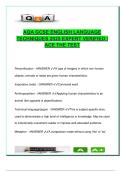
Personification - 🧠ANSWER ✔✔A type of imagery in which non-human
objects, animals or ideas are given human characteristics.
Imperative (verb) - 🧠ANSWER ✔✔Command word
Anthroporphism - 🧠ANSWER ✔✔Applying human characteristics to an
animal (the opposite is objectification).
Technical language/jargon - 🧠ANSWER ✔✔This is subject-specific lexis,
used to demonstrate a high level of intelligence or knowledge. May be used
to intentionally overwhelm reader or impress well-educated audience.
Metaphor - 🧠ANSWER ✔✔A comparison made without using 'like' or 'as'.
, Inclusive Pronouns - 🧠ANSWER ✔✔These, such as 'you' and 'we', link the
reader and audience together. They create feelings of warmth and empathy
and subtly coerce the reader into feeling they agree with the author's
viewpoint or are at risk from the dangers the author points out.
Simile - 🧠ANSWER ✔✔A comparison using 'like' or 'as' to create a vivid
image.
Analogy - 🧠ANSWER ✔✔This is similar to a simile - something is compared
to something else IN ORDER to prove a point about the first thing. E.g. 'Not
implementing electoral reform would be like handcuffing people and
confiscating their ballots before they entered the polling station
Onomatopoeia - 🧠ANSWER ✔✔The sounds of words to express or
underline their meaning, sensory imagery. It adds realism and may help
create better imagery in a situation hence making events more credible.
Anecdote - 🧠ANSWER ✔✔This is a past story or even an 'urban legend'
that someone uses to demonstrate an occurrence; it can also be used to
create an emotive reaction. For example describing a tragic story about a
family in a house fire is far more emotive than an objective statistic than the
numbers per year dying in fires.
TECHNIQUES 2025 EXPERT VERIFIED |
ACE THE TEST
Personification - 🧠ANSWER ✔✔A type of imagery in which non-human
objects, animals or ideas are given human characteristics.
Imperative (verb) - 🧠ANSWER ✔✔Command word
Anthroporphism - 🧠ANSWER ✔✔Applying human characteristics to an
animal (the opposite is objectification).
Technical language/jargon - 🧠ANSWER ✔✔This is subject-specific lexis,
used to demonstrate a high level of intelligence or knowledge. May be used
to intentionally overwhelm reader or impress well-educated audience.
Metaphor - 🧠ANSWER ✔✔A comparison made without using 'like' or 'as'.
, Inclusive Pronouns - 🧠ANSWER ✔✔These, such as 'you' and 'we', link the
reader and audience together. They create feelings of warmth and empathy
and subtly coerce the reader into feeling they agree with the author's
viewpoint or are at risk from the dangers the author points out.
Simile - 🧠ANSWER ✔✔A comparison using 'like' or 'as' to create a vivid
image.
Analogy - 🧠ANSWER ✔✔This is similar to a simile - something is compared
to something else IN ORDER to prove a point about the first thing. E.g. 'Not
implementing electoral reform would be like handcuffing people and
confiscating their ballots before they entered the polling station
Onomatopoeia - 🧠ANSWER ✔✔The sounds of words to express or
underline their meaning, sensory imagery. It adds realism and may help
create better imagery in a situation hence making events more credible.
Anecdote - 🧠ANSWER ✔✔This is a past story or even an 'urban legend'
that someone uses to demonstrate an occurrence; it can also be used to
create an emotive reaction. For example describing a tragic story about a
family in a house fire is far more emotive than an objective statistic than the
numbers per year dying in fires.