Science / Medicine / Nursing
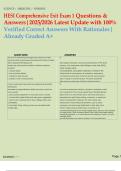
HESI Comprehensive Exit Exam 1 Questions &
Answers|2025/2026 Latest Update with 100%
Verified Correct Answers With Rationales|
Already Graded A+
QUESTIONS ANSWERS
The nurse is monitoring neurological vital signs for a male D
client who lost consciousness after falling and hitting his head.
Which assessment finding is the (Neurological vital signs include serial assessments of TPR, blood
earliest and most sensitive indication of altered cerebral pressure, and components of the Glasgow coma scale (GCS),
function? which includes verbal,
a. Unequal pupils. musculoskeletal, and pupillary responses. A change in the
b. Loss of central reflexes. client's level of consciousness, as indicated by responses to
c. Inability to open the eyes. commands during the GCS, is the first and the most sensitive
d. Change in level of consciousness. sign of change in cerebral function. The other assessment
data choices are late signs of altered cerebral function.)
A nurse is planning to teach self-care measures to a female D
client about
prevention of yeast infections. Which instructions should the (A common genital tract infection in females is candidiasis, which
nurse provide? is an overgrowth of the normal vaginal flora of Candida albicans
a. Use a douche preparation no more than once a month. that thrives in an environment that is warm and moist and is
b. Increase daily intake of fiber and leafy green vegetables. perpetuated by tight-fitting clothing, underwear, or pantyhose
c. Select nylon underwear that is loose- fitting, white, and made of nonabsorbent materials. The client should wear
comfortable. clothing that is loose fitting and absorbent, such as cotton
d. Avoid tight-fitting clothing and do not use bubble-bath underwear, and avoid using bubble-bath or bath salts which
or bath salts. further irritate sensitive genital tissue. Douching is not
recommended because it can irritate vaginal tissue, alter pH, and contribute
to fungal growth. While increasing dietary fiber intake encourages healthy,
nutritional guidelines, it is not the focus of the teaching. Cotton, not nylon
undergarments,
provide absorbancy and reduce moisture in the perineal area.)
ExamsWizard Page 1
, A client who has active tuberculosis (TB) is admitted to the D
medical unit. What action is most important for the nurse to
implement? (Active tuberculosis requires implementation of airborne
precautions, so the client should be assigned to a negative
a. Place an isolation cart in the hallway. pressure air-flow room. Although isolation gowns and isolation
b. Fit the client with a respirator mask. carts should be implemented for clients in isolation with
c. Don a clean gown for client care. contact
d. Assign the client to a negative air-flow room. precautions, it is most important that air flow from the room is minimized when
the
client has TB. The respirator mask should be implemented when
the client leaves the isolation environment.)
The nurse is planning to conduct nutritional assessments and A
diet teaching to clients at a family health clinic. Which
individual has the greatest nutritional and energy demands? A pregnant woman's metabolic demands are 20 to 24%
a. A pregnant woman. more than the basic metabolic rate. The other clients
b. A teenager beginning puberty. require only 15 to 20% more than the basic metabolic
c. A 3-month-old infant. rate.
d. A school-aged child.
B
What nursing delivery of care provides the nurse to plan and
direct care of a group of clients over a 24-hour period? (Primary nursing is a model of delivery of care where a nurse is
a. Team nursing. accountable for planning care for clients around the clock.
b. Primary nursing. Functional nursing is a care delivery
c. Case management. model that provides client care by assignment of functions or
d. Functional nursing. tasks. Team nursing is a care delivery model where
assignments to a group of clients are provided by a mixed-
staff team. Case management is the delivery of care that uses a
collaborative process of assessment, planning, facilitation, and
advocacy for options and services to meet an individual's health
needs and promote quality cost-effective outcomes.)
A
Which approach should the nurse use when preparing a
toddler for a procedure? (Imitation is one of the most distinguishing characteristics of
toddler play, so demonstration of a procedure on a doll
a. Demonstrate the procedure using a doll. enables a non-threatening, dramatic experience that can help
b. Avoid asking the child to make choices. prepare the toddler for the actual procedure. The primary
c. Plan a teaching session to last about 20 minutes. developmental task in toddlerhood is acquiring a sense of
d. Show equipment but prevent child from handling it. autonomy, so giving choices whenever possible to a toddler is
recommended, not avoiding asking the toddler to make a
choice. Since the toddler's attention span is short, teaching
sessions should be brief and can be repeated for
reinforcement. Showing the
equipment before its use helps relieve anxiety, but the child
should be allowed to handle some of the equipment to prevent
frustration and alleviate fear.)
ExamsWizard Page 2
, The nurse is caring for a client who is the daughter of a local D
politician. When the
nurse approaches a man who is reading the names on the hall (Confidentiality is the nurse's primary responsibility and is
doors, he identifies supported by HIPAA, which mandates that personal information
himself as a reporter for the local is not disclosed and access to sensitive
newspaper and requests information about the client's status. client information is limited. Caring involves the nurse's concern
Which standard of about how the client experiences the world. Veracity is the
nursing practice should the nurse use to respond? nurse's duty to tell the truth and not deceive
a. Caring. others. Advocacy is support of the client's best interests.)
b. Veracity.
c. Advocacy.
d. Confidentiality.
ExamsWizard Page 3
, A male client diagnosed with antisocial D
personality disorder is morbidly obese and is placed on a low fat,
low calorie diet. At dinner the nurse notes that he is trying to (The nurse should provide a reality check by helping the client
get other clients on the unit to give him realize that there are consequences to his behavior. Removing
part of their meals. What intervention should the nurse the client from the room or table does not help the client
implement? realize that his behavior is manipulative and harmful to himself
as well as others. This behavior needs to be documented, but
a. Remove the client from the table and have him sit alone. does not need to be reported immediately.)
b. Send the client back to his room and do not allow him to
eat.
c. Report the behavior to the on-call psychologist
immediately.
d. Confront the client about the consequences of the
behavior.
The nurse is assessing a client who A
complains of weight loss, racing heart rate, and difficulty
sleeping. The nurse (This client is exhibiting symptoms associated with
determines the client has moist skin with fine hair, prominent hyperthyroidism or Grave's disease, which is an autoimmune
eyes, lid retraction, and a staring expression. These findings are condition affecting the thyroid. Cushing syndrome, multiple
consistent with which disorder? sclerosis, or Addison's disease are not associated with these
a. Grave's disease. symptoms.)
b. Cushing syndrome.
c. Multiple sclerosis.
d. Addison's disease.
C
Which information should the nurse give a client with chronic
kidney disease (CKD)? (A client with CKD should restrict sodium and potassium dietary
a. Restrict calcium-rich foods. intake, and salt substitutes usually contain potassium, so they
b. Obtain monthly B12 injections. should avoid using them.
c. Avoid salt substitutes. Hypocalcemia is a complication of CKD and calcium
d. Increase daily intake of fiber. supplements are often needed. Anemia related to CKD is
treated with iron, folic acid, and erythropoietin, not B12
injections. Although increasing fiber is a common dietary
recommendation, it not an essential part of client teaching
for CKD.)
ExamsWizard Page 4
HESI Comprehensive Exit Exam 1 Questions &
Answers|2025/2026 Latest Update with 100%
Verified Correct Answers With Rationales|
Already Graded A+
QUESTIONS ANSWERS
The nurse is monitoring neurological vital signs for a male D
client who lost consciousness after falling and hitting his head.
Which assessment finding is the (Neurological vital signs include serial assessments of TPR, blood
earliest and most sensitive indication of altered cerebral pressure, and components of the Glasgow coma scale (GCS),
function? which includes verbal,
a. Unequal pupils. musculoskeletal, and pupillary responses. A change in the
b. Loss of central reflexes. client's level of consciousness, as indicated by responses to
c. Inability to open the eyes. commands during the GCS, is the first and the most sensitive
d. Change in level of consciousness. sign of change in cerebral function. The other assessment
data choices are late signs of altered cerebral function.)
A nurse is planning to teach self-care measures to a female D
client about
prevention of yeast infections. Which instructions should the (A common genital tract infection in females is candidiasis, which
nurse provide? is an overgrowth of the normal vaginal flora of Candida albicans
a. Use a douche preparation no more than once a month. that thrives in an environment that is warm and moist and is
b. Increase daily intake of fiber and leafy green vegetables. perpetuated by tight-fitting clothing, underwear, or pantyhose
c. Select nylon underwear that is loose- fitting, white, and made of nonabsorbent materials. The client should wear
comfortable. clothing that is loose fitting and absorbent, such as cotton
d. Avoid tight-fitting clothing and do not use bubble-bath underwear, and avoid using bubble-bath or bath salts which
or bath salts. further irritate sensitive genital tissue. Douching is not
recommended because it can irritate vaginal tissue, alter pH, and contribute
to fungal growth. While increasing dietary fiber intake encourages healthy,
nutritional guidelines, it is not the focus of the teaching. Cotton, not nylon
undergarments,
provide absorbancy and reduce moisture in the perineal area.)
ExamsWizard Page 1
, A client who has active tuberculosis (TB) is admitted to the D
medical unit. What action is most important for the nurse to
implement? (Active tuberculosis requires implementation of airborne
precautions, so the client should be assigned to a negative
a. Place an isolation cart in the hallway. pressure air-flow room. Although isolation gowns and isolation
b. Fit the client with a respirator mask. carts should be implemented for clients in isolation with
c. Don a clean gown for client care. contact
d. Assign the client to a negative air-flow room. precautions, it is most important that air flow from the room is minimized when
the
client has TB. The respirator mask should be implemented when
the client leaves the isolation environment.)
The nurse is planning to conduct nutritional assessments and A
diet teaching to clients at a family health clinic. Which
individual has the greatest nutritional and energy demands? A pregnant woman's metabolic demands are 20 to 24%
a. A pregnant woman. more than the basic metabolic rate. The other clients
b. A teenager beginning puberty. require only 15 to 20% more than the basic metabolic
c. A 3-month-old infant. rate.
d. A school-aged child.
B
What nursing delivery of care provides the nurse to plan and
direct care of a group of clients over a 24-hour period? (Primary nursing is a model of delivery of care where a nurse is
a. Team nursing. accountable for planning care for clients around the clock.
b. Primary nursing. Functional nursing is a care delivery
c. Case management. model that provides client care by assignment of functions or
d. Functional nursing. tasks. Team nursing is a care delivery model where
assignments to a group of clients are provided by a mixed-
staff team. Case management is the delivery of care that uses a
collaborative process of assessment, planning, facilitation, and
advocacy for options and services to meet an individual's health
needs and promote quality cost-effective outcomes.)
A
Which approach should the nurse use when preparing a
toddler for a procedure? (Imitation is one of the most distinguishing characteristics of
toddler play, so demonstration of a procedure on a doll
a. Demonstrate the procedure using a doll. enables a non-threatening, dramatic experience that can help
b. Avoid asking the child to make choices. prepare the toddler for the actual procedure. The primary
c. Plan a teaching session to last about 20 minutes. developmental task in toddlerhood is acquiring a sense of
d. Show equipment but prevent child from handling it. autonomy, so giving choices whenever possible to a toddler is
recommended, not avoiding asking the toddler to make a
choice. Since the toddler's attention span is short, teaching
sessions should be brief and can be repeated for
reinforcement. Showing the
equipment before its use helps relieve anxiety, but the child
should be allowed to handle some of the equipment to prevent
frustration and alleviate fear.)
ExamsWizard Page 2
, The nurse is caring for a client who is the daughter of a local D
politician. When the
nurse approaches a man who is reading the names on the hall (Confidentiality is the nurse's primary responsibility and is
doors, he identifies supported by HIPAA, which mandates that personal information
himself as a reporter for the local is not disclosed and access to sensitive
newspaper and requests information about the client's status. client information is limited. Caring involves the nurse's concern
Which standard of about how the client experiences the world. Veracity is the
nursing practice should the nurse use to respond? nurse's duty to tell the truth and not deceive
a. Caring. others. Advocacy is support of the client's best interests.)
b. Veracity.
c. Advocacy.
d. Confidentiality.
ExamsWizard Page 3
, A male client diagnosed with antisocial D
personality disorder is morbidly obese and is placed on a low fat,
low calorie diet. At dinner the nurse notes that he is trying to (The nurse should provide a reality check by helping the client
get other clients on the unit to give him realize that there are consequences to his behavior. Removing
part of their meals. What intervention should the nurse the client from the room or table does not help the client
implement? realize that his behavior is manipulative and harmful to himself
as well as others. This behavior needs to be documented, but
a. Remove the client from the table and have him sit alone. does not need to be reported immediately.)
b. Send the client back to his room and do not allow him to
eat.
c. Report the behavior to the on-call psychologist
immediately.
d. Confront the client about the consequences of the
behavior.
The nurse is assessing a client who A
complains of weight loss, racing heart rate, and difficulty
sleeping. The nurse (This client is exhibiting symptoms associated with
determines the client has moist skin with fine hair, prominent hyperthyroidism or Grave's disease, which is an autoimmune
eyes, lid retraction, and a staring expression. These findings are condition affecting the thyroid. Cushing syndrome, multiple
consistent with which disorder? sclerosis, or Addison's disease are not associated with these
a. Grave's disease. symptoms.)
b. Cushing syndrome.
c. Multiple sclerosis.
d. Addison's disease.
C
Which information should the nurse give a client with chronic
kidney disease (CKD)? (A client with CKD should restrict sodium and potassium dietary
a. Restrict calcium-rich foods. intake, and salt substitutes usually contain potassium, so they
b. Obtain monthly B12 injections. should avoid using them.
c. Avoid salt substitutes. Hypocalcemia is a complication of CKD and calcium
d. Increase daily intake of fiber. supplements are often needed. Anemia related to CKD is
treated with iron, folic acid, and erythropoietin, not B12
injections. Although increasing fiber is a common dietary
recommendation, it not an essential part of client teaching
for CKD.)
ExamsWizard Page 4