Maternal/OB Exam 1 Blueprint 1
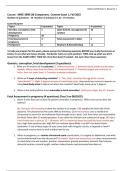
Course: NRSE 3900 OB Component, Content Exam 1, Fall 2025
Number of questions: 50 Number of minutes (x 1.5) = 75 minutes
Exam Blueprint
Topics # questions Topics # questions
Genetics, conception, fetal 3 Labor & birth, management & 10
development comfort
Pregnancy 10
Fetal Assessment in 4 Fetal assessment in labor 4
pregnancy
Postpartum 8 Newborn & Breastfeeding 11
To help you prepare for this exam, please answer the following questions BEFORE you study the lectures or
books, to see what you know already. Handwrite notes on each question, THEN look up what you don’t
know from the SLIDES FIRST, THEN ATI, then Ricci book if needed. Ask each other these questions:
Genetics, conception, fetal development (3 questions):
1. What are 4 functions of the placenta? 1. Makes hormones 2. Removes waste products and carbon
dioxide, diffuse away from the fetus, into maternal blood. 3. Transfers oxygen and nutrients to
fetus- does not make food. 4. Transfers maternal antibodies
2. What are 2 ways of detecting ovulation? 1. Thin, clear, stretches like egg white- mucus-
“spinnbarkeit” 2. Slight ½ degree increase in basal body temp How would you instruct a woman on
using basal body temp to figure out when she ovulates? Basal body temp up by ½ degree.
3. When is the embryo/fetus most vulnerable to birth anomalies? Embryonic stage- day 15- 8 weeks
Fetal Assessment in pregnancy (4 questions) Class 3 on 08/29/25
1. Name 3 tests that can be done for genetic anomalies in pregnancy. Which one can be done the
earliest?
(1) Chorionic Villa Sampling is done the earliest at 10 weeks. CVS samples the fetal side of the
placenta. The placenta has the same DNA as the fetus. (2) Amniocentesis uses a needle and
ultrasound to search for and withdraw fluid through mom’s belly. Cells from fetus are found within
the fluid. Done after 15 weeks gestation. It can check for bilirubin and surfactant of lungs. (3) Alpha-
Feto Protein test is done at 15 – 18 weeks. AFP is a maternal blood test and the least invasive but
has a high false-positive rate. High AFP can indicate Spina Bifida. Low AFP can detect Down
Syndrome. If any of these types of tests come back with irregular results, a targeted or level II
ultrasound may be done to look at baby head to toe.
2. When in pregnancy is a routine ultrasound exam usually done, is it vaginal or abdominal, and what
can be determined from the ultrasound? 18 weeks/ abdominal anatomical scan does measurements
to check fetal size and number, position, movements, growth anomalies, amniotic fluid volume,
placenta location, cervical length, mothers tubes/ovaries and presumed due date ect,
, Maternal/OB Exam 1 Blueprint 2
3. Complete the chart:
Test How is it done? What is a good A bad result? What do you do if it is bad?
result?
BPP Ultrasound/fetal 8/8 or 10/10 4/10 Need to deliver baby
BioPhysical monitor for
Profile evaluation of 5
values: Amnio
Volume, Fetal
breathing, Fetal
movement, Fetal
muscle tone,
Non-Stress test
NST Continuous Reactive, at Non-Reactive <2. – Stimulate baby and get him
Non Stress monitor of FHR least 2 accels moving.
Test for 20-40 min. in 20 minutes
CST Stimulate 3 Negative result Positive Result is bad- Baby has multiple late
contractions in 10 is good. Baby decels when contraction decreases placenta
minutes using has normal perfusion. Usually keep in hospital and prepare
oxytocin or heart accel and to deliver.
nipple stim. decel
Fetal Assessment in Labor (4 questions)
4. What would you do if you noticed absent fetal heart variability? The autonomic system is causing a
loss of reaction. Could be a bad placenta, cord compression, mom hypotension, uterine
hyperstimulation, placenta abruption, fetal dysrhythmia, fetal hypoxemia or metabolic acidemia.
Reposition mom – lateral, hands and knees. Give IV fluid bolus. O2 of 12 to 15 L/min by a non
rebreather face mask. Notify provider, document findings and consider internal monitoring and
prepare for surgical birth if it continues. Position, O2 and IV fluids.
5. Create the VEAL CHOP MINE chart. Apply this to interpreting fetal heart tracings in labor, and your
nursing actions. 9/3/2024 around 20 minutes?
Type V E A L
Variable Early Acceleration Late
deceleration Deceleration deceleration
Cause C H O P
Cord Compression Head Compression OK Placental
Insufficiency
Action M I N E
Move to new Investigate Progress No Action Needed Execute
Position of Labor Immediate
Action-
Emergency
Course: NRSE 3900 OB Component, Content Exam 1, Fall 2025
Number of questions: 50 Number of minutes (x 1.5) = 75 minutes
Exam Blueprint
Topics # questions Topics # questions
Genetics, conception, fetal 3 Labor & birth, management & 10
development comfort
Pregnancy 10
Fetal Assessment in 4 Fetal assessment in labor 4
pregnancy
Postpartum 8 Newborn & Breastfeeding 11
To help you prepare for this exam, please answer the following questions BEFORE you study the lectures or
books, to see what you know already. Handwrite notes on each question, THEN look up what you don’t
know from the SLIDES FIRST, THEN ATI, then Ricci book if needed. Ask each other these questions:
Genetics, conception, fetal development (3 questions):
1. What are 4 functions of the placenta? 1. Makes hormones 2. Removes waste products and carbon
dioxide, diffuse away from the fetus, into maternal blood. 3. Transfers oxygen and nutrients to
fetus- does not make food. 4. Transfers maternal antibodies
2. What are 2 ways of detecting ovulation? 1. Thin, clear, stretches like egg white- mucus-
“spinnbarkeit” 2. Slight ½ degree increase in basal body temp How would you instruct a woman on
using basal body temp to figure out when she ovulates? Basal body temp up by ½ degree.
3. When is the embryo/fetus most vulnerable to birth anomalies? Embryonic stage- day 15- 8 weeks
Fetal Assessment in pregnancy (4 questions) Class 3 on 08/29/25
1. Name 3 tests that can be done for genetic anomalies in pregnancy. Which one can be done the
earliest?
(1) Chorionic Villa Sampling is done the earliest at 10 weeks. CVS samples the fetal side of the
placenta. The placenta has the same DNA as the fetus. (2) Amniocentesis uses a needle and
ultrasound to search for and withdraw fluid through mom’s belly. Cells from fetus are found within
the fluid. Done after 15 weeks gestation. It can check for bilirubin and surfactant of lungs. (3) Alpha-
Feto Protein test is done at 15 – 18 weeks. AFP is a maternal blood test and the least invasive but
has a high false-positive rate. High AFP can indicate Spina Bifida. Low AFP can detect Down
Syndrome. If any of these types of tests come back with irregular results, a targeted or level II
ultrasound may be done to look at baby head to toe.
2. When in pregnancy is a routine ultrasound exam usually done, is it vaginal or abdominal, and what
can be determined from the ultrasound? 18 weeks/ abdominal anatomical scan does measurements
to check fetal size and number, position, movements, growth anomalies, amniotic fluid volume,
placenta location, cervical length, mothers tubes/ovaries and presumed due date ect,
, Maternal/OB Exam 1 Blueprint 2
3. Complete the chart:
Test How is it done? What is a good A bad result? What do you do if it is bad?
result?
BPP Ultrasound/fetal 8/8 or 10/10 4/10 Need to deliver baby
BioPhysical monitor for
Profile evaluation of 5
values: Amnio
Volume, Fetal
breathing, Fetal
movement, Fetal
muscle tone,
Non-Stress test
NST Continuous Reactive, at Non-Reactive <2. – Stimulate baby and get him
Non Stress monitor of FHR least 2 accels moving.
Test for 20-40 min. in 20 minutes
CST Stimulate 3 Negative result Positive Result is bad- Baby has multiple late
contractions in 10 is good. Baby decels when contraction decreases placenta
minutes using has normal perfusion. Usually keep in hospital and prepare
oxytocin or heart accel and to deliver.
nipple stim. decel
Fetal Assessment in Labor (4 questions)
4. What would you do if you noticed absent fetal heart variability? The autonomic system is causing a
loss of reaction. Could be a bad placenta, cord compression, mom hypotension, uterine
hyperstimulation, placenta abruption, fetal dysrhythmia, fetal hypoxemia or metabolic acidemia.
Reposition mom – lateral, hands and knees. Give IV fluid bolus. O2 of 12 to 15 L/min by a non
rebreather face mask. Notify provider, document findings and consider internal monitoring and
prepare for surgical birth if it continues. Position, O2 and IV fluids.
5. Create the VEAL CHOP MINE chart. Apply this to interpreting fetal heart tracings in labor, and your
nursing actions. 9/3/2024 around 20 minutes?
Type V E A L
Variable Early Acceleration Late
deceleration Deceleration deceleration
Cause C H O P
Cord Compression Head Compression OK Placental
Insufficiency
Action M I N E
Move to new Investigate Progress No Action Needed Execute
Position of Labor Immediate
Action-
Emergency