N
O
TI
LU
O
STS
TE
, kjhgfdsa
Contents
To the Instructor iv
Syllabus (10 weeks) v
Syllabus (16 weeks) xiii
TE
Chapter 1: Introduction to Criminal Procedure 1
Chapter 2: The Exclusionary Rule and Other Remedies 17
Chapter 3: Introduction to the 4th Amendment 27
Chapter 4: Searches and Arrests with Warrants 39
Chapter 5: Searches and Arrests without Warrants 52
S
Chapter 6: Stop and Frisk 64
Chapter 7: Special Needs and Regulatory Searches 74
Chapter 8: Interrogations and Confessions 86
Chapter 9: Identifications 96
TS
Chapter 10: The Pretrial Process 106
Chapter 11: Prosecutors, Grand Juries, and Defense Attorneys 120
Chapter 12: Plea Bargaining and Guilty Pleas 132
Chapter 13: Trial and Beyond 143
Test Bank 156
O
LU
TI
O
N
ertyuiop
, kjhgfdsa
To the Instructor
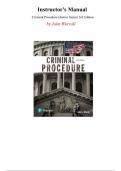
The instructor’s manual is a comprehensive document that includes a chapter overview, chapter
objectives, a lecture outline with teaching tips, answers to the “Think About It” exercises in the
main text, and suggested answers to the end-of-chapter assignments (Review Questions).
Criminal Procedure is divided into four parts: (1) Foundations; (2) Search and Seizure;
TE
(3) Interrogations, Confessions, and Identification Procedures; and (4) Formal Proceedings.
Chapter 1 is introductory and provides readers with the information necessary to begin studying
criminal procedure. In particular, it defines criminal procedure, ties in the constitutional basis,
covers the importance of precedents, covers competing concerns, highlights the structure of the
court systems, and explains court cases from the beginning stage through adjudication.
Chapter 2 begins by discussing the exclusionary rule, and then considers criminal, civil,
and non-judicial remedies. Remedies are presented early in the text so readers will become aware
S
of how people’s rights can be enforced in the U.S. courts.
Chapter 3 provides a framework for studying the Fourth Amendment; specifically, it
defines Fourth Amendment terminology and specifies when searches and seizures occur. This
TS
chapter also covers the doctrine of justification, focusing on the definitions of probable cause,
reasonable suspicion, and administrative justification. Chapters 4 and 5 go on to cover searches
and seizures with warrants and without warrants, respectively. Chapter 6 covers actions based on
reasonable suspicion, including stops and frisks and investigative detentions, and Chapter 7
covers actions based on administrative justification and consent, including inventories,
inspections, checkpoints, school and office searches, drug and alcohol testing, and the like.
O
Chapter 8 focuses heavily on the Fifth Amendment’s self-incrimination clause and then
summarizes the proper procedures for conducting interrogations and obtaining valid confessions.
Further, it also examines how the Sixth Amendment governs interrogations and confessions.
Chapter 9 discusses identification procedures, including the guidelines for proper pretrial
LU
identifications, and also introduces identification procedures used during trial, including the
proper questioning of witnesses to assist in valid in-court identifications.
Chapter 10 begins by discussing booking, the initial appearance, the probable cause
hearing, pretrial release, the preliminary hearing, and the arraignment. This chapter also
introduces the rules surrounding discovery. While discovery can occur well into a trial, most
often discovery is pretrial in nature; thus, it is appropriate to discuss discovery in this context.
TI
Chapter 11 covers prosecutors, grand juries, and defense attorneys, including the constitutional
guidelines by which each must abide. Of course, the actions of prosecutors, defense attorneys,
and even grand juries matter outside the pretrial context, but readers should be familiar with
these important actors before moving into the adjudication section. Finally, Chapter 12 covers
plea-bargaining and guilty pleas. Again, both can occur well into a trial, but most plea bargains
O
and guilty pleas are undertaken in an effort to avoid trial.
Chapter 13 covers the defendant’s rights at trial, examines the right to a speedy trial and
the right to an impartial judge and jury, discussing openness, confrontation, compulsory process,
double jeopardy, and entrapment. Lastly, Chapter 13 covers important topics in sentencing as
N
well as appeals and habeas corpus.
ertyuiop
, kjhgfdsa
Course Syllabus (10 weeks)
Course Title: Criminal Procedure Course Number:
Credit Hours: Course Length: 10 Weeks
Date: Course Schedule:
Prerequisite: Instructor:
Phone:
TE
Email:
Course Description:
This course covers the fundamental principles and procedures employed in the investigation of
crimes. It is a comprehensive introduction to criminal procedure from the first point individuals
S
come into contact with the police, all the way through to the appeal process. The course connects
criminal procedure cases to the real world through innovative pedagogy, and encourages students
to think critically. This course is designed to develop a working knowledge of the steps of
TS
investigation beginning with the initial security of the crime scene and concluding with the
presentation of evidence and proper testimony in court.
Course Materials
• Criminal Procedure 3rded.
John L. Worrall, University of Texas at Dallas
O
ISBN-10: 0-13-454865-5• ISBN-13:
©2016 • Pearson Education Inc.
Course Assignments
LU
• Exams (50 points each – 150 points)
There are three (3) multiple-choice exams. The exams are not cumulative but will be
based on the chapters presented immediately preceding each exam.
• Final exam (100 points)
TI
There will be final exam for this class. The format for the exam may consist of some type
of multiple choices, fill-ins the blanks, and/or essay questions that pertain to all of the
information presented.
• Instructor assignments (10 points each – 80 points)
O
Assignments will be given out throughout the semester. Students are expected to
complete each assignment and submit them on the due date.
• Miscellaneous graded assignments in class (10 points each for 120 points)
N
Students will complete assignments in class for points.
• Project Paper (50 Points)
Students will write a research paper about a criminal procedures topic that is of interest to
them. The paper will be in APA format and contain an introduction, the body of the
ertyuiop
O
TI
LU
O
STS
TE
, kjhgfdsa
Contents
To the Instructor iv
Syllabus (10 weeks) v
Syllabus (16 weeks) xiii
TE
Chapter 1: Introduction to Criminal Procedure 1
Chapter 2: The Exclusionary Rule and Other Remedies 17
Chapter 3: Introduction to the 4th Amendment 27
Chapter 4: Searches and Arrests with Warrants 39
Chapter 5: Searches and Arrests without Warrants 52
S
Chapter 6: Stop and Frisk 64
Chapter 7: Special Needs and Regulatory Searches 74
Chapter 8: Interrogations and Confessions 86
Chapter 9: Identifications 96
TS
Chapter 10: The Pretrial Process 106
Chapter 11: Prosecutors, Grand Juries, and Defense Attorneys 120
Chapter 12: Plea Bargaining and Guilty Pleas 132
Chapter 13: Trial and Beyond 143
Test Bank 156
O
LU
TI
O
N
ertyuiop
, kjhgfdsa
To the Instructor
The instructor’s manual is a comprehensive document that includes a chapter overview, chapter
objectives, a lecture outline with teaching tips, answers to the “Think About It” exercises in the
main text, and suggested answers to the end-of-chapter assignments (Review Questions).
Criminal Procedure is divided into four parts: (1) Foundations; (2) Search and Seizure;
TE
(3) Interrogations, Confessions, and Identification Procedures; and (4) Formal Proceedings.
Chapter 1 is introductory and provides readers with the information necessary to begin studying
criminal procedure. In particular, it defines criminal procedure, ties in the constitutional basis,
covers the importance of precedents, covers competing concerns, highlights the structure of the
court systems, and explains court cases from the beginning stage through adjudication.
Chapter 2 begins by discussing the exclusionary rule, and then considers criminal, civil,
and non-judicial remedies. Remedies are presented early in the text so readers will become aware
S
of how people’s rights can be enforced in the U.S. courts.
Chapter 3 provides a framework for studying the Fourth Amendment; specifically, it
defines Fourth Amendment terminology and specifies when searches and seizures occur. This
TS
chapter also covers the doctrine of justification, focusing on the definitions of probable cause,
reasonable suspicion, and administrative justification. Chapters 4 and 5 go on to cover searches
and seizures with warrants and without warrants, respectively. Chapter 6 covers actions based on
reasonable suspicion, including stops and frisks and investigative detentions, and Chapter 7
covers actions based on administrative justification and consent, including inventories,
inspections, checkpoints, school and office searches, drug and alcohol testing, and the like.
O
Chapter 8 focuses heavily on the Fifth Amendment’s self-incrimination clause and then
summarizes the proper procedures for conducting interrogations and obtaining valid confessions.
Further, it also examines how the Sixth Amendment governs interrogations and confessions.
Chapter 9 discusses identification procedures, including the guidelines for proper pretrial
LU
identifications, and also introduces identification procedures used during trial, including the
proper questioning of witnesses to assist in valid in-court identifications.
Chapter 10 begins by discussing booking, the initial appearance, the probable cause
hearing, pretrial release, the preliminary hearing, and the arraignment. This chapter also
introduces the rules surrounding discovery. While discovery can occur well into a trial, most
often discovery is pretrial in nature; thus, it is appropriate to discuss discovery in this context.
TI
Chapter 11 covers prosecutors, grand juries, and defense attorneys, including the constitutional
guidelines by which each must abide. Of course, the actions of prosecutors, defense attorneys,
and even grand juries matter outside the pretrial context, but readers should be familiar with
these important actors before moving into the adjudication section. Finally, Chapter 12 covers
plea-bargaining and guilty pleas. Again, both can occur well into a trial, but most plea bargains
O
and guilty pleas are undertaken in an effort to avoid trial.
Chapter 13 covers the defendant’s rights at trial, examines the right to a speedy trial and
the right to an impartial judge and jury, discussing openness, confrontation, compulsory process,
double jeopardy, and entrapment. Lastly, Chapter 13 covers important topics in sentencing as
N
well as appeals and habeas corpus.
ertyuiop
, kjhgfdsa
Course Syllabus (10 weeks)
Course Title: Criminal Procedure Course Number:
Credit Hours: Course Length: 10 Weeks
Date: Course Schedule:
Prerequisite: Instructor:
Phone:
TE
Email:
Course Description:
This course covers the fundamental principles and procedures employed in the investigation of
crimes. It is a comprehensive introduction to criminal procedure from the first point individuals
S
come into contact with the police, all the way through to the appeal process. The course connects
criminal procedure cases to the real world through innovative pedagogy, and encourages students
to think critically. This course is designed to develop a working knowledge of the steps of
TS
investigation beginning with the initial security of the crime scene and concluding with the
presentation of evidence and proper testimony in court.
Course Materials
• Criminal Procedure 3rded.
John L. Worrall, University of Texas at Dallas
O
ISBN-10: 0-13-454865-5• ISBN-13:
©2016 • Pearson Education Inc.
Course Assignments
LU
• Exams (50 points each – 150 points)
There are three (3) multiple-choice exams. The exams are not cumulative but will be
based on the chapters presented immediately preceding each exam.
• Final exam (100 points)
TI
There will be final exam for this class. The format for the exam may consist of some type
of multiple choices, fill-ins the blanks, and/or essay questions that pertain to all of the
information presented.
• Instructor assignments (10 points each – 80 points)
O
Assignments will be given out throughout the semester. Students are expected to
complete each assignment and submit them on the due date.
• Miscellaneous graded assignments in class (10 points each for 120 points)
N
Students will complete assignments in class for points.
• Project Paper (50 Points)
Students will write a research paper about a criminal procedures topic that is of interest to
them. The paper will be in APA format and contain an introduction, the body of the
ertyuiop