N
O
TI
LU
O
STS
TE
, KJHGFDSA
CONTENTS
TE
To the Instructor iv
Syllabi v
Chapter 1: What Is Criminal Justice? 1
S
Chapter 2: The Crime Picture 17
Chapter 3: The Search for Causes 31
TS
Chapter 4: Criminal Law 47
Chapter 5: Policing: History and Structure 58
Chapter 6: Policing: Purpose and Organization 72
Chapter 7: Policing: Legal Aspects 82
O
Chapter 8: Policing: Issues and Challenges 94
Chapter 9: The Courts: Structure and Participants 104
LU
Chapter 10: Pretrial Activities and the Criminal Trial 114
Chapter 11: Sentencing 122
Chapter 12: Probation, Parole, and Community Corrections 135
Chapter 13: Prisons and Jails 144
TI
Chapter 14: Prison Life 154
Chapter 15: Juvenile Justice 165
O
Chapter 16: Drugs and Crime 174
Chapter 17: Terrorism, Multinational Criminal Justice, and Global Issues 184
Chapter 18: High-Technology Crimes 194
N
KJHGFDS
, KJHGFDSA
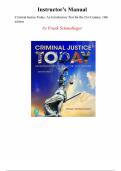
To the Instructor
This Instructor’s Manual with Test Bank is designed to accompany and complement the sixteenth
edition of Criminal Justice Today by Frank Schmalleger and to make your job more manageable
and your teaching more effective. It provides you with a comprehensive summary of the
information in the textbook and serves as an easy-access reference to the issues presented in the
textbook and to complementary materials.
TE
The chapters of the IM correspond directly to the chapters in the textbook. Each chapter contains
the following sections:
Chapter Overview: This section highlights the main points of the chapter, including definitions,
S
significant cases, and important research findings.
Chapter Objectives: This section provides a list of the overall learning objectives for each
TS
chapter that are identified in the textbook.
Chapter Outline: This is a detailed description of the information in each chapter of the
textbook. It highlights the main topics, briefly describes the information in each section, and
includes all of the key terms and many of the key cases discussed in the textbook. Discussion
starters are woven into the outline to suggest focus points to stimulate class discussions.
O
List of Changes/Transition Guide: This section identifies the main changes that have been
made to the text in each chapter since the thirteenth edition, making it easy to update lesson plans,
assignments, and other course materials to reflect the new fourteenth edition.
LU
Additional Assignments and Class Activities: This section includes a variety of ideas for
activities that may be used in class or assigned to students as outside activities. Many involve the
use of the World Wide Web.
TI
Suggested Answers to End-of-Chapter Assignments: At the end of each chapter, there is a list
of Questions for Review and Questions for Reflection. Although students’ personal opinions may
play a role in their answers to these questions, many of the responses can be assessed in terms of
basic information and common themes found throughout the textbook. Sample suggested answers
to the questions are provided.
O
In addition, several sample syllabi are provided for courses using Criminal Justice Today,
fifteenth edition. Both 10-week and 16-week samples are included.
N
KJHGFDSA
, KJHGFDSA
Syllabi
Sample Syllabus
Introduction to Criminal Justice
16-Week Course
TE
COURSE INFORMATION
Course Number:
Class Meeting Times:
Class Meeting Location:
INSTRUCTOR INFORMATION
S
Instructor Name:
Office Location:
TS
Office Hours:
Telephone Number:
E-mail Address:
REQUIRED TEXT
O
Schmalleger, Frank. 2021. Criminal Justice Today (16th ed.). Upper Saddle River, NJ: Pearson.
COURSE DESCRIPTION
This course provides an introduction to the criminal justice system. The primary goal of this
LU
course is to develop a general understanding of the criminal justice system and its response to
crime in society today. Students will consider crime in the United States, explore the key
elements of the criminal justice system (policing, courts, and corrections), and examine a number
of special issues relevant to criminal justice today.
COURSE REQUIREMENTS
TI
Examinations: There will be five non-cumulative examinations, including both multiple choice
and true/false questions. Each examination will be worth 100 points and will contain 50 questions
(each question will be worth two points). Examinations will cover materials presented in lectures
and the textbook.
O
Make-up policy: [Insert here]
Writing Assignments: Each chapter of Criminal Justice Today includes a number of Questions
N
for Review and Questions for Reflection. You will select one question from each chapter and
provide a detailed written response. Each assignment will be worth 20 points.
Class Participation: Participation in class is worth 50 points. Read and study the textbook before
each class and be prepared to ask and answer questions.
KJHGFDSA
O
TI
LU
O
STS
TE
, KJHGFDSA
CONTENTS
TE
To the Instructor iv
Syllabi v
Chapter 1: What Is Criminal Justice? 1
S
Chapter 2: The Crime Picture 17
Chapter 3: The Search for Causes 31
TS
Chapter 4: Criminal Law 47
Chapter 5: Policing: History and Structure 58
Chapter 6: Policing: Purpose and Organization 72
Chapter 7: Policing: Legal Aspects 82
O
Chapter 8: Policing: Issues and Challenges 94
Chapter 9: The Courts: Structure and Participants 104
LU
Chapter 10: Pretrial Activities and the Criminal Trial 114
Chapter 11: Sentencing 122
Chapter 12: Probation, Parole, and Community Corrections 135
Chapter 13: Prisons and Jails 144
TI
Chapter 14: Prison Life 154
Chapter 15: Juvenile Justice 165
O
Chapter 16: Drugs and Crime 174
Chapter 17: Terrorism, Multinational Criminal Justice, and Global Issues 184
Chapter 18: High-Technology Crimes 194
N
KJHGFDS
, KJHGFDSA
To the Instructor
This Instructor’s Manual with Test Bank is designed to accompany and complement the sixteenth
edition of Criminal Justice Today by Frank Schmalleger and to make your job more manageable
and your teaching more effective. It provides you with a comprehensive summary of the
information in the textbook and serves as an easy-access reference to the issues presented in the
textbook and to complementary materials.
TE
The chapters of the IM correspond directly to the chapters in the textbook. Each chapter contains
the following sections:
Chapter Overview: This section highlights the main points of the chapter, including definitions,
S
significant cases, and important research findings.
Chapter Objectives: This section provides a list of the overall learning objectives for each
TS
chapter that are identified in the textbook.
Chapter Outline: This is a detailed description of the information in each chapter of the
textbook. It highlights the main topics, briefly describes the information in each section, and
includes all of the key terms and many of the key cases discussed in the textbook. Discussion
starters are woven into the outline to suggest focus points to stimulate class discussions.
O
List of Changes/Transition Guide: This section identifies the main changes that have been
made to the text in each chapter since the thirteenth edition, making it easy to update lesson plans,
assignments, and other course materials to reflect the new fourteenth edition.
LU
Additional Assignments and Class Activities: This section includes a variety of ideas for
activities that may be used in class or assigned to students as outside activities. Many involve the
use of the World Wide Web.
TI
Suggested Answers to End-of-Chapter Assignments: At the end of each chapter, there is a list
of Questions for Review and Questions for Reflection. Although students’ personal opinions may
play a role in their answers to these questions, many of the responses can be assessed in terms of
basic information and common themes found throughout the textbook. Sample suggested answers
to the questions are provided.
O
In addition, several sample syllabi are provided for courses using Criminal Justice Today,
fifteenth edition. Both 10-week and 16-week samples are included.
N
KJHGFDSA
, KJHGFDSA
Syllabi
Sample Syllabus
Introduction to Criminal Justice
16-Week Course
TE
COURSE INFORMATION
Course Number:
Class Meeting Times:
Class Meeting Location:
INSTRUCTOR INFORMATION
S
Instructor Name:
Office Location:
TS
Office Hours:
Telephone Number:
E-mail Address:
REQUIRED TEXT
O
Schmalleger, Frank. 2021. Criminal Justice Today (16th ed.). Upper Saddle River, NJ: Pearson.
COURSE DESCRIPTION
This course provides an introduction to the criminal justice system. The primary goal of this
LU
course is to develop a general understanding of the criminal justice system and its response to
crime in society today. Students will consider crime in the United States, explore the key
elements of the criminal justice system (policing, courts, and corrections), and examine a number
of special issues relevant to criminal justice today.
COURSE REQUIREMENTS
TI
Examinations: There will be five non-cumulative examinations, including both multiple choice
and true/false questions. Each examination will be worth 100 points and will contain 50 questions
(each question will be worth two points). Examinations will cover materials presented in lectures
and the textbook.
O
Make-up policy: [Insert here]
Writing Assignments: Each chapter of Criminal Justice Today includes a number of Questions
N
for Review and Questions for Reflection. You will select one question from each chapter and
provide a detailed written response. Each assignment will be worth 20 points.
Class Participation: Participation in class is worth 50 points. Read and study the textbook before
each class and be prepared to ask and answer questions.
KJHGFDSA