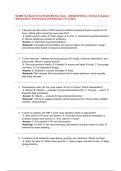
NUR 378 Pharmacology Exam 1, 2, 3 & Final Exam
2025 – Actual Questions & Answers | Concordia
University St. Paul
/.What drug class is digoxin? - Answer-✅cardiac glycoside
/.Digoxin mechanism of action - Answer-✅1. Inhibits sodium/potassium pump, thereby
increasing intracellular calcium levels
2. Positive inotropic effect, increases cardiac output
3. Decreases chronotropy and dromotropy; slows AV conduction
/.indications for digoxin - Answer-✅systolic heart failure, atrial fibrillation
/.adverse effects of digoxin - Answer-✅Dysrhythmias, cardiotoxicity, hypotension,
bradycardia, GI effects (nausea, vomiting, and abdominal pain), CNS effects including
fatigue, weakness, vision changes.
/.interactions of digoxin - Answer-✅Amiodarone, quinidine, cyclosporine, diltiazem, and
verapamil increase serum levels
Diuretic-induced hypokalemia increases effects and toxicity
/.What drug class is losartan? - Answer-✅Angiotensin II Receptor Blocker (ARB)
/.mechanism of action for losartan - Answer-✅It inhibits angiotensin IIs vasoconstrictive
and aldosterone-secreting actions by blocking angiotensin II receptor on the surface of
vascular smooth muscle/other tissue cells
/.indications for losartan - Answer-✅hypertension, heart failure
/.adverse effects of losartan - Answer-✅chest pain, fatigue, hypoglycemia, diarrhea,
UTI, hyperkalemia (less likely than ACE),angioedema, fetal harm, renal failure
FETAL TOXICITY
/.interactions with losartan - Answer-✅NSAIDS (decreased ARB effect, potential for
renal failure); Lithium (lithium toxicity); Rifampin (decreased ARB effect); K+
supplements/K+ sparing diuretics (hyperkalemia)
,/.What drug class is hydralazine? - Answer-✅vasodilator
/.mechanism of action for hydralazine - Answer-✅directly acts on arteriolar and/or
venous smooth muscle to cause relaxation/vasodilation.
/.indications for hydralazine - Answer-✅hypertension
/.adverse effects of hydralazine - Answer-✅dizziness, HA, anxiety, tachycardia, edema,
dyspnea, N/V, SLE, rash, B6 deficiency, hepatitis
/.interactions of hydralazine - Answer-✅- •Beta Blockers (good)
•Diuretics (good - blood volume)
•Isosorbide (good - HF pt)
Other anti hypertensive agents
/.What drug class if doxazosin? - Answer-✅Alpha-1 blocker
/.mechanism of action of doxazosin - Answer-✅Selective for Alpha1-adrenergic
receptors, thus causes vasodilation; also cause relaxation of smooth muscle around
prostate gland
/.indications for doxazosin - Answer-✅HTN, BPH, and severe CHF
/.adverse effects of doxazosin - Answer-✅dizziness, dyspnea, asthenia, headache,
hypotension, orthostatic hypotension, somnolence
/.interactions of doxazosin - Answer-✅Pregnancy Category C, drug hypersensitivity
/.what drug class is amlodipine? - Answer-✅calcium channel blocker
/.mechanism of action for amlodipine - Answer-✅cause smooth muscle relaxation by
blocking the binding of calcium to its receptors and prevents contraction
/.indications for amlodipine - Answer-✅hypertension, angina, sometimes Raynaud's
and.or migraine
/.adverse effects of amlodipine - Answer-✅edema, flushing, headache, fatigue,
abdominal pain
/.Beta blocker mechanism of action - Answer-✅By blocking sympathetic stimulation of
heart at Beta receptors, reduce heart rate and contractility, thus decreasing the
metabolic demands on the heart and reducing risk of ischemia
, /.examples of beta blockers - Answer-✅Metoprolol, Atenolol, Propanolol
/.Adverse effects of beta blockers - Answer-✅Bradycardia, AV block, impotence,
dyslipidemia, exacerbation of COPD
/.Indications for beta blockers - Answer-✅angina, MI, cardiac dysrhythmias,
hypertension, and heart failure, treat migraines, glaucoma
/.Contraindications of beta blockers - Answer-✅DO NOT USE BETA2 WITH CLIENTS
WHO HAVE ASTHMA, BRONCHOSPASM, AND HEART FAILURE
/.Pharmacodynamics - Answer-✅what the drug does to the body
/.Pharmacokinetics - Answer-✅what the body does to the drug
/.Absorption of drug - Answer-✅The movement of a drug from the site of administration
into the circulatory system
/.distribution of drug - Answer-✅The movement of a drug by the circulatory system to its
intended site of action
/.metabolism of drug - Answer-✅The change of a drug into a more or less potent or
more soluble form after it passes through the liver, kidneys, intestinal mucosa, or other
body part
/.excretion of drug - Answer-✅The removal of the drug or its metabolites through the
kidneys, gastrointestinal tract, skin, or lungs
/.nursing process - Answer-✅Assessment
Diagnosis
Planning
Implementation
Evaluation
/.nursing process (assessment) - Answer-✅Through the patient's eyes
Gather information, synthesize, apply critical thinking
Physical and emotional factors
Developmental factors
Sociocultural factors
Gender
/.what drug class is nitroglycerin? - Answer-✅Antianginal; nitrate
2025 – Actual Questions & Answers | Concordia
University St. Paul
/.What drug class is digoxin? - Answer-✅cardiac glycoside
/.Digoxin mechanism of action - Answer-✅1. Inhibits sodium/potassium pump, thereby
increasing intracellular calcium levels
2. Positive inotropic effect, increases cardiac output
3. Decreases chronotropy and dromotropy; slows AV conduction
/.indications for digoxin - Answer-✅systolic heart failure, atrial fibrillation
/.adverse effects of digoxin - Answer-✅Dysrhythmias, cardiotoxicity, hypotension,
bradycardia, GI effects (nausea, vomiting, and abdominal pain), CNS effects including
fatigue, weakness, vision changes.
/.interactions of digoxin - Answer-✅Amiodarone, quinidine, cyclosporine, diltiazem, and
verapamil increase serum levels
Diuretic-induced hypokalemia increases effects and toxicity
/.What drug class is losartan? - Answer-✅Angiotensin II Receptor Blocker (ARB)
/.mechanism of action for losartan - Answer-✅It inhibits angiotensin IIs vasoconstrictive
and aldosterone-secreting actions by blocking angiotensin II receptor on the surface of
vascular smooth muscle/other tissue cells
/.indications for losartan - Answer-✅hypertension, heart failure
/.adverse effects of losartan - Answer-✅chest pain, fatigue, hypoglycemia, diarrhea,
UTI, hyperkalemia (less likely than ACE),angioedema, fetal harm, renal failure
FETAL TOXICITY
/.interactions with losartan - Answer-✅NSAIDS (decreased ARB effect, potential for
renal failure); Lithium (lithium toxicity); Rifampin (decreased ARB effect); K+
supplements/K+ sparing diuretics (hyperkalemia)
,/.What drug class is hydralazine? - Answer-✅vasodilator
/.mechanism of action for hydralazine - Answer-✅directly acts on arteriolar and/or
venous smooth muscle to cause relaxation/vasodilation.
/.indications for hydralazine - Answer-✅hypertension
/.adverse effects of hydralazine - Answer-✅dizziness, HA, anxiety, tachycardia, edema,
dyspnea, N/V, SLE, rash, B6 deficiency, hepatitis
/.interactions of hydralazine - Answer-✅- •Beta Blockers (good)
•Diuretics (good - blood volume)
•Isosorbide (good - HF pt)
Other anti hypertensive agents
/.What drug class if doxazosin? - Answer-✅Alpha-1 blocker
/.mechanism of action of doxazosin - Answer-✅Selective for Alpha1-adrenergic
receptors, thus causes vasodilation; also cause relaxation of smooth muscle around
prostate gland
/.indications for doxazosin - Answer-✅HTN, BPH, and severe CHF
/.adverse effects of doxazosin - Answer-✅dizziness, dyspnea, asthenia, headache,
hypotension, orthostatic hypotension, somnolence
/.interactions of doxazosin - Answer-✅Pregnancy Category C, drug hypersensitivity
/.what drug class is amlodipine? - Answer-✅calcium channel blocker
/.mechanism of action for amlodipine - Answer-✅cause smooth muscle relaxation by
blocking the binding of calcium to its receptors and prevents contraction
/.indications for amlodipine - Answer-✅hypertension, angina, sometimes Raynaud's
and.or migraine
/.adverse effects of amlodipine - Answer-✅edema, flushing, headache, fatigue,
abdominal pain
/.Beta blocker mechanism of action - Answer-✅By blocking sympathetic stimulation of
heart at Beta receptors, reduce heart rate and contractility, thus decreasing the
metabolic demands on the heart and reducing risk of ischemia
, /.examples of beta blockers - Answer-✅Metoprolol, Atenolol, Propanolol
/.Adverse effects of beta blockers - Answer-✅Bradycardia, AV block, impotence,
dyslipidemia, exacerbation of COPD
/.Indications for beta blockers - Answer-✅angina, MI, cardiac dysrhythmias,
hypertension, and heart failure, treat migraines, glaucoma
/.Contraindications of beta blockers - Answer-✅DO NOT USE BETA2 WITH CLIENTS
WHO HAVE ASTHMA, BRONCHOSPASM, AND HEART FAILURE
/.Pharmacodynamics - Answer-✅what the drug does to the body
/.Pharmacokinetics - Answer-✅what the body does to the drug
/.Absorption of drug - Answer-✅The movement of a drug from the site of administration
into the circulatory system
/.distribution of drug - Answer-✅The movement of a drug by the circulatory system to its
intended site of action
/.metabolism of drug - Answer-✅The change of a drug into a more or less potent or
more soluble form after it passes through the liver, kidneys, intestinal mucosa, or other
body part
/.excretion of drug - Answer-✅The removal of the drug or its metabolites through the
kidneys, gastrointestinal tract, skin, or lungs
/.nursing process - Answer-✅Assessment
Diagnosis
Planning
Implementation
Evaluation
/.nursing process (assessment) - Answer-✅Through the patient's eyes
Gather information, synthesize, apply critical thinking
Physical and emotional factors
Developmental factors
Sociocultural factors
Gender
/.what drug class is nitroglycerin? - Answer-✅Antianginal; nitrate