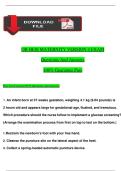
OB HESI MATERNITY VERSION 4 EXAM
Questions And Answers
100% Guarantee Pass
This Test Consists Of 55 Questions And Answers
1. An infant born at 37 weeks gestation, weighing 4.1 kg (9.04 pounds) is
2 hours old and appears large for gestational age, flushed, and tremulous.
Which procedure should the nurse follow to implement a glucose screening?
(Arrange the examination process from first on top to last on the bottom.)
1. Restrain the newborn's foot with your free hand.
2. Cleanse the puncture site on the lateral aspect of the heel.
3. Collect a spring-loaded automatic puncture device.
,4. Wrap the infant's foot with a heel warmer for 5 minutes Ans>1. Wrap the
infant'sfoot with a heel warmer for 5 minutes.
2. Collect a spring-loaded automatic puncture device.
3. Restrain the newborn's foot with your free hand.
4. Cleanse the puncture site on the lateral aspect of the heel.
2. Which cardiovascular findings should the nurse assess further in a client
who is at 20-weeks gestation?
a. Decrease in pulse rate.
b. Decrease in blood pressure.
c. Increase in heart sounds (S1, S2).
d. Increase in red blood cell production Ans>a. Decrease in pulse rate.
3. Which prescription should the nurse administer to a newborn to reduce
complications related to birth trauma?
a. Silver nitrate.
b. Erythromycin.
c. Ceftriaxone.
d. Vitamin KAns>d. Vitamin K.
, 4. The nurse is assessing a full-term newborn's breathing pattern. Which
findings should the nurse assess further? (Select all that apply.) Select all that
apply
a. Shallow with an irregular rhythm.
b. Chest breathing with nasal flaring.
c. Diaphragmatic with chest retraction.
d. Abdominal with synchronous chest movements.
e. Rate of 58 breaths per minute.
f. Grunting is heard with a stethoscope Ans>b. Chest breathing with nasal
flaring.
c. Diaphragmatic with chest retraction.
f. Grunting is heard with a stethoscope.
Questions And Answers
100% Guarantee Pass
This Test Consists Of 55 Questions And Answers
1. An infant born at 37 weeks gestation, weighing 4.1 kg (9.04 pounds) is
2 hours old and appears large for gestational age, flushed, and tremulous.
Which procedure should the nurse follow to implement a glucose screening?
(Arrange the examination process from first on top to last on the bottom.)
1. Restrain the newborn's foot with your free hand.
2. Cleanse the puncture site on the lateral aspect of the heel.
3. Collect a spring-loaded automatic puncture device.
,4. Wrap the infant's foot with a heel warmer for 5 minutes Ans>1. Wrap the
infant'sfoot with a heel warmer for 5 minutes.
2. Collect a spring-loaded automatic puncture device.
3. Restrain the newborn's foot with your free hand.
4. Cleanse the puncture site on the lateral aspect of the heel.
2. Which cardiovascular findings should the nurse assess further in a client
who is at 20-weeks gestation?
a. Decrease in pulse rate.
b. Decrease in blood pressure.
c. Increase in heart sounds (S1, S2).
d. Increase in red blood cell production Ans>a. Decrease in pulse rate.
3. Which prescription should the nurse administer to a newborn to reduce
complications related to birth trauma?
a. Silver nitrate.
b. Erythromycin.
c. Ceftriaxone.
d. Vitamin KAns>d. Vitamin K.
, 4. The nurse is assessing a full-term newborn's breathing pattern. Which
findings should the nurse assess further? (Select all that apply.) Select all that
apply
a. Shallow with an irregular rhythm.
b. Chest breathing with nasal flaring.
c. Diaphragmatic with chest retraction.
d. Abdominal with synchronous chest movements.
e. Rate of 58 breaths per minute.
f. Grunting is heard with a stethoscope Ans>b. Chest breathing with nasal
flaring.
c. Diaphragmatic with chest retraction.
f. Grunting is heard with a stethoscope.