Corporate Level Strategy
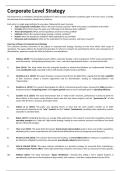
This document is a centralized, structured repository for notes on every compulsory academic paper in the CLS course. Crucially,
the structure of this repository should not be arbitrary.
Each entry is a single page dedicated to one paper, following this exact structure:
Topic & Expected Contribution: What is the main research question? What is the paper's contribution to the field?
Framing: Which theory does the paper use? What gap in the literature does it address?
Theory Development: What are the hypotheses and how are they justified?
Methods: What is the empirical design (sample, method, variables)?
Results: Were the hypotheses validated? What explanations are provided?
Discussion and Conclusions: What are the implications for theory, practice, and future research?
Overview of Papers in Corporate-Level Strategy
This collection provides summaries of key papers in corporate-level strategy, focusing on how firms define their scope of
operations. The papers address the fundamental question of "where to compete" by examining the drivers and consequences of
diversification, expansion modes like M&A and alliances, and divestitures.
0. Feldman (2020): This foundational paper defines corporate strategy as the management of firm scope and provides a
novel framework—distinguishing between intra-, inter-, and extra-organizational actions—to structure the field.
1. Zhou (2011): This study shows that the synergistic benefits of related diversification are fundamentally limited by
rising coordination costs, especially in firms with already complex business portfolios.
2. Giustiziero et al. (2023): This paper develops a resource-based theory for digital firms, arguing that the high scalability
of their resources creates a massive opportunity cost for diversification, leading to "hyperspecialization" and
"hyperscaling."
3. Moatti et al. (2015): This research disentangles the effects of horizontal growth modes, showing that M&A provides a
temporary boost in bargaining power while organic growth leads to more sustainable gains in operating efficiency.
4. Castañer et al. (2014): This study demonstrates that in "make-or-ally" decisions, performance is driven by both the
direct effects of the chosen mode (alliances boost sales but slow down projects) and the "governance fit" of that
choice with the firm's resources and project needs.
5. Aalbers et al. (2021): This paper uses signaling theory to show that the stock market's reaction to an M&A
announcement depends on the "why" (motive) and the "where" (relatedness), penalizing risky, explorative motives,
especially in unrelated deals.
6. Rabier (2017): Challenging the focus on average M&A performance, this research reveals that acquisitions driven by
operating synergies are a high-risk, high-reward strategy, leading to more extreme successes and failures than deals
based on financial synergies.
7. Chen et al. (2016): This study finds that greater female board representation leads to fewer and smaller acquisitions,
attributing this to more comprehensive and critical board deliberations driven by intergroup social dynamics.
8. Pavićević & Keil (2021): This research shows that the tendency of overconfident CEOs to overpay for acquisitions can
be effectively mitigated by enforcing a slow-paced, procedurally rational predeal process.
9. Vidal & Mitchell (2015): This paper reframes divestiture as a proactive strategy for successful firms, introducing a
"complementary Penrose effect" where high-performing companies sell assets to free up resources for future growth.
10. Feldman (2014): This study introduces "legacy divestitures," showing that selling a firm's original business is
operationally costly due to the disruption of deep-seated, tacit routines, a risk often underestimated by new CEOs.
, Overall Summary
The Architecture of the Firm: A Corporate Strategy Synthesis
Corporate-level strategy addresses the fundamental question of a firm's scope: where and in which businesses should it
compete? This is a dynamic challenge of architectural design, requiring leaders to skillfully manage a portfolio through
diversification, expansion, and contraction. The papers in corporate-level strategy reveal that success lies not just in choosing the
right path, but in understanding the deep-seated trade-offs involving resources, costs, and human cognition that govern the
boundaries of the firm.
The Logic of Scope and Its Limits
The very definition of corporate strategy revolves around managing firm scope, which can be understood through a framework
of intra-organizational (internal coordination), inter-organizational (alliances), and extra-organizational (M&A, divestitures)
actions (Feldman, 2020) . While firms often diversify to seek synergies by sharing resources, this path has clear limits. The pursuit
of relatedness itself creates coordination costs that escalate with the complexity of the firm's portfolio, eventually outweighing
the benefits of synergy (Zhou, 2011) . This logic is radically reshaped in the digital era, where the immense scalability of
resources creates a powerful opportunity cost for diversification, pushing firms toward "hyperspecialization" to achieve
"hyperscaling" instead of broadening their scope (Giustiziero et al., 2023) .
The Mechanics of Expansion: M&A and Alliances
When firms choose to expand, the method matters immensely. The choice between M&A and organic growth presents a
fundamental trade-off: M&A offers a rapid, temporary boost in bargaining power, while organic growth builds more sustainable,
long-term operating efficiency (Moatti et al., 2015) . Similarly, the "make-or-ally" decision reveals that while alliances can
enhance market success through resource pooling, they often come at the cost of speed. Ultimately, performance depends not
just on the mode chosen but on the "governance fit"—the alignment of that choice with the firm's resources and the project's
specific needs (Castañer et al., 2014).
Diving deeper into M&A, the communicated rationale for a deal shapes its reception and, potentially, its success. The market,
acting as a risk-averse observer, scrutinizes both the "why" (motive) and the "where" (relatedness) of an acquisition, penalizing
risky explorative motives, particularly in unrelated industries (Aalbers et al., 2021) . This perception of risk is well-founded, as
acquisitions driven by complex operating synergies are a high-risk, high-reward gamble, leading to more extreme successes and
failures than deals based on simpler financial synergies (Rabier, 2017) .
The Human Element: Leadership, Bias, and Divestiture
Corporate-level decisions are ultimately made by people, whose cognitive and social dynamics shape a firm's strategic path. At
the board level, greater female representation can fundamentally alter decision-making processes through intergroup social
dynamics, leading to more rigorous oversight and a more cautious M&A strategy with fewer and smaller deals (Chen et al.,
2016). The biases of the CEO are also a powerful force; the well-documented tendency of overconfident CEOs to overpay for
acquisitions can be effectively reined in by a key governance tool: enforcing a slow-paced, procedurally rational predeal process
(Pavićević & Keil, 2021).
Finally, corporate architecture is shaped as much by subtraction as by addition. Divestiture is not merely a sign of failure but a
proactive tool for successful firms. Through a "complementary Penrose effect," high-performing companies divest assets to free
up scarce managerial and financial resources to fuel future growth (Vidal & Mitchell, 2015) . Yet, this strategy carries its own
risks, especially in the case of "legacy divestitures." Selling a firm's original business often proves operationally costly by
disrupting deep-seated, tacit routines—a danger that new CEOs, who are most likely to undertake such deals, tend to
underestimate (Feldman, 2014) .
In conclusion, shaping the corporate portfolio is a delicate balancing act. Effective corporate strategy requires leaders to weigh
the allure of synergistic growth against the burdens of complexity, to choose expansion modes that fit their specific goals, and to
appreciate that sometimes, the wisest move is not to expand, but to strategically contract.
Table of Contents
1. FELDMAN (2020). CORPORATE STRATEGY: PAST, PRESENT, AND FUTURE...............................................4
This document is a centralized, structured repository for notes on every compulsory academic paper in the CLS course. Crucially,
the structure of this repository should not be arbitrary.
Each entry is a single page dedicated to one paper, following this exact structure:
Topic & Expected Contribution: What is the main research question? What is the paper's contribution to the field?
Framing: Which theory does the paper use? What gap in the literature does it address?
Theory Development: What are the hypotheses and how are they justified?
Methods: What is the empirical design (sample, method, variables)?
Results: Were the hypotheses validated? What explanations are provided?
Discussion and Conclusions: What are the implications for theory, practice, and future research?
Overview of Papers in Corporate-Level Strategy
This collection provides summaries of key papers in corporate-level strategy, focusing on how firms define their scope of
operations. The papers address the fundamental question of "where to compete" by examining the drivers and consequences of
diversification, expansion modes like M&A and alliances, and divestitures.
0. Feldman (2020): This foundational paper defines corporate strategy as the management of firm scope and provides a
novel framework—distinguishing between intra-, inter-, and extra-organizational actions—to structure the field.
1. Zhou (2011): This study shows that the synergistic benefits of related diversification are fundamentally limited by
rising coordination costs, especially in firms with already complex business portfolios.
2. Giustiziero et al. (2023): This paper develops a resource-based theory for digital firms, arguing that the high scalability
of their resources creates a massive opportunity cost for diversification, leading to "hyperspecialization" and
"hyperscaling."
3. Moatti et al. (2015): This research disentangles the effects of horizontal growth modes, showing that M&A provides a
temporary boost in bargaining power while organic growth leads to more sustainable gains in operating efficiency.
4. Castañer et al. (2014): This study demonstrates that in "make-or-ally" decisions, performance is driven by both the
direct effects of the chosen mode (alliances boost sales but slow down projects) and the "governance fit" of that
choice with the firm's resources and project needs.
5. Aalbers et al. (2021): This paper uses signaling theory to show that the stock market's reaction to an M&A
announcement depends on the "why" (motive) and the "where" (relatedness), penalizing risky, explorative motives,
especially in unrelated deals.
6. Rabier (2017): Challenging the focus on average M&A performance, this research reveals that acquisitions driven by
operating synergies are a high-risk, high-reward strategy, leading to more extreme successes and failures than deals
based on financial synergies.
7. Chen et al. (2016): This study finds that greater female board representation leads to fewer and smaller acquisitions,
attributing this to more comprehensive and critical board deliberations driven by intergroup social dynamics.
8. Pavićević & Keil (2021): This research shows that the tendency of overconfident CEOs to overpay for acquisitions can
be effectively mitigated by enforcing a slow-paced, procedurally rational predeal process.
9. Vidal & Mitchell (2015): This paper reframes divestiture as a proactive strategy for successful firms, introducing a
"complementary Penrose effect" where high-performing companies sell assets to free up resources for future growth.
10. Feldman (2014): This study introduces "legacy divestitures," showing that selling a firm's original business is
operationally costly due to the disruption of deep-seated, tacit routines, a risk often underestimated by new CEOs.
, Overall Summary
The Architecture of the Firm: A Corporate Strategy Synthesis
Corporate-level strategy addresses the fundamental question of a firm's scope: where and in which businesses should it
compete? This is a dynamic challenge of architectural design, requiring leaders to skillfully manage a portfolio through
diversification, expansion, and contraction. The papers in corporate-level strategy reveal that success lies not just in choosing the
right path, but in understanding the deep-seated trade-offs involving resources, costs, and human cognition that govern the
boundaries of the firm.
The Logic of Scope and Its Limits
The very definition of corporate strategy revolves around managing firm scope, which can be understood through a framework
of intra-organizational (internal coordination), inter-organizational (alliances), and extra-organizational (M&A, divestitures)
actions (Feldman, 2020) . While firms often diversify to seek synergies by sharing resources, this path has clear limits. The pursuit
of relatedness itself creates coordination costs that escalate with the complexity of the firm's portfolio, eventually outweighing
the benefits of synergy (Zhou, 2011) . This logic is radically reshaped in the digital era, where the immense scalability of
resources creates a powerful opportunity cost for diversification, pushing firms toward "hyperspecialization" to achieve
"hyperscaling" instead of broadening their scope (Giustiziero et al., 2023) .
The Mechanics of Expansion: M&A and Alliances
When firms choose to expand, the method matters immensely. The choice between M&A and organic growth presents a
fundamental trade-off: M&A offers a rapid, temporary boost in bargaining power, while organic growth builds more sustainable,
long-term operating efficiency (Moatti et al., 2015) . Similarly, the "make-or-ally" decision reveals that while alliances can
enhance market success through resource pooling, they often come at the cost of speed. Ultimately, performance depends not
just on the mode chosen but on the "governance fit"—the alignment of that choice with the firm's resources and the project's
specific needs (Castañer et al., 2014).
Diving deeper into M&A, the communicated rationale for a deal shapes its reception and, potentially, its success. The market,
acting as a risk-averse observer, scrutinizes both the "why" (motive) and the "where" (relatedness) of an acquisition, penalizing
risky explorative motives, particularly in unrelated industries (Aalbers et al., 2021) . This perception of risk is well-founded, as
acquisitions driven by complex operating synergies are a high-risk, high-reward gamble, leading to more extreme successes and
failures than deals based on simpler financial synergies (Rabier, 2017) .
The Human Element: Leadership, Bias, and Divestiture
Corporate-level decisions are ultimately made by people, whose cognitive and social dynamics shape a firm's strategic path. At
the board level, greater female representation can fundamentally alter decision-making processes through intergroup social
dynamics, leading to more rigorous oversight and a more cautious M&A strategy with fewer and smaller deals (Chen et al.,
2016). The biases of the CEO are also a powerful force; the well-documented tendency of overconfident CEOs to overpay for
acquisitions can be effectively reined in by a key governance tool: enforcing a slow-paced, procedurally rational predeal process
(Pavićević & Keil, 2021).
Finally, corporate architecture is shaped as much by subtraction as by addition. Divestiture is not merely a sign of failure but a
proactive tool for successful firms. Through a "complementary Penrose effect," high-performing companies divest assets to free
up scarce managerial and financial resources to fuel future growth (Vidal & Mitchell, 2015) . Yet, this strategy carries its own
risks, especially in the case of "legacy divestitures." Selling a firm's original business often proves operationally costly by
disrupting deep-seated, tacit routines—a danger that new CEOs, who are most likely to undertake such deals, tend to
underestimate (Feldman, 2014) .
In conclusion, shaping the corporate portfolio is a delicate balancing act. Effective corporate strategy requires leaders to weigh
the allure of synergistic growth against the burdens of complexity, to choose expansion modes that fit their specific goals, and to
appreciate that sometimes, the wisest move is not to expand, but to strategically contract.
Table of Contents
1. FELDMAN (2020). CORPORATE STRATEGY: PAST, PRESENT, AND FUTURE...............................................4