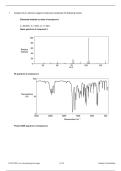
1 Analysis of an unknown organic compound J produces the following results.
Elemental analysis by mass of compound J
C, 80.60%; H, 7.46%; O, 11.94%
Mass spectrum of compound J
IR spectrum of compound J
Proton NMR spectrum of compound J
© OCR 2025. You may photocopy this page. 1 of 78 Created in ExamBuilder
, The numbers by the peaks are the relative peak areas.
Determine the structure of compound J, showing all your reasoning.
© OCR 2025. You may photocopy this page. 2 of 78 Created in ExamBuilder
, [6]
2 Which statement gives a valid scientific reason for global warming?
A Infrared radiation causes bonds in CH4 molecules to vibrate more.
B Infrared radiation causes O2 molecules to vibrate more.
C Ultraviolet radiation causes bonds in CO2 to vibrate more.
D Ultraviolet radiation causes bonds in CFC molecules to break.
Your answer [1]
3 Which compound could have produced the IR spectrum shown below?
A HOCH2CHO
B CH3CH2COOH
C CH3CH2COOCH3
D (CH3)2C(OH)COOH
Your answer [1]
© OCR 2025. You may photocopy this page. 3 of 78 Created in ExamBuilder
, 4 Which statement about infrared radiation (IR) is not correct?
A Absorption of IR by molecules such as CO2, H2O and CH4 has been linked to global warming.
B IR causes CFC molecules to produce chlorine radicals that initiate ozone breakdown in the upper
atmosphere.
C IR causes some covalent bonds to vibrate more and absorb energy.
D IR is used in modern breathalysers to detect ethanol.
Your answer [1]
5 An alcohol CH3CH2CH(CH3)OH produces a mass spectrum.
The mass spectrum contains a large fragment ion at m/z = 45.
What is the possible identity of this fragment ion?
A CH2CHOH+
B CH2CH2OH+
C CH3CHOH+
D CH3CH2CH+
Your answer [1]
6 Compound X is an organic compound with two functional groups.
Compound X has the percentage composition by mass:
C, 40.91%; H, 4.54%; O, 54.55%.
Compound X does not decolourise bromine water.
A scientist analyses compound X using mass spectrometry and infrared spectroscopy.
© OCR 2025. You may photocopy this page. 4 of 78 Created in ExamBuilder
Elemental analysis by mass of compound J
C, 80.60%; H, 7.46%; O, 11.94%
Mass spectrum of compound J
IR spectrum of compound J
Proton NMR spectrum of compound J
© OCR 2025. You may photocopy this page. 1 of 78 Created in ExamBuilder
, The numbers by the peaks are the relative peak areas.
Determine the structure of compound J, showing all your reasoning.
© OCR 2025. You may photocopy this page. 2 of 78 Created in ExamBuilder
, [6]
2 Which statement gives a valid scientific reason for global warming?
A Infrared radiation causes bonds in CH4 molecules to vibrate more.
B Infrared radiation causes O2 molecules to vibrate more.
C Ultraviolet radiation causes bonds in CO2 to vibrate more.
D Ultraviolet radiation causes bonds in CFC molecules to break.
Your answer [1]
3 Which compound could have produced the IR spectrum shown below?
A HOCH2CHO
B CH3CH2COOH
C CH3CH2COOCH3
D (CH3)2C(OH)COOH
Your answer [1]
© OCR 2025. You may photocopy this page. 3 of 78 Created in ExamBuilder
, 4 Which statement about infrared radiation (IR) is not correct?
A Absorption of IR by molecules such as CO2, H2O and CH4 has been linked to global warming.
B IR causes CFC molecules to produce chlorine radicals that initiate ozone breakdown in the upper
atmosphere.
C IR causes some covalent bonds to vibrate more and absorb energy.
D IR is used in modern breathalysers to detect ethanol.
Your answer [1]
5 An alcohol CH3CH2CH(CH3)OH produces a mass spectrum.
The mass spectrum contains a large fragment ion at m/z = 45.
What is the possible identity of this fragment ion?
A CH2CHOH+
B CH2CH2OH+
C CH3CHOH+
D CH3CH2CH+
Your answer [1]
6 Compound X is an organic compound with two functional groups.
Compound X has the percentage composition by mass:
C, 40.91%; H, 4.54%; O, 54.55%.
Compound X does not decolourise bromine water.
A scientist analyses compound X using mass spectrometry and infrared spectroscopy.
© OCR 2025. You may photocopy this page. 4 of 78 Created in ExamBuilder