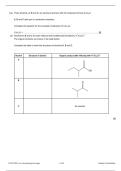
1(a) Three alcohols, A, B and C, are structural isomers with the molecular formula C5H12O.
A, B and C take part in combustion reactions.
Complete the equation for the complete combustion of C5H12O.
C5H12O + ..................................................................................................................................... [2]
(b) Alcohols A, B and C are each refluxed with acidified dichromate(VI), H+/Cr2O72–.
The organic products are shown in the table below.
Complete the table to show the structures of alcohols A, B and C.
Alcohol Structure of alcohol Organic product after refluxing with H+/Cr2O72–
A
B
C No reaction
[3]
© OCR 2025. You may photocopy this page. 1 of 93 Created in ExamBuilder
, 2 This question is about the analysis of organic compounds.
Compounds F, G, H and I are structural isomers.
A student carries out test-tube tests on the compounds.
The student records the observations after carrying out each test.
These are shown in Table 5.1.
In Table 5.1, 2,4-dintrophenylhydrazine has been abbreviated to 2,4–DNP.
Table 5.1
Compound Test
2,4-DNP Acidified Bromine water Tollens' reagent
dichromate(VI)
reflux
F Orange solution Green solution Colourless solution Colourless solution
G Orange solution Green solution Orange solution Colourless solution
H Orange precipitate Orange solution Orange solution Colourless solution
I Orange precipitate Green solution Orange solution Silver mirror
i. Write the formula of the species causing the colours after refluxing with acidified dichromate(VI).
Green solution
Orange solution [2]
ii. The student is provided with further information about compounds F–I.
• They all have the molecular formula C5H10O.
• One of the compounds is alicyclic.
• The other compounds are unbranched.
Use this further information and the student’s observations in Table 5.1 to answer the following.
• How do the observations provide evidence for the possible functional groups in compounds F–I?
• Suggest a possible structure for each of the compounds F–I.
Show your reasoning.
© OCR 2025. You may photocopy this page. 2 of 93 Created in ExamBuilder
, Extra answer space if required.
[6]
© OCR 2025. You may photocopy this page. 3 of 93 Created in ExamBuilder
, 3(a) This question is about reactions of alcohols.
There are 4 structural isomers of C4H10O that are alcohols:
CH3CH2CH2CH2OH
CH3CH2CHOHCH3
(CH3)2CHCH2OH
(CH3)3COH
Alcohols take part in many different types of reaction, including
• elimination
• oxidation
• substitution
• esterification.
For each type of reaction, choose appropriate reagent(s) and/or catalyst, and show the organic product formed.
Elimination reaction of CH3CH2CH2CH2OH
Reagent(s) and/or catalyst
organic product
[2]
© OCR 2025. You may photocopy this page. 4 of 93 Created in ExamBuilder
A, B and C take part in combustion reactions.
Complete the equation for the complete combustion of C5H12O.
C5H12O + ..................................................................................................................................... [2]
(b) Alcohols A, B and C are each refluxed with acidified dichromate(VI), H+/Cr2O72–.
The organic products are shown in the table below.
Complete the table to show the structures of alcohols A, B and C.
Alcohol Structure of alcohol Organic product after refluxing with H+/Cr2O72–
A
B
C No reaction
[3]
© OCR 2025. You may photocopy this page. 1 of 93 Created in ExamBuilder
, 2 This question is about the analysis of organic compounds.
Compounds F, G, H and I are structural isomers.
A student carries out test-tube tests on the compounds.
The student records the observations after carrying out each test.
These are shown in Table 5.1.
In Table 5.1, 2,4-dintrophenylhydrazine has been abbreviated to 2,4–DNP.
Table 5.1
Compound Test
2,4-DNP Acidified Bromine water Tollens' reagent
dichromate(VI)
reflux
F Orange solution Green solution Colourless solution Colourless solution
G Orange solution Green solution Orange solution Colourless solution
H Orange precipitate Orange solution Orange solution Colourless solution
I Orange precipitate Green solution Orange solution Silver mirror
i. Write the formula of the species causing the colours after refluxing with acidified dichromate(VI).
Green solution
Orange solution [2]
ii. The student is provided with further information about compounds F–I.
• They all have the molecular formula C5H10O.
• One of the compounds is alicyclic.
• The other compounds are unbranched.
Use this further information and the student’s observations in Table 5.1 to answer the following.
• How do the observations provide evidence for the possible functional groups in compounds F–I?
• Suggest a possible structure for each of the compounds F–I.
Show your reasoning.
© OCR 2025. You may photocopy this page. 2 of 93 Created in ExamBuilder
, Extra answer space if required.
[6]
© OCR 2025. You may photocopy this page. 3 of 93 Created in ExamBuilder
, 3(a) This question is about reactions of alcohols.
There are 4 structural isomers of C4H10O that are alcohols:
CH3CH2CH2CH2OH
CH3CH2CHOHCH3
(CH3)2CHCH2OH
(CH3)3COH
Alcohols take part in many different types of reaction, including
• elimination
• oxidation
• substitution
• esterification.
For each type of reaction, choose appropriate reagent(s) and/or catalyst, and show the organic product formed.
Elimination reaction of CH3CH2CH2CH2OH
Reagent(s) and/or catalyst
organic product
[2]
© OCR 2025. You may photocopy this page. 4 of 93 Created in ExamBuilder