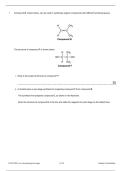
1 Compound B, shown below, can be used to synthesise organic compounds with different functional groups.
The structure of compound F is shown below.
i. What is the empirical formula of compound F?
[2]
ii. A student plans a two-stage synthesis for preparing compound F from compound B.
The synthesis first prepares compound E, as shown in the flowchart.
Draw the structure of compound E in the box and state the reagents for each stage on the dotted lines.
© OCR 2025. You may photocopy this page. 1 of 78 Created in ExamBuilder
, [3]
© OCR 2025. You may photocopy this page. 2 of 78 Created in ExamBuilder
, 2(a) Aqueous lead(II) nitrate, Pb(NO3)2(aq), and aqueous potassium iodide, KI(aq), react together.
The equation is shown below.
Pb(NO3)2(aq) + 2KI(aq) → PbI2(s) + 2KNO3(aq)
A student carries out an experiment to determine the enthalpy change of reaction, ΔrH, of this reaction.
The student follows the method outlined below.
Add 50.0 cm3 of 1.50 mol dm−3 Pb(NO3)2(aq) to a polystyrene cup.
Measure out 50.0 cm3 of a solution of KI(aq), which is in excess.
Measure the temperature of both solutions.
Add the KI(aq) to the polystyrene cup, stir the mixture and record the maximum temperature.
Temperature readings
Initial temperature of both solutions = 19.5 °C
Maximum temperature of mixture = 30.0 °C
Calculate ΔrH, in kJ mol−1, for the reaction shown in the equation above.
Give your answer to an appropriate number of significant figures.
Assume that the density of all solutions and specific heat capacity, c, of the reaction mixture is the same as for
water.
ΔrH = _ _ _ _ _ _ _ _ _ _ _ _ _ _ _ _ _ _ _ _ _ _ _ _ _ _ _ _ kJ mol−1 [4]
(b) Write an ionic equation for the reaction that the student carries out.
Include state symbols.
[1]
© OCR 2025. You may photocopy this page. 3 of 78 Created in ExamBuilder
, (c) The 50.0 cm3 of KI(aq) used inthe experiment contains 10% more KI than is needed to react with 50.0 cm3 of
1.50 mol dm−3 Pb(NO3)2(aq).
Pb(NO3)2(aq) + 2KI(aq) → PbI2(s) + 2KNO3(aq)
Calculate the concentration, in mol dm−3, of KI that the student used.
concentration of KI =_ _ _ _ _ _ _ _ _ _ _ _ _ _ _ _ _ _ _ _ _ _ _ _ _ _ _ _ mol dm−3 [2]
3(a) A student carries out an experiment to determine the amount of water of crystallisation in the formula of another
hydrated salt. The student intends to remove the water by heating the hydrated salt.
A diagram of the apparatus used by the student is shown below.
The student adds the hydrated salt to the crucible and weighs the crucible and contents.
The student heats the crucible and contents and allows them to cool.
The student weighs the crucible and residue.
The student's results are shown below.
Mass of crucible + hydrated salt / g 16.84
Mass of crucible + residue after heating / g 16.26
i. The maximum error in each mass measurement using the balance is ±0.005 g.
Calculate the percentage error in the mass of water removed.
© OCR 2025. You may photocopy this page. 4 of 78 Created in ExamBuilder
The structure of compound F is shown below.
i. What is the empirical formula of compound F?
[2]
ii. A student plans a two-stage synthesis for preparing compound F from compound B.
The synthesis first prepares compound E, as shown in the flowchart.
Draw the structure of compound E in the box and state the reagents for each stage on the dotted lines.
© OCR 2025. You may photocopy this page. 1 of 78 Created in ExamBuilder
, [3]
© OCR 2025. You may photocopy this page. 2 of 78 Created in ExamBuilder
, 2(a) Aqueous lead(II) nitrate, Pb(NO3)2(aq), and aqueous potassium iodide, KI(aq), react together.
The equation is shown below.
Pb(NO3)2(aq) + 2KI(aq) → PbI2(s) + 2KNO3(aq)
A student carries out an experiment to determine the enthalpy change of reaction, ΔrH, of this reaction.
The student follows the method outlined below.
Add 50.0 cm3 of 1.50 mol dm−3 Pb(NO3)2(aq) to a polystyrene cup.
Measure out 50.0 cm3 of a solution of KI(aq), which is in excess.
Measure the temperature of both solutions.
Add the KI(aq) to the polystyrene cup, stir the mixture and record the maximum temperature.
Temperature readings
Initial temperature of both solutions = 19.5 °C
Maximum temperature of mixture = 30.0 °C
Calculate ΔrH, in kJ mol−1, for the reaction shown in the equation above.
Give your answer to an appropriate number of significant figures.
Assume that the density of all solutions and specific heat capacity, c, of the reaction mixture is the same as for
water.
ΔrH = _ _ _ _ _ _ _ _ _ _ _ _ _ _ _ _ _ _ _ _ _ _ _ _ _ _ _ _ kJ mol−1 [4]
(b) Write an ionic equation for the reaction that the student carries out.
Include state symbols.
[1]
© OCR 2025. You may photocopy this page. 3 of 78 Created in ExamBuilder
, (c) The 50.0 cm3 of KI(aq) used inthe experiment contains 10% more KI than is needed to react with 50.0 cm3 of
1.50 mol dm−3 Pb(NO3)2(aq).
Pb(NO3)2(aq) + 2KI(aq) → PbI2(s) + 2KNO3(aq)
Calculate the concentration, in mol dm−3, of KI that the student used.
concentration of KI =_ _ _ _ _ _ _ _ _ _ _ _ _ _ _ _ _ _ _ _ _ _ _ _ _ _ _ _ mol dm−3 [2]
3(a) A student carries out an experiment to determine the amount of water of crystallisation in the formula of another
hydrated salt. The student intends to remove the water by heating the hydrated salt.
A diagram of the apparatus used by the student is shown below.
The student adds the hydrated salt to the crucible and weighs the crucible and contents.
The student heats the crucible and contents and allows them to cool.
The student weighs the crucible and residue.
The student's results are shown below.
Mass of crucible + hydrated salt / g 16.84
Mass of crucible + residue after heating / g 16.26
i. The maximum error in each mass measurement using the balance is ±0.005 g.
Calculate the percentage error in the mass of water removed.
© OCR 2025. You may photocopy this page. 4 of 78 Created in ExamBuilder