LEO Exam UPDATED ACTUAL Questions and CORRECT Answers
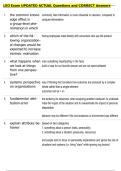
1. the common knowl- commonly held information is more influential on deicison, compared to
edge effect is unique information
a group-level phe-
nomenon in which
2. which of the fol- having employees meet directly with consumers who use the product
lowing organization-
al changes would be
expected to increase
intrinsic motivation
3. what happens when miss something important/big in the facts
we look at things build a case for our favorite answer and are not open/unbiased
from one perspec-
tive?
4. systems perspective way of thinking that considers how outcomes are produced by a complex
on organizations whole rather than a single element
outcomes can be + or -
5. fundamental attri- the tendency for observers, when analyzing another's behavior, to underesti-
bution error mate the impact of the situation and to overestimate the impact of personal
disposition
behavior may be different if the circumstances or environment was different
6. explain attribute be- based on two categories
havior 1. something about a person (traits, personality)
2. something about a situation (pressures, resources)
and people tend to focus on personality explanations and ignore the role of
situations and systems (i.e. hiring "stars" while ignoring org factors)
, goal: focus on finding the right people and putting together the right system
7. fixed pay vs. contin- depends on fundamental trade-off:
gent reward...how motivation - how much do extrinsic incentives increase effort?
much of a comp risk - what are the risk preference and how much uncertainty is there in system?
package should be
contingent on per-
formance
8. factors that influ- observability - can org observe employee effort directly
ence efficacy of con-
tingent reward measurability - can org measure desired performance?
controllability - do employees believe they can increase output being mea-
sured through their effort (CAN BE REDUCED BY: dependence on others,
favoritism in evals)
reliability -do employees believe there is clear, consistent policy for translating
measures into rewards ( reduced by: discretionary rewards, changing formu-
las)
9. how does from individual perspective: strong link between effort performance and com-
pay-for-perfor- pensation
mance work well 1. relative independence
from individual's 2. stability of rates
perspective (LE 3. transparent and egalitarian culture
example)
10. what are the three 1. inflated perspectives of contribution
biggest problems 2. process perceived as unfair
with contingent re- 3. incentivizes wrong behavior
ward?
, 11. what makes a participation of those affected
process fair in terms impartiality of decision maker
of contingent re- transparency of decision process
ward
fair procedures make unfavorable distributions more acceptable because
there is a distinguished process and set of rules followed...reduces subjectivity
12. alternatives to con- if you provide someone with a target value to achieve, they can develop a sense
tingent reward? of personal satisfaction
goals...
loss aversion - you can motivate to eliminate a loss
distance effect - problems occur when you put too much or too little effort into
your work
13. alternatives to con- respect/status
tingent reward? so- group acceptance
cial motivations competition with other companies
14. alternatives to con- internal drive to perform well
tingent reward? in- inherent motivation to do task itself
trinsic motivations drive to have mastery or learning or control
15. how do organiza- skill variety
tions increase in- task identity
trinsic motivation? task significance
explain task de-
sign characteristics autonomy
(3 major aspects)
feedback from job
16. why does intrinsic "fills the gaps" when you cant measure or monitor
motivation matter? creates enthusiasm and excitement for work
(3 major reasons) predicts "extra-role" behavior .. doing work outside of scope
1. the common knowl- commonly held information is more influential on deicison, compared to
edge effect is unique information
a group-level phe-
nomenon in which
2. which of the fol- having employees meet directly with consumers who use the product
lowing organization-
al changes would be
expected to increase
intrinsic motivation
3. what happens when miss something important/big in the facts
we look at things build a case for our favorite answer and are not open/unbiased
from one perspec-
tive?
4. systems perspective way of thinking that considers how outcomes are produced by a complex
on organizations whole rather than a single element
outcomes can be + or -
5. fundamental attri- the tendency for observers, when analyzing another's behavior, to underesti-
bution error mate the impact of the situation and to overestimate the impact of personal
disposition
behavior may be different if the circumstances or environment was different
6. explain attribute be- based on two categories
havior 1. something about a person (traits, personality)
2. something about a situation (pressures, resources)
and people tend to focus on personality explanations and ignore the role of
situations and systems (i.e. hiring "stars" while ignoring org factors)
, goal: focus on finding the right people and putting together the right system
7. fixed pay vs. contin- depends on fundamental trade-off:
gent reward...how motivation - how much do extrinsic incentives increase effort?
much of a comp risk - what are the risk preference and how much uncertainty is there in system?
package should be
contingent on per-
formance
8. factors that influ- observability - can org observe employee effort directly
ence efficacy of con-
tingent reward measurability - can org measure desired performance?
controllability - do employees believe they can increase output being mea-
sured through their effort (CAN BE REDUCED BY: dependence on others,
favoritism in evals)
reliability -do employees believe there is clear, consistent policy for translating
measures into rewards ( reduced by: discretionary rewards, changing formu-
las)
9. how does from individual perspective: strong link between effort performance and com-
pay-for-perfor- pensation
mance work well 1. relative independence
from individual's 2. stability of rates
perspective (LE 3. transparent and egalitarian culture
example)
10. what are the three 1. inflated perspectives of contribution
biggest problems 2. process perceived as unfair
with contingent re- 3. incentivizes wrong behavior
ward?
, 11. what makes a participation of those affected
process fair in terms impartiality of decision maker
of contingent re- transparency of decision process
ward
fair procedures make unfavorable distributions more acceptable because
there is a distinguished process and set of rules followed...reduces subjectivity
12. alternatives to con- if you provide someone with a target value to achieve, they can develop a sense
tingent reward? of personal satisfaction
goals...
loss aversion - you can motivate to eliminate a loss
distance effect - problems occur when you put too much or too little effort into
your work
13. alternatives to con- respect/status
tingent reward? so- group acceptance
cial motivations competition with other companies
14. alternatives to con- internal drive to perform well
tingent reward? in- inherent motivation to do task itself
trinsic motivations drive to have mastery or learning or control
15. how do organiza- skill variety
tions increase in- task identity
trinsic motivation? task significance
explain task de-
sign characteristics autonomy
(3 major aspects)
feedback from job
16. why does intrinsic "fills the gaps" when you cant measure or monitor
motivation matter? creates enthusiasm and excitement for work
(3 major reasons) predicts "extra-role" behavior .. doing work outside of scope