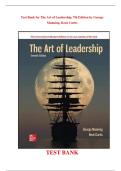
Test Bank for The Art of Leadership, 7th Edition by George
Manning, Kent Curtis
TEST BANK
,Introduction:
This document contains a complete test bank for The Art of Leadership (7th Edition) by
George Manning and Kent Curtis. It includes summary Q&A sections, true/false questions,
and multiple-choice questions with correct answers provided. The material spans multiple
chapters, covering leadership theories, emotional intelligence, transformational vs.
transactional leadership, conflict resolution, ethics, motivation, and strategic visioning. This
is a comprehensive study resource for students preparing for exams based on the book.
Summary Q & As
1: What is the primary focus of The Art of Leadership by George Manning and Kent Curtis?-
-- correct answer ---
The primary focus of The Art of Leadership is to provide readers with practical insights and
tools to develop effective leadership skills, emphasizing the balance between people-oriented
and task-oriented leadership.
2: According to Manning and Curtis, what are the key characteristics of an effective leader?--
- correct answer ---
Key characteristics of an effective leader include integrity, empathy, resilience,
communication skills, and the ability to inspire and motivate others.
3: How do Manning and Curtis define leadership in their book?--- correct answer ---
Manning and Curtis define leadership as the process of influencing others to achieve goals by
providing purpose, direction, and motivation.
4: What role does emotional intelligence play in leadership according to the book?--- correct
answer ---
Emotional intelligence is crucial in leadership as it helps leaders understand and manage their
own emotions, as well as empathize with and influence the emotions of others to foster a
positive work environment.
5: Describe the difference between transformational and transactional leadership as outlined
,in the book.--- correct answer ---
Transformational leadership focuses on inspiring and motivating followers to achieve their
full potential and exceed expectations, while transactional leadership is based on a system of
rewards and punishments to manage performance.
6: What is the significance of vision in leadership according to Manning and Curtis?---
correct answer ---
Vision is significant in leadership as it provides a clear and compelling picture of the future
that inspires and guides the actions of the leader and their followers.
7: How do the authors suggest leaders should handle conflict within a team?--- correct
answer --- Leaders should handle conflict by addressing it directly and constructively,
facilitating open communication, and seeking collaborative solutions that address the
underlying issues.
8: What strategies do Manning and Curtis recommend for effective decision-making in
leadership?--- correct answer ---
Effective decision-making strategies include gathering relevant information, considering
multiple perspectives, weighing the pros and cons, and making timely decisions while being
open to feedback and adjustments.
9: According to the book, how can leaders foster a culture of innovation within their teams?--
- correct answer ---
Leaders can foster a culture of innovation by encouraging creativity, providing resources and
support for new ideas, recognizing and rewarding innovative efforts, and creating an
environment where risk-taking is accepted.
10: What is the importance of communication in leadership as discussed in the book?---
correct answer ---
Communication is vital in leadership as it facilitates clarity, builds trust, aligns team efforts,
and ensures that everyone is informed and engaged in achieving organizational goals.
11: How do Manning and Curtis address the concept of ethical leadership?--- correct answer
--- Ethical leadership is addressed as the practice of leading with integrity, fairness, and
, respect for others, ensuring that decisions and actions align with moral and ethical standards.
12: What techniques do the authors suggest for developing leadership skills over time?---
correct answer ---
Techniques for developing leadership skills include seeking feedback, engaging in
continuous learning, practicing self-reflection, and gaining diverse experiences through
different roles and challenges.
13: How can leaders effectively manage change within an organization according to the
book?--- correct answer ---
Leaders can effectively manage change by communicating the vision and benefits of the
change, involving stakeholders in the process, addressing concerns, and providing support
and resources to facilitate the transition.
14: What role does team building play in leadership as per Manning and Curtis?--- correct
answer ---
Team building plays a critical role in leadership by enhancing collaboration, trust, and
cohesion among team members, leading to improved performance and goal achievement.
15: How do the authors suggest leaders should approach goal setting?--- correct answer ---
Leaders should approach goal setting by ensuring goals are specific, measurable, achievable,
relevant, and time-bound (SMART), and by involving team members in the goal-setting
process to enhance commitment and accountability.
16: Describe the concept of servant leadership as discussed in the book.--- correct answer ---
Servant leadership is a leadership philosophy that prioritizes serving others, focusing on the
growth and well-being of people and communities, and leading by example through humility
and empathy.
17: What is the impact of a leaders attitude on their team according to Manning and Curtis?---
correct answer ---
A leaders attitude significantly impacts their team by influencing morale, motivation, and the
overall work environment; a positive attitude can inspire and energize the team, while a
negative attitude can lead to disengagement and conflict.
Manning, Kent Curtis
TEST BANK
,Introduction:
This document contains a complete test bank for The Art of Leadership (7th Edition) by
George Manning and Kent Curtis. It includes summary Q&A sections, true/false questions,
and multiple-choice questions with correct answers provided. The material spans multiple
chapters, covering leadership theories, emotional intelligence, transformational vs.
transactional leadership, conflict resolution, ethics, motivation, and strategic visioning. This
is a comprehensive study resource for students preparing for exams based on the book.
Summary Q & As
1: What is the primary focus of The Art of Leadership by George Manning and Kent Curtis?-
-- correct answer ---
The primary focus of The Art of Leadership is to provide readers with practical insights and
tools to develop effective leadership skills, emphasizing the balance between people-oriented
and task-oriented leadership.
2: According to Manning and Curtis, what are the key characteristics of an effective leader?--
- correct answer ---
Key characteristics of an effective leader include integrity, empathy, resilience,
communication skills, and the ability to inspire and motivate others.
3: How do Manning and Curtis define leadership in their book?--- correct answer ---
Manning and Curtis define leadership as the process of influencing others to achieve goals by
providing purpose, direction, and motivation.
4: What role does emotional intelligence play in leadership according to the book?--- correct
answer ---
Emotional intelligence is crucial in leadership as it helps leaders understand and manage their
own emotions, as well as empathize with and influence the emotions of others to foster a
positive work environment.
5: Describe the difference between transformational and transactional leadership as outlined
,in the book.--- correct answer ---
Transformational leadership focuses on inspiring and motivating followers to achieve their
full potential and exceed expectations, while transactional leadership is based on a system of
rewards and punishments to manage performance.
6: What is the significance of vision in leadership according to Manning and Curtis?---
correct answer ---
Vision is significant in leadership as it provides a clear and compelling picture of the future
that inspires and guides the actions of the leader and their followers.
7: How do the authors suggest leaders should handle conflict within a team?--- correct
answer --- Leaders should handle conflict by addressing it directly and constructively,
facilitating open communication, and seeking collaborative solutions that address the
underlying issues.
8: What strategies do Manning and Curtis recommend for effective decision-making in
leadership?--- correct answer ---
Effective decision-making strategies include gathering relevant information, considering
multiple perspectives, weighing the pros and cons, and making timely decisions while being
open to feedback and adjustments.
9: According to the book, how can leaders foster a culture of innovation within their teams?--
- correct answer ---
Leaders can foster a culture of innovation by encouraging creativity, providing resources and
support for new ideas, recognizing and rewarding innovative efforts, and creating an
environment where risk-taking is accepted.
10: What is the importance of communication in leadership as discussed in the book?---
correct answer ---
Communication is vital in leadership as it facilitates clarity, builds trust, aligns team efforts,
and ensures that everyone is informed and engaged in achieving organizational goals.
11: How do Manning and Curtis address the concept of ethical leadership?--- correct answer
--- Ethical leadership is addressed as the practice of leading with integrity, fairness, and
, respect for others, ensuring that decisions and actions align with moral and ethical standards.
12: What techniques do the authors suggest for developing leadership skills over time?---
correct answer ---
Techniques for developing leadership skills include seeking feedback, engaging in
continuous learning, practicing self-reflection, and gaining diverse experiences through
different roles and challenges.
13: How can leaders effectively manage change within an organization according to the
book?--- correct answer ---
Leaders can effectively manage change by communicating the vision and benefits of the
change, involving stakeholders in the process, addressing concerns, and providing support
and resources to facilitate the transition.
14: What role does team building play in leadership as per Manning and Curtis?--- correct
answer ---
Team building plays a critical role in leadership by enhancing collaboration, trust, and
cohesion among team members, leading to improved performance and goal achievement.
15: How do the authors suggest leaders should approach goal setting?--- correct answer ---
Leaders should approach goal setting by ensuring goals are specific, measurable, achievable,
relevant, and time-bound (SMART), and by involving team members in the goal-setting
process to enhance commitment and accountability.
16: Describe the concept of servant leadership as discussed in the book.--- correct answer ---
Servant leadership is a leadership philosophy that prioritizes serving others, focusing on the
growth and well-being of people and communities, and leading by example through humility
and empathy.
17: What is the impact of a leaders attitude on their team according to Manning and Curtis?---
correct answer ---
A leaders attitude significantly impacts their team by influencing morale, motivation, and the
overall work environment; a positive attitude can inspire and energize the team, while a
negative attitude can lead to disengagement and conflict.