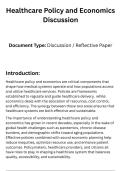
Healthcare Policy and Economics
Discussion
Document Type: Discussion / Reflective Paper
Introduction:
Healthcare policy and economics are critical components that
shape how medical systems operate and how populations access
and utilize healthcare services. Policies are frameworks
established to regulate and guide healthcare delivery, while
economics deals with the allocation of resources, cost control,
and efficiency. The synergy between these two areas ensures that
healthcare systems are both effective and sustainable.
The importance of understanding healthcare policy and
economics has grown in recent decades, especially in the wake of
global health challenges such as pandemics, chronic disease
burdens, and demographic shifts toward aging populations.
Effective policies combined with sound economic planning help
reduce inequities, optimize resource use, and enhance patient
outcomes. Policymakers, healthcare providers, and citizens all
have roles to play in shaping a healthcare system that balances
quality, accessibility, and sustainability.
, This discussion delves into the key components of healthcare
policy, examines economic principles as they relate to healthcare
delivery, and provides an analytical perspective on their interplay.
Additionally, it explores the challenges, innovations, and future
directions necessary to build resilient healthcare systems.
Healthcare Policy: Foundations and
Frameworks.
Healthcare policy refers to formal rules, regulations, and
guidelines created to influence healthcare practices and
outcomes. Policies exist at multiple levels, from local hospital
regulations to national government legislation, and their aim is to
ensure equitable access, patient safety, and cost-effective care.
1 . Access to Care
One of the primary goals of healthcare policy is to guarantee that
all individuals can obtain necessary medical services. Policies
addressing access often focus on:
Expanding health insurance coverage to underserved
populations
Establishing community clinics in rural and low-income areas
Reducing barriers to preventive care and early diagnosis
Access-related policies are vital because a lack of timely care can
exacerbate health disparities and increase long-term costs. For
example, programs like Medicaid in the United States provide
coverage to low-income individuals, ensuring essential care is
available even to vulnerable populations.
2. Quality Standards and Regulations
Discussion
Document Type: Discussion / Reflective Paper
Introduction:
Healthcare policy and economics are critical components that
shape how medical systems operate and how populations access
and utilize healthcare services. Policies are frameworks
established to regulate and guide healthcare delivery, while
economics deals with the allocation of resources, cost control,
and efficiency. The synergy between these two areas ensures that
healthcare systems are both effective and sustainable.
The importance of understanding healthcare policy and
economics has grown in recent decades, especially in the wake of
global health challenges such as pandemics, chronic disease
burdens, and demographic shifts toward aging populations.
Effective policies combined with sound economic planning help
reduce inequities, optimize resource use, and enhance patient
outcomes. Policymakers, healthcare providers, and citizens all
have roles to play in shaping a healthcare system that balances
quality, accessibility, and sustainability.
, This discussion delves into the key components of healthcare
policy, examines economic principles as they relate to healthcare
delivery, and provides an analytical perspective on their interplay.
Additionally, it explores the challenges, innovations, and future
directions necessary to build resilient healthcare systems.
Healthcare Policy: Foundations and
Frameworks.
Healthcare policy refers to formal rules, regulations, and
guidelines created to influence healthcare practices and
outcomes. Policies exist at multiple levels, from local hospital
regulations to national government legislation, and their aim is to
ensure equitable access, patient safety, and cost-effective care.
1 . Access to Care
One of the primary goals of healthcare policy is to guarantee that
all individuals can obtain necessary medical services. Policies
addressing access often focus on:
Expanding health insurance coverage to underserved
populations
Establishing community clinics in rural and low-income areas
Reducing barriers to preventive care and early diagnosis
Access-related policies are vital because a lack of timely care can
exacerbate health disparities and increase long-term costs. For
example, programs like Medicaid in the United States provide
coverage to low-income individuals, ensuring essential care is
available even to vulnerable populations.
2. Quality Standards and Regulations