
CPR Test-American
CPR Test-AmericanRed Cross Questions and Answers with Life Saving Skills
Red Cross-2025
Study online at https://quizlet.com/_hwxw5x
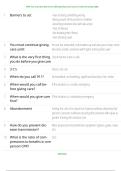
1. Barriers to act -Fear of doing something wrong
-Being unsure of the person's condition
-Assuming someone else will take action
-Fear of disease
-Not knowing their illness
-Fear of being sued
2. You must continue giving You are too exhausted, victim wakes up and asks you to stop, scene
care until: becomes unsafe, someone with higher training takes over
3. What is the very first thing Check that the scene is safe
you do before you give care
4. 3 C's Check, call, care
5. When do you call 911? No heartbeat, no breathing, significant blood loss, fire, stroke
6. When would you call be- If the situation is a cardiac emergency
fore giving care?
7. When would you give care If the situation is a respiratory emergency
first?
8. Abandonment Ending the care of an injured or ill person without obtaining that
person's consent or without ensuring that someone with equal or
greater training will continue care
9. How do you prevent dis- Wear proper personal protective equipment (gloves, gown, mask,
ease transmission? etc)
10. What is the ratio of com- 30:2
pressions to breaths in one
person CPR?
2025/2026
1/6
, CPR Test-American
CPR Test-AmericanRed Cross Questions and Answers with Life Saving Skills
Red Cross-2025
Study online at https://quizlet.com/_hwxw5x
11. What is the ratio of com- 30:2
pressions to breaths in two
person CPR on ADULTS?
12. What is the ratio of com- 15:2
pressions to breaths in
two person CPR on CHIL-
DREN/INFANTS?
13. What are the types of con- Expressed, implied
sent?
14. Expressed consent Verbal, gestures, parent giving consent for child
15. Implied consent A person unable to give consent because they are unconscious/ill,
consent is implied. If no parent is around for child, consent is
implied.
16. Life-threatening conditions Unconscious, not breathing, no pulse, severe bleeding
17. Agonal breathing When someone is not breathing regularly; shallow and irregular
18. How do you treat victims Treat as if there is no breathing at all
with agonal breathing?
19. How do you do a primary Look, listen, feel and give two rescue breaths FIRST before checking
assessment on children/in- for blood
fants?
20. Respiratory distress Troubled breathing
21. Respiratory arrest No breathing
22. Tap shoulder and shout
2025/2026
2/6
CPR Test-AmericanRed Cross Questions and Answers with Life Saving Skills
Red Cross-2025
Study online at https://quizlet.com/_hwxw5x
1. Barriers to act -Fear of doing something wrong
-Being unsure of the person's condition
-Assuming someone else will take action
-Fear of disease
-Not knowing their illness
-Fear of being sued
2. You must continue giving You are too exhausted, victim wakes up and asks you to stop, scene
care until: becomes unsafe, someone with higher training takes over
3. What is the very first thing Check that the scene is safe
you do before you give care
4. 3 C's Check, call, care
5. When do you call 911? No heartbeat, no breathing, significant blood loss, fire, stroke
6. When would you call be- If the situation is a cardiac emergency
fore giving care?
7. When would you give care If the situation is a respiratory emergency
first?
8. Abandonment Ending the care of an injured or ill person without obtaining that
person's consent or without ensuring that someone with equal or
greater training will continue care
9. How do you prevent dis- Wear proper personal protective equipment (gloves, gown, mask,
ease transmission? etc)
10. What is the ratio of com- 30:2
pressions to breaths in one
person CPR?
2025/2026
1/6
, CPR Test-American
CPR Test-AmericanRed Cross Questions and Answers with Life Saving Skills
Red Cross-2025
Study online at https://quizlet.com/_hwxw5x
11. What is the ratio of com- 30:2
pressions to breaths in two
person CPR on ADULTS?
12. What is the ratio of com- 15:2
pressions to breaths in
two person CPR on CHIL-
DREN/INFANTS?
13. What are the types of con- Expressed, implied
sent?
14. Expressed consent Verbal, gestures, parent giving consent for child
15. Implied consent A person unable to give consent because they are unconscious/ill,
consent is implied. If no parent is around for child, consent is
implied.
16. Life-threatening conditions Unconscious, not breathing, no pulse, severe bleeding
17. Agonal breathing When someone is not breathing regularly; shallow and irregular
18. How do you treat victims Treat as if there is no breathing at all
with agonal breathing?
19. How do you do a primary Look, listen, feel and give two rescue breaths FIRST before checking
assessment on children/in- for blood
fants?
20. Respiratory distress Troubled breathing
21. Respiratory arrest No breathing
22. Tap shoulder and shout
2025/2026
2/6


