AICPA FINAL UPDATED ACTUAL Questions and CORRECT Answers
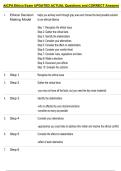
1. What are the 10 steps Step One: Recognize the Ethical Issue
in the ethical decision Step Two: Gather the Critical Facts
making model? Step Three: Identify the Stakeholders
Step Four: Consider Alternatives
Step Five: Consider the Effect on Stakeholders
Step Six: Consider Your Comfort Level
Step Seven: Consider Rules, Regulations, and Laws
Step Eight: Make a Decision
Step Nine: Document your Efforts
Step Ten: Evaluate the Outcome
2. What does recognizing
a potential ethical is-
sue look like?
3. What does consider- Ask yourself "If I had to discuss your decision in public, would you be
ing your comfort level concerned about it reflects on your ethics?"
look like?
4. What is the difference The AICPA is the national professional organization for CPAs. AICPA provides
between the AICPA, resources and information to members and coordinate activities with state
SEC, PCAOB, and your CPA societies. SEC empowered by congress to regulate financial reporting
state board of public of PUBLICLY-held companies. SEC establishes and enforces rules on ac-
accountancy? counting and auditing (including auditor independence). PCAOB (created
by SOX and overseen by SEC) establish rules with respect to auditing and
other attestation engagements, quality control of audits, and indepen-
dence of public auditors. State Board issues CPA license and are frontline
for oversight on ethical behavior. Can create state ethics codes (can create
separate ones, or incorporate AICPA rules). Must follow state board rules
for state they are licensed in.
5.
, What is the new struc- Preface - overview, principles, and definitions)
ture of the AICPA Part 1 - rules related to those in public practice, conceptual framework on
Ethics codification? independence and other rules on ethical conflicts
Part 2 - Rules and interpretations applicable to members in business
(private practice)
Part 3 - Rules and interpretations applicable to all other members (retired,
between jobs, etc.)
6. What are the 4 sec- Pretty sure it's just this again (looked it up and this is what I got everywhere
tions of the AICPA I looked)
Ethics codification?
1. Preface - overview, principles, and definitions
2. Part 1 - Rules related to those in public practice, conceptual framework
on independence and other rules, guidance on ethical conflict resolution
3. Part 2 - Rules and interpretations applicable to members in business
(private practice)
4. Part 3 - Rules and interpretations applicable to all other members
(retired, between jobs, etc.)
7. What are the 6 pil- (1) responsibilities - In carrying out your professional responsibilities, you
lars/principles of the should exercise sensitive professional and moral judgment
code and what do each (2) serve the public interest - You should act in a way that will serve the
mean? public interest, honor the public trust, and demonstrate your commitment
to professionalism
(3) integrity - To maintain and broaden public confidence, you should
perform all professional responsibilities with the highest sense of integrity
(being honest even when no one is looking or "above reproach").
(4) objectivity and independence - You should maintain objectivity and be
free from conflicts of interest in discharging your professional duties.
(5) due care and - You should observe the profession's technical and
, ethical standards, strive continually to improve competence and the quality
of services, and discharge professional responsibility to the best of your
ability.
(6) scope and nature of services - As a member in public practice, you
should observe the principles of the AICPA Code in determining the scope
and nature of services to be performed
8. What is the Profession- As a professional CPA, I willingly accept my responsibility (1) to serve the
al Creed? public interest, (2) to maintain and broaden public confidence by perform-
ing all my responsibilities with integrity, (3) to maintain my objectivity and
be free of conflicts of interest, and to discharge all of my responsibilities
with due care.
9. What are the AICPA Gifts cannot impair your ability to be objective. The following three factors
rules on receiving gifts should be considered:
from a client? What 1. Self-interest - threat that you could benefit financially
factors should be con- 2. Familiarity - due to long or close relationship
sidered? 3. Undue Influence - threat that you will subordinate your judgment to an
individual associated with the client due to that individual's reputation or
expertise, aggressive personality, or excessive influence
10. What is the definition Each CPA should evaluate whether his/her education, experience, and
of professional com- judgment are adequate for the responsibilities assumed
petence according to
AICPA?
11. What's an example of Having the education, experience, and judgement for a certain position in
having competence as the company (ex: CFO)
a CPA?
12. What does it mean to You do not have to be perfect or infallible. Conducting Due Care means you
conduct your respon- adequately plan and supervise professional activities
sibilities with due care?
1. What are the 10 steps Step One: Recognize the Ethical Issue
in the ethical decision Step Two: Gather the Critical Facts
making model? Step Three: Identify the Stakeholders
Step Four: Consider Alternatives
Step Five: Consider the Effect on Stakeholders
Step Six: Consider Your Comfort Level
Step Seven: Consider Rules, Regulations, and Laws
Step Eight: Make a Decision
Step Nine: Document your Efforts
Step Ten: Evaluate the Outcome
2. What does recognizing
a potential ethical is-
sue look like?
3. What does consider- Ask yourself "If I had to discuss your decision in public, would you be
ing your comfort level concerned about it reflects on your ethics?"
look like?
4. What is the difference The AICPA is the national professional organization for CPAs. AICPA provides
between the AICPA, resources and information to members and coordinate activities with state
SEC, PCAOB, and your CPA societies. SEC empowered by congress to regulate financial reporting
state board of public of PUBLICLY-held companies. SEC establishes and enforces rules on ac-
accountancy? counting and auditing (including auditor independence). PCAOB (created
by SOX and overseen by SEC) establish rules with respect to auditing and
other attestation engagements, quality control of audits, and indepen-
dence of public auditors. State Board issues CPA license and are frontline
for oversight on ethical behavior. Can create state ethics codes (can create
separate ones, or incorporate AICPA rules). Must follow state board rules
for state they are licensed in.
5.
, What is the new struc- Preface - overview, principles, and definitions)
ture of the AICPA Part 1 - rules related to those in public practice, conceptual framework on
Ethics codification? independence and other rules on ethical conflicts
Part 2 - Rules and interpretations applicable to members in business
(private practice)
Part 3 - Rules and interpretations applicable to all other members (retired,
between jobs, etc.)
6. What are the 4 sec- Pretty sure it's just this again (looked it up and this is what I got everywhere
tions of the AICPA I looked)
Ethics codification?
1. Preface - overview, principles, and definitions
2. Part 1 - Rules related to those in public practice, conceptual framework
on independence and other rules, guidance on ethical conflict resolution
3. Part 2 - Rules and interpretations applicable to members in business
(private practice)
4. Part 3 - Rules and interpretations applicable to all other members
(retired, between jobs, etc.)
7. What are the 6 pil- (1) responsibilities - In carrying out your professional responsibilities, you
lars/principles of the should exercise sensitive professional and moral judgment
code and what do each (2) serve the public interest - You should act in a way that will serve the
mean? public interest, honor the public trust, and demonstrate your commitment
to professionalism
(3) integrity - To maintain and broaden public confidence, you should
perform all professional responsibilities with the highest sense of integrity
(being honest even when no one is looking or "above reproach").
(4) objectivity and independence - You should maintain objectivity and be
free from conflicts of interest in discharging your professional duties.
(5) due care and - You should observe the profession's technical and
, ethical standards, strive continually to improve competence and the quality
of services, and discharge professional responsibility to the best of your
ability.
(6) scope and nature of services - As a member in public practice, you
should observe the principles of the AICPA Code in determining the scope
and nature of services to be performed
8. What is the Profession- As a professional CPA, I willingly accept my responsibility (1) to serve the
al Creed? public interest, (2) to maintain and broaden public confidence by perform-
ing all my responsibilities with integrity, (3) to maintain my objectivity and
be free of conflicts of interest, and to discharge all of my responsibilities
with due care.
9. What are the AICPA Gifts cannot impair your ability to be objective. The following three factors
rules on receiving gifts should be considered:
from a client? What 1. Self-interest - threat that you could benefit financially
factors should be con- 2. Familiarity - due to long or close relationship
sidered? 3. Undue Influence - threat that you will subordinate your judgment to an
individual associated with the client due to that individual's reputation or
expertise, aggressive personality, or excessive influence
10. What is the definition Each CPA should evaluate whether his/her education, experience, and
of professional com- judgment are adequate for the responsibilities assumed
petence according to
AICPA?
11. What's an example of Having the education, experience, and judgement for a certain position in
having competence as the company (ex: CFO)
a CPA?
12. What does it mean to You do not have to be perfect or infallible. Conducting Due Care means you
conduct your respon- adequately plan and supervise professional activities
sibilities with due care?