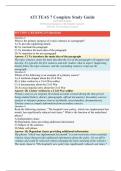
ATI TEAS 7 Complete Study Guide
2025/2026 Edition
60 Practice Questions with Detailed Answers
All Four Test Sections Covered
SECTION 1: READING (15 Questions)
Question 1:
What is the primary purpose of a topic sentence in a paragraph?
A) To provide supporting details
B) To conclude the paragraph
C) To introduce the main idea of the paragraph
D) To transition to the next paragraph
Answer: C) To introduce the main idea of the paragraph
The topic sentence states the main idea that the rest of the paragraph will support and
develop. It's typically the first sentence and tells readers what to expect. Supporting
details follow the topic sentence, and the concluding sentence wraps up the
paragraph.
Question 2:
Which of the following is an example of a primary source?
A) A textbook chapter about the Civil War
B) A letter written by a Civil War soldier
C) A documentary about the Civil War
D) An encyclopedia entry about the Civil War
Answer: B) A letter written by a Civil War soldier
Primary sources are original, first-hand accounts created during the time period
being studied (letters, diaries, photographs, official documents). Secondary sources
analyze or interpret primary sources (textbooks, encyclopedias, documentaries).
Tertiary sources compile information from secondary sources.
Question 3:
Read the following sentence: "The hospital's new policy, which was implemented last
month, has significantly reduced wait times." What is the function of the underlined
phrase?
A) Independent clause
B) Dependent clause providing additional information
C) Subject of the sentence
D) Main verb phrase
Answer: B) Dependent clause providing additional information
The phrase "which was implemented last month" is a non-restrictive (non-essential)
relative clause that provides additional information about the policy. It's set off by
commas and could be removed without changing the basic meaning of the sentence.
The main clause is "The hospital's new policy has significantly reduced wait times."
, Question 4:
An author uses the phrase "tip of the iceberg" in a passage about healthcare costs. This
is an example of:
A) Simile
B) Metaphor
C) Personification
D) Hyperbole
Answer: B) Metaphor
"Tip of the iceberg" is a metaphor suggesting that what's visible is only a small part of
a larger problem. A simile uses "like" or "as" for comparison. Personification gives
human qualities to non-human things. Hyperbole is extreme exaggeration.
Recognizing figurative language helps understand author's intended meaning.
Question 5:
When evaluating the credibility of a source, which is MOST important?
A) The length of the article
B) The author's credentials and expertise
C) The number of images included
D) The font size used
Answer: B) The author's credentials and expertise
Credibility evaluation requires examining: author credentials, publication date
(currency), publisher reputation, citations/references, bias detection, and peer review
status. Author expertise in the subject matter is fundamental to source reliability.
Length, images, and formatting don't indicate credibility.
TEST TIP: TEAS Reading tests your ability to identify main ideas, make
inferences, understand text structure, and evaluate sources. Practice active
reading by underlining key points.
Question 6:
In which part of a research article would you find the author's interpretation of the
data?
A) Abstract
B) Introduction
C) Methods
D) Discussion
Answer: D) Discussion
Research article structure: Abstract (summary), Introduction (background/purpose),
Methods (procedures), Results (findings), Discussion (interpretation/implications),
Conclusion (summary/recommendations). The Discussion section interprets results,
explains significance, compares to other studies, and addresses limitations.
Question 7:
What is the purpose of a bibliography or works cited page?
A) To make the document longer
B) To acknowledge sources and allow verification
2025/2026 Edition
60 Practice Questions with Detailed Answers
All Four Test Sections Covered
SECTION 1: READING (15 Questions)
Question 1:
What is the primary purpose of a topic sentence in a paragraph?
A) To provide supporting details
B) To conclude the paragraph
C) To introduce the main idea of the paragraph
D) To transition to the next paragraph
Answer: C) To introduce the main idea of the paragraph
The topic sentence states the main idea that the rest of the paragraph will support and
develop. It's typically the first sentence and tells readers what to expect. Supporting
details follow the topic sentence, and the concluding sentence wraps up the
paragraph.
Question 2:
Which of the following is an example of a primary source?
A) A textbook chapter about the Civil War
B) A letter written by a Civil War soldier
C) A documentary about the Civil War
D) An encyclopedia entry about the Civil War
Answer: B) A letter written by a Civil War soldier
Primary sources are original, first-hand accounts created during the time period
being studied (letters, diaries, photographs, official documents). Secondary sources
analyze or interpret primary sources (textbooks, encyclopedias, documentaries).
Tertiary sources compile information from secondary sources.
Question 3:
Read the following sentence: "The hospital's new policy, which was implemented last
month, has significantly reduced wait times." What is the function of the underlined
phrase?
A) Independent clause
B) Dependent clause providing additional information
C) Subject of the sentence
D) Main verb phrase
Answer: B) Dependent clause providing additional information
The phrase "which was implemented last month" is a non-restrictive (non-essential)
relative clause that provides additional information about the policy. It's set off by
commas and could be removed without changing the basic meaning of the sentence.
The main clause is "The hospital's new policy has significantly reduced wait times."
, Question 4:
An author uses the phrase "tip of the iceberg" in a passage about healthcare costs. This
is an example of:
A) Simile
B) Metaphor
C) Personification
D) Hyperbole
Answer: B) Metaphor
"Tip of the iceberg" is a metaphor suggesting that what's visible is only a small part of
a larger problem. A simile uses "like" or "as" for comparison. Personification gives
human qualities to non-human things. Hyperbole is extreme exaggeration.
Recognizing figurative language helps understand author's intended meaning.
Question 5:
When evaluating the credibility of a source, which is MOST important?
A) The length of the article
B) The author's credentials and expertise
C) The number of images included
D) The font size used
Answer: B) The author's credentials and expertise
Credibility evaluation requires examining: author credentials, publication date
(currency), publisher reputation, citations/references, bias detection, and peer review
status. Author expertise in the subject matter is fundamental to source reliability.
Length, images, and formatting don't indicate credibility.
TEST TIP: TEAS Reading tests your ability to identify main ideas, make
inferences, understand text structure, and evaluate sources. Practice active
reading by underlining key points.
Question 6:
In which part of a research article would you find the author's interpretation of the
data?
A) Abstract
B) Introduction
C) Methods
D) Discussion
Answer: D) Discussion
Research article structure: Abstract (summary), Introduction (background/purpose),
Methods (procedures), Results (findings), Discussion (interpretation/implications),
Conclusion (summary/recommendations). The Discussion section interprets results,
explains significance, compares to other studies, and addresses limitations.
Question 7:
What is the purpose of a bibliography or works cited page?
A) To make the document longer
B) To acknowledge sources and allow verification