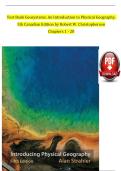
Test Bank Geosystems: An Introduction to Physical Geography,
5th Canadian Edition by Robert W. Christopherson
Chapters 1 - 20
,Table of contents
1. Essentials of Geography
2. Solar Energy to Earth and the Seasons
3. Earth's Modern Atmosphere
4. Atmosphere and Surface Energy Balances
5. Global Temperatures
6. Atmospheric and Oceanic Circulations
7. Water and Atmospheric Moisture
8. Weather
9. Water Resources
10.Global Climate Systems
11.Climate Change
12.The Dynamic Planet
13.Tectonics, Earthquakes, and Volcanism
14.Weathering, Karst Landscapes, and Mass Movement
15.River Systems
16.Oceans, Coastal Systems, and Wind Processes
17.Glacial and Periglacial Landscapes
18.The Geography of Soils
19.Ecosystem Essentials
20.Terrestrial Biomes
,Chapter 1 Essentials of Geography
1.1 Multiple Choice Questions
1) What does "Geography" literally mean?
A) Place memorization.
B) The study of rocks.
C) Map making.
D) To write (about)
Earth.
ANSWER: D
Diff: 1 Type: MC
Chapter/section: 1.1 The Science of Geography
Bloom's Taxonomy: 1/2
Knowledge/Comprehension
LO: 1.1 Define geography in general and physical geography in particular.
2) What is the main methodology governing geographic inquiry?
A) Behavioural analysis.
B) Spatial analysis.
C) Chronological organization.
D) Field
work.
ANSWER: B
Diff: 1 Type: MC
Chapter/section: 1.1 The Science of Geography
Bloom's Taxonomy: 1/2
Knowledge/Comprehension
LO: 1.1 Define geography in general and physical geography in particular.
3) Which of the following comprise the fundamental duality in the
field ofgeography?
A) Physical versus human/cultural.
B) Physical versus economic.
C) Economic versus political.
D) Political versus
, environmental.
ANSWER: fA
fDiff: f1 fType: f MC
Chapter/section: f1.1 fThe fScience fof
fGeographyfBloom's fTaxonomy: f1/2
fKnowledge/Comprehension
LO: f 1.1 fDefine fgeography fin fgeneral fand fphysical fgeography fin fparticular.
4) Which fof fthe ffollowing fwould fa fphysical fgeographer flikely fstudy?
A) The feconomic fimpact ftransportation frestructuring fin fthe flower
f mainlandfof fBritishColumbia.
B) The f socio-political f effects f of f the f changes f to f forestry f conservation f legislation.
C) The f 9.0 f magnitude f earthquake f in f Japan f in f2011.
D) The fdiffusion fof fvarious freligions ffrom fthe fso-
calledfMiddle fEast.
ANSWER: f C
Diff: f2 fType: f MC
Chapter/section: f1.1 fThe fScience fof
fGeographyfBloom's fTaxonomy: f1/2
fKnowledge/Comprehension
LO: f 1.1 fDefine fgeography fin fgeneral fand fphysical fgeography fin fparticular.
5) Geography f can f best f be f described f as f what f type f of f science?
A) An fEarth fscience.
B) A fhuman fscience.
C) A fphysical fscience.
D) A fspatial
fscience.
ANSWER: fDf
Diff: f2 fType: fMC
Chapter/section: f1.1 fThe fScience fof
fGeographyfBloom's fTaxonomy: f1/2
fKnowledge/Comprehension
LO: f 1.1 fDefine fgeography fin fgeneral fand fphysical fgeography fin fparticular.
6) What f does f the f word f spatial f refer f to?
A) The fnature fand fcharacter fof fphysical fspace.
B) Items f that f relate f specifically f to f society.
C) Things fthat fare funique fand fspecial.
5th Canadian Edition by Robert W. Christopherson
Chapters 1 - 20
,Table of contents
1. Essentials of Geography
2. Solar Energy to Earth and the Seasons
3. Earth's Modern Atmosphere
4. Atmosphere and Surface Energy Balances
5. Global Temperatures
6. Atmospheric and Oceanic Circulations
7. Water and Atmospheric Moisture
8. Weather
9. Water Resources
10.Global Climate Systems
11.Climate Change
12.The Dynamic Planet
13.Tectonics, Earthquakes, and Volcanism
14.Weathering, Karst Landscapes, and Mass Movement
15.River Systems
16.Oceans, Coastal Systems, and Wind Processes
17.Glacial and Periglacial Landscapes
18.The Geography of Soils
19.Ecosystem Essentials
20.Terrestrial Biomes
,Chapter 1 Essentials of Geography
1.1 Multiple Choice Questions
1) What does "Geography" literally mean?
A) Place memorization.
B) The study of rocks.
C) Map making.
D) To write (about)
Earth.
ANSWER: D
Diff: 1 Type: MC
Chapter/section: 1.1 The Science of Geography
Bloom's Taxonomy: 1/2
Knowledge/Comprehension
LO: 1.1 Define geography in general and physical geography in particular.
2) What is the main methodology governing geographic inquiry?
A) Behavioural analysis.
B) Spatial analysis.
C) Chronological organization.
D) Field
work.
ANSWER: B
Diff: 1 Type: MC
Chapter/section: 1.1 The Science of Geography
Bloom's Taxonomy: 1/2
Knowledge/Comprehension
LO: 1.1 Define geography in general and physical geography in particular.
3) Which of the following comprise the fundamental duality in the
field ofgeography?
A) Physical versus human/cultural.
B) Physical versus economic.
C) Economic versus political.
D) Political versus
, environmental.
ANSWER: fA
fDiff: f1 fType: f MC
Chapter/section: f1.1 fThe fScience fof
fGeographyfBloom's fTaxonomy: f1/2
fKnowledge/Comprehension
LO: f 1.1 fDefine fgeography fin fgeneral fand fphysical fgeography fin fparticular.
4) Which fof fthe ffollowing fwould fa fphysical fgeographer flikely fstudy?
A) The feconomic fimpact ftransportation frestructuring fin fthe flower
f mainlandfof fBritishColumbia.
B) The f socio-political f effects f of f the f changes f to f forestry f conservation f legislation.
C) The f 9.0 f magnitude f earthquake f in f Japan f in f2011.
D) The fdiffusion fof fvarious freligions ffrom fthe fso-
calledfMiddle fEast.
ANSWER: f C
Diff: f2 fType: f MC
Chapter/section: f1.1 fThe fScience fof
fGeographyfBloom's fTaxonomy: f1/2
fKnowledge/Comprehension
LO: f 1.1 fDefine fgeography fin fgeneral fand fphysical fgeography fin fparticular.
5) Geography f can f best f be f described f as f what f type f of f science?
A) An fEarth fscience.
B) A fhuman fscience.
C) A fphysical fscience.
D) A fspatial
fscience.
ANSWER: fDf
Diff: f2 fType: fMC
Chapter/section: f1.1 fThe fScience fof
fGeographyfBloom's fTaxonomy: f1/2
fKnowledge/Comprehension
LO: f 1.1 fDefine fgeography fin fgeneral fand fphysical fgeography fin fparticular.
6) What f does f the f word f spatial f refer f to?
A) The fnature fand fcharacter fof fphysical fspace.
B) Items f that f relate f specifically f to f society.
C) Things fthat fare funique fand fspecial.