
100% satisfaction guarantee Immediately available after payment Both online and in PDF No strings attached 4.2 TrustPilot
logo-home
Exam (elaborations)

Java Programming – 100+ Exam Q&A on JVM, Type Casting, Operators, Editions – CS101

Rating
-
Sold
-
Pages
12
Grade
A+
Uploaded on
29-09-2025
Written in
2025/2026

This exam-focused document provides over 100 multiple-choice and short-answer Java questions with verified answers, compiled for the Intro to Java Programming (CS101) course in the 2025/2026 academic year. Structured for clarity and high retention, it is ideal for first-year students in Computer Science, Software Engineering, and Information Technology, especially those preparing for theory-heavy Java exams or certifications like OCAJP. Each answer is directly marked as correct, with many questions covering Java fundamentals, type systems, the JVM, compilation workflow, bytecode behavior, operator precedence, and data type sizes. Several sections also explore Java editions (J2SE, J2EE, J2ME), platform independence, and comparisons with C/C++—making it a well-rounded academic support resource. Main topics covered: JVM & Compilation Concepts: .java → .class, javac, java, bytecode, class loader, JRE, JDK Java Editions & History: J2SE, J2ME, J2EE, Oak language origin, platform independence Data Types & Ranges: int, byte, short, float, double, literals, size in bytes/bits Type Casting & Conversion: widening vs narrowing, truncation behavior, type promotion Boolean & Relational Operators: ==, !=, >, <, >=, <=, expression evaluations Bitwise Operators: >>, >>>, <<, precedence and use with primitive types Arithmetic Operators: associativity, postfix vs prefix, modulo logic, unary operators Access Modifiers & Visibility: public, private, method and class accessibility Java Syntax & Execution: main() method, method location, source file naming rules Control Structures: if, else, flow evaluation, loop conditions Program Execution Flow: class loading, bytecode interpretation, execution by JVM Common Errors & Misconceptions: public method access, valid keywords, compilation units String & System Output Methods: S(), println(), member access (.) Boolean Expressions: evaluation rules, valid literals (true, false) Relational Operator Priority: expression results and evaluation types This material is especially suited for: CS101 or introductory Java students preparing for written and MCQ-based exams Java beginners needing reinforcement on foundational and compiler-level concepts Certification candidates reviewing type systems, syntax, and operator logic Tutors assembling classroom quizzes or teaching Java fundamentals through concept checks Self-learners seeking a complete Java terminology and syntax practice guide Its exam-authentic phrasing, correctness assurance, and wide topical coverage make it a valuable study resource across theory-heavy programming modules. Keywords: Java JVM, Java bytecode, Java javac java, Java editions, Java class loader, Java type casting, Java widening conversion, Java narrowing, Java operator precedence, Java relational operators, Java boolean logic, Java float size, Java class execution, Java public private, Java CS101 exam

Show more Read less
Institution
JAVA
Course
JAVA


Whoops! We can’t load your doc right now. Try again or contact support.

Written for

Institution
JAVA
Course
JAVA

Document information

Uploaded on
September 29, 2025
Number of pages
12
Written in
2025/2026
Type
Exam (elaborations)
Contains
Questions & answers

Subjects

Content preview

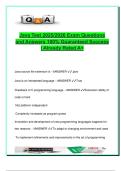
Java Test 2025/2026 Exam Questions
and Answers 100% Guaranteed Success
| Already Rated A+


Java source file extension is - 🧠ANSWER ✔✔.java


Java is an interpreted language - 🧠ANSWER ✔✔True


Drawback of C programming language - 🧠ANSWER ✔✔Extension ability of

code is hard

Not platform independent

Complexity increases as program grows

Innovation and development of new programming languages happens for

two reasons: - 🧠ANSWER ✔✔To adapt to changing environment and uses


To implement refinements and improvements in the art of programming

, Each bytecode instruction is translated into machine code at the time of

execution - 🧠ANSWER ✔✔True


JAVA compiler javac takes your source file as input file to be compiled and

generates _____ file. - 🧠ANSWER ✔✔Bytecode file


Java enables the creation of cross-platform programs by compiling into an

intermediate representation called Java bytecode - 🧠ANSWER ✔✔True


Problem with both C and C++ is - 🧠ANSWER ✔✔Not secure as JAVA


Memory management is not automatic

Platform dependent language


Powerful features of C programming language are - 🧠ANSWER ✔✔Efficient


Powerful

Structured language

Easy to learn


Advantages of C++ over C - 🧠ANSWER ✔✔Easy to learn


Helps to manage growing code - extension ability

Powerful

Get to know the seller

Seller avatar
Reputation scores are based on the amount of documents a seller has sold for a fee and the reviews they have received for those documents. There are three levels: Bronze, Silver and Gold. The better the reputation, the more your can rely on the quality of the sellers work.
JOSHCLAY West Governors University
View profile
Follow You need to be logged in order to follow users or courses
Sold
210
Member since
2 year
Number of followers
14
Documents
17146
Last sold
22 hours ago
JOSHCLAY

JOSHCLAY EXAM HUB, WELCOME ALL, HERE YOU WILL FIND ALL DOCUMENTS & PACKAGE DEAL YOU NEED FOR YOUR SCHOOL WORK OFFERED BY SELLER JOSHCLAY

3.7

39 reviews

5
16
4
7
3
8
2
4
1
4

Recently viewed by you

Why students choose Stuvia

Created by fellow students, verified by reviews

Quality you can trust: written by students who passed their tests and reviewed by others who've used these notes.

Didn't get what you expected? Choose another document

No worries! You can instantly pick a different document that better fits what you're looking for.

Pay as you like, start learning right away

No subscription, no commitments. Pay the way you're used to via credit card and download your PDF document instantly.

Student with book image

“Bought, downloaded, and aced it. It really can be that simple.”

Alisha Student

Frequently asked questions

