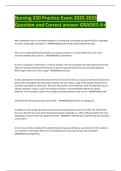
MIE 305 Exam 2025-2026 Question and
Correct answer GRADED A+
Common Law - ANSWERSBody of law derived from judicial decisions rather than from statutes or
constitutions.
Stare Decisis - ANSWERSPrinciple of 'to let past decisions stand'; like cases should be decided alike,
providing certainty and predictability.
Ratio Decidendi - ANSWERSThe reason for deciding; writing down reasoning for a verdict, part of judicial
opinion providing legal reasoning of judge.
Curia Regis - ANSWERSPre-existing rules present and clear judges were expected to apply them; if not,
decisions were made on a case-to-case basis.
Precedent - ANSWERSA legal principle that settles a matter in a way consistent with previous cases.
Common Law vs. Code Law/Civil Law - ANSWERSCommon Law is derived from judicial decisions, while
Code Law/Civil Law emphasizes dispensation and enforcement of a code of laws.
Sharia Law - ANSWERSLaw based on tenets of Islamic faith.
Socialist Law - ANSWERSCode law modified by socialist principles.
Civil Law - ANSWERSLegal system where parties in civil cases are Plaintiff and Defendant; verdicts are
liable or not liable.
Criminal Law - ANSWERSLegal system where Prosecutor represents the state and Defendant is the
accused; verdicts are guilty or not guilty.
,Substantive Law - ANSWERSLaws that regulate and control the rights and duties of persons and are used
to resolve disputes.
Procedural Law - ANSWERSLaws that establish the process by which litigation is conducted.
Public Law - ANSWERSLaw that affects the public generally, divided into three categories: Constitutional
Law, Administrative Law, and Criminal Law.
Constitutional Law - ANSWERSConcerned with rights, powers, and duties of federal and state
governments under U.S. Constitutions and state constitutions.
Administrative Law - ANSWERSConcerned with administrative agencies and their rulemaking and rule-
enforcement powers within government.
Private Law - ANSWERSPertains to relationships between individuals in an organized society.
Law of Contracts - ANSWERSCovers sales, commercial paper, agency, and business organizations.
Law of Torts - ANSWERSPrimary source of litigation in the U.S.; wrong committed by one party against
another or another's property, leading to compensation.
Law of Property - ANSWERSSubdivided into wills, trusts, estates, etc.
Federal Rules of Criminal Procedure - ANSWERSSet of procedures specifically for criminal courts.
Federal Rules of Civil Procedure - ANSWERSSet of procedures specifically for civil courts.
Statutes - ANSWERSWritten, codified laws passed by a legislative body, including treaties by the federal
government.
, Regulations/Administrative Law - ANSWERSBody of rules and regulations issued by administrative
agencies.
Case Law/Common Law Rules - ANSWERSPrecedents created by judges in the legal system, where
higher court decisions are more binding than lower ones.
Problems of Case Law - ANSWERSIssues arising from a large volume of judicial decisions that create
unclear law for laypersons and conflicting precedents.
Dicta vs. Precedent - ANSWERSDicta are comments on matters not necessary to the decision reached,
while precedent is a binding decision.
Judicial Review - ANSWERSPower of the judiciary to review actions of other government branches,
established by Marbury vs. Madison in 1803.
Res Judicata - ANSWERSLegal doctrine meaning 'the thing has been decided'; a cause of action may not
be relitigated once judged on the merits.
Separation of Power - ANSWERSDivision of government responsibilities into distinct branches to limit
any one branch from exercising the core functions of another.
Distinction between Law and Equity - ANSWERSEquity assists the law where it is defective and weak,
providing remedies beyond monetary damages.
Legal Remedies - ANSWERSRelief sought from court in the form of monetary damages.
Equitable Remedies - ANSWERSAny form of relief that does not involve monetary damages.
Decree - ANSWERSDecision of a court of equity.
Order of Specific Performance - ANSWERSCourt order that directs a party to do something or refrain
from doing something.
Correct answer GRADED A+
Common Law - ANSWERSBody of law derived from judicial decisions rather than from statutes or
constitutions.
Stare Decisis - ANSWERSPrinciple of 'to let past decisions stand'; like cases should be decided alike,
providing certainty and predictability.
Ratio Decidendi - ANSWERSThe reason for deciding; writing down reasoning for a verdict, part of judicial
opinion providing legal reasoning of judge.
Curia Regis - ANSWERSPre-existing rules present and clear judges were expected to apply them; if not,
decisions were made on a case-to-case basis.
Precedent - ANSWERSA legal principle that settles a matter in a way consistent with previous cases.
Common Law vs. Code Law/Civil Law - ANSWERSCommon Law is derived from judicial decisions, while
Code Law/Civil Law emphasizes dispensation and enforcement of a code of laws.
Sharia Law - ANSWERSLaw based on tenets of Islamic faith.
Socialist Law - ANSWERSCode law modified by socialist principles.
Civil Law - ANSWERSLegal system where parties in civil cases are Plaintiff and Defendant; verdicts are
liable or not liable.
Criminal Law - ANSWERSLegal system where Prosecutor represents the state and Defendant is the
accused; verdicts are guilty or not guilty.
,Substantive Law - ANSWERSLaws that regulate and control the rights and duties of persons and are used
to resolve disputes.
Procedural Law - ANSWERSLaws that establish the process by which litigation is conducted.
Public Law - ANSWERSLaw that affects the public generally, divided into three categories: Constitutional
Law, Administrative Law, and Criminal Law.
Constitutional Law - ANSWERSConcerned with rights, powers, and duties of federal and state
governments under U.S. Constitutions and state constitutions.
Administrative Law - ANSWERSConcerned with administrative agencies and their rulemaking and rule-
enforcement powers within government.
Private Law - ANSWERSPertains to relationships between individuals in an organized society.
Law of Contracts - ANSWERSCovers sales, commercial paper, agency, and business organizations.
Law of Torts - ANSWERSPrimary source of litigation in the U.S.; wrong committed by one party against
another or another's property, leading to compensation.
Law of Property - ANSWERSSubdivided into wills, trusts, estates, etc.
Federal Rules of Criminal Procedure - ANSWERSSet of procedures specifically for criminal courts.
Federal Rules of Civil Procedure - ANSWERSSet of procedures specifically for civil courts.
Statutes - ANSWERSWritten, codified laws passed by a legislative body, including treaties by the federal
government.
, Regulations/Administrative Law - ANSWERSBody of rules and regulations issued by administrative
agencies.
Case Law/Common Law Rules - ANSWERSPrecedents created by judges in the legal system, where
higher court decisions are more binding than lower ones.
Problems of Case Law - ANSWERSIssues arising from a large volume of judicial decisions that create
unclear law for laypersons and conflicting precedents.
Dicta vs. Precedent - ANSWERSDicta are comments on matters not necessary to the decision reached,
while precedent is a binding decision.
Judicial Review - ANSWERSPower of the judiciary to review actions of other government branches,
established by Marbury vs. Madison in 1803.
Res Judicata - ANSWERSLegal doctrine meaning 'the thing has been decided'; a cause of action may not
be relitigated once judged on the merits.
Separation of Power - ANSWERSDivision of government responsibilities into distinct branches to limit
any one branch from exercising the core functions of another.
Distinction between Law and Equity - ANSWERSEquity assists the law where it is defective and weak,
providing remedies beyond monetary damages.
Legal Remedies - ANSWERSRelief sought from court in the form of monetary damages.
Equitable Remedies - ANSWERSAny form of relief that does not involve monetary damages.
Decree - ANSWERSDecision of a court of equity.
Order of Specific Performance - ANSWERSCourt order that directs a party to do something or refrain
from doing something.