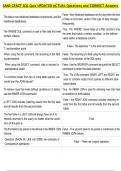
SANS GFACT SQL Quiz UPDATED ACTUAL Questions and CORRECT Answers
False - Non-relational databases are for use when the kind
The data in non-relational databases is structured, just like
of data is not known, and/or if the type of data changes
relational databases.
frequently.
True - The `WHERE` clause helps us to filter records to only
The 'WHERE' SQL command is used to filter data that meet
the ones that match a certain condition, i.e.the defined
certain criteria.
value within a database column
To select all data from a table, use the wild card character
False - The asterisks '*' is the wild card character
'!', exclamation point
When using the AS command, the renaming of the field False - The renaming of a field using the AS command only
is permanent exists fo the duration of the SQL query.
When using the SELECT command, data is returned in False - Use the ORDER BY command along with the SELECT
alphabetical order command to order the data returned
True - The JOIN command, INNER, LEFT and RIGHT, are
To combine results from two or more table queries, you
used to combine output from queries to different data-
would use the JOIN clause?
base tables
To retrieve rows that meet defined conditions in 2 tables, True - An INNER JOIN is used for retrieving rows that meet
use the INNER JOIN command a condition in both tables
False - the RIGHT JOIN command includes matching re-
a LEFT JOIN includes matching results from the first table
sults from the first table and all results from the second
and all results from the second table
table
The first table in a LEFT JOIN will always have all of its
records returned in the query no matter what the condi- True
tion of the join is
The first table to be joined is mentioned in the INNER JOIN False - The second table to be joined is mentioned in the
clause. INNER JOIN clause.
Operators UNION, IN, LIKE and SOME are examples of
False - These are Logical operators
Comparison operators
False - Non-relational databases are for use when the kind
The data in non-relational databases is structured, just like
of data is not known, and/or if the type of data changes
relational databases.
frequently.
True - The `WHERE` clause helps us to filter records to only
The 'WHERE' SQL command is used to filter data that meet
the ones that match a certain condition, i.e.the defined
certain criteria.
value within a database column
To select all data from a table, use the wild card character
False - The asterisks '*' is the wild card character
'!', exclamation point
When using the AS command, the renaming of the field False - The renaming of a field using the AS command only
is permanent exists fo the duration of the SQL query.
When using the SELECT command, data is returned in False - Use the ORDER BY command along with the SELECT
alphabetical order command to order the data returned
True - The JOIN command, INNER, LEFT and RIGHT, are
To combine results from two or more table queries, you
used to combine output from queries to different data-
would use the JOIN clause?
base tables
To retrieve rows that meet defined conditions in 2 tables, True - An INNER JOIN is used for retrieving rows that meet
use the INNER JOIN command a condition in both tables
False - the RIGHT JOIN command includes matching re-
a LEFT JOIN includes matching results from the first table
sults from the first table and all results from the second
and all results from the second table
table
The first table in a LEFT JOIN will always have all of its
records returned in the query no matter what the condi- True
tion of the join is
The first table to be joined is mentioned in the INNER JOIN False - The second table to be joined is mentioned in the
clause. INNER JOIN clause.
Operators UNION, IN, LIKE and SOME are examples of
False - These are Logical operators
Comparison operators