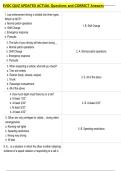
EVOC QUIZ UPDATED ACTUAL Questions and CORRECT Answers
1. Law enforcement driving is divided into three types.
Which is NOT?
a. Normal patrol operations
1. B. Shift Change
b. Shift Change
c. Emergency response
d. Pursuits
2. The bulk of your driving will take place during _.
a. Normal patrol operations
b. Shift Change 2. A. Normal patrol operations
c. Emergency response
d. Pursuits
3. When inspecting a vehicle, what will you check?
a. Tires and wheels
b. Exterior (body, chassis, engine)
3. E. All of the above
c. Trunk
d. Passenger compartment
e. All of the above
4. How much depth must there be on a tire?
a. At least 1/32"
b. At least 2/32" 4. B. At least 2/32"
c. At least 3/32"
d. At least 4/32"
5. Oflcer are only privileged to violate _ during silent
emergencies.
a. Running red lights
5. B. Speeding restrictions
b. Speeding restrictions
c. Wrong way driving
d. All laws
6. A _ is a situation in which the oflcer is either obtaining
evidence of a speed violation or responding to a call in
, which there is a need to avoid alerting a suspect to the
oflcer's presence.
a. Loud emergency
6. C. Silent emergency
b. Silent pursuit
c. Silent emergency
d. Speeding emergency
7. During stress response, you can do the three tech-
niques to bring your stress down. Which one is NOT?
a. Breath
7. D. Drink
b. Scan
c. Self-Talk
d. Drink
8. When sympathetic nervous system kicks in, you will
exhibit which of the following?
a. Your body secretes adrenaline.
b. Blood flow to the large muscles increases, making it
easier for you to fight or run from danger—thus, this re-
8. D. All of the above
sponse is sometimes called the "fight or flight" response.
c. Your heart rate, blood pressure, and respiration rate
all increase, ensuring that your large muscles are well
oxygenated.
d. All of the above
9. When sympathetic nervous system kicks in, you will NOT
exhibit which of the following?
a. Your sweat glands are stimulated.
b. Your blood sugar decreases 9. C. Your blood sugar increases.
c. Your blood sugar increases.
d. Your vision & hearing may become keener — and may
exclude stimuli that are not part of the perceived danger.
1. Law enforcement driving is divided into three types.
Which is NOT?
a. Normal patrol operations
1. B. Shift Change
b. Shift Change
c. Emergency response
d. Pursuits
2. The bulk of your driving will take place during _.
a. Normal patrol operations
b. Shift Change 2. A. Normal patrol operations
c. Emergency response
d. Pursuits
3. When inspecting a vehicle, what will you check?
a. Tires and wheels
b. Exterior (body, chassis, engine)
3. E. All of the above
c. Trunk
d. Passenger compartment
e. All of the above
4. How much depth must there be on a tire?
a. At least 1/32"
b. At least 2/32" 4. B. At least 2/32"
c. At least 3/32"
d. At least 4/32"
5. Oflcer are only privileged to violate _ during silent
emergencies.
a. Running red lights
5. B. Speeding restrictions
b. Speeding restrictions
c. Wrong way driving
d. All laws
6. A _ is a situation in which the oflcer is either obtaining
evidence of a speed violation or responding to a call in
, which there is a need to avoid alerting a suspect to the
oflcer's presence.
a. Loud emergency
6. C. Silent emergency
b. Silent pursuit
c. Silent emergency
d. Speeding emergency
7. During stress response, you can do the three tech-
niques to bring your stress down. Which one is NOT?
a. Breath
7. D. Drink
b. Scan
c. Self-Talk
d. Drink
8. When sympathetic nervous system kicks in, you will
exhibit which of the following?
a. Your body secretes adrenaline.
b. Blood flow to the large muscles increases, making it
easier for you to fight or run from danger—thus, this re-
8. D. All of the above
sponse is sometimes called the "fight or flight" response.
c. Your heart rate, blood pressure, and respiration rate
all increase, ensuring that your large muscles are well
oxygenated.
d. All of the above
9. When sympathetic nervous system kicks in, you will NOT
exhibit which of the following?
a. Your sweat glands are stimulated.
b. Your blood sugar decreases 9. C. Your blood sugar increases.
c. Your blood sugar increases.
d. Your vision & hearing may become keener — and may
exclude stimuli that are not part of the perceived danger.