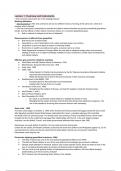
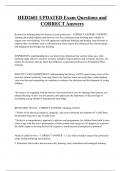
NUR 239 Exam 1 – Questions With Reviewed
Solutions
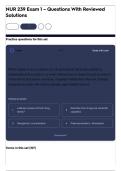
Save
Practice questions for this set
Learn 1 /7 Study with Learn
When intake or accumulation of a drug exceeds the body's ability to
metabolize and excrete it, or when interactions increase the active amount
in the blood (excessive overdose, impaired metabolism like liver disease,
impaired excretion like kidney disease, age-related factors)
Choose an answer
what are causes of toxic drug Describe how drugs are named &
1 2
levels? classified
3 therapeutic concentration 4 Pharmacokinetics- Absorption
Don't know?
Terms in this set (107)
, NAME-
Prototype: often first, sets standard
Generic: official name related to chemical name
(lower case, common ending for drug group)
Describe how drugs are Brand/Trade: manufacturer patent name (upper
named & classified case)
CLASSIFICATIONS:
-effect on body
-therapeutic use
-chemical characteristics
Classify which one is the generic: ibuprofen
prototype, generic, Brand/Trade: Motrin, Advil
brand/trade
-ibuprofen
-Advil
-Motrin
how drugs move through to body to get to site of
Pharmacokinetics
action, get metabolized and excreted
passive diffusion- most common
facilitated diffusion- combine with carrier (protein or
How drugs move in body
enzyme)
active transport- carrier+energy
Time it takes medication to enter body & then
bloodstream (affects onset of action & intensity of
Pharmacokinetics-
action, affected by route of administration/blood
Absorption
flow/ & stomach contents. Iv route fastest, Oral is
the slowest, & IM & SubQ are in between)
transport of drugs within the body (medications
bind to protein (albumin) to be transported in
blood), *monitor serum albumin levels- low albumin
Pharmacokinetics-
levels mean less binding & more active drug (liver
Distribution
disease- risk for toxic effects, monitor live function
bcs if the liver isn't working patients should be
administered lower dosage)
Pharmacokinetics- inactivated/transformed so can be excreted
Metabolism
Solutions
Save
Practice questions for this set
Learn 1 /7 Study with Learn
When intake or accumulation of a drug exceeds the body's ability to
metabolize and excrete it, or when interactions increase the active amount
in the blood (excessive overdose, impaired metabolism like liver disease,
impaired excretion like kidney disease, age-related factors)
Choose an answer
what are causes of toxic drug Describe how drugs are named &
1 2
levels? classified
3 therapeutic concentration 4 Pharmacokinetics- Absorption
Don't know?
Terms in this set (107)
, NAME-
Prototype: often first, sets standard
Generic: official name related to chemical name
(lower case, common ending for drug group)
Describe how drugs are Brand/Trade: manufacturer patent name (upper
named & classified case)
CLASSIFICATIONS:
-effect on body
-therapeutic use
-chemical characteristics
Classify which one is the generic: ibuprofen
prototype, generic, Brand/Trade: Motrin, Advil
brand/trade
-ibuprofen
-Advil
-Motrin
how drugs move through to body to get to site of
Pharmacokinetics
action, get metabolized and excreted
passive diffusion- most common
facilitated diffusion- combine with carrier (protein or
How drugs move in body
enzyme)
active transport- carrier+energy
Time it takes medication to enter body & then
bloodstream (affects onset of action & intensity of
Pharmacokinetics-
action, affected by route of administration/blood
Absorption
flow/ & stomach contents. Iv route fastest, Oral is
the slowest, & IM & SubQ are in between)
transport of drugs within the body (medications
bind to protein (albumin) to be transported in
blood), *monitor serum albumin levels- low albumin
Pharmacokinetics-
levels mean less binding & more active drug (liver
Distribution
disease- risk for toxic effects, monitor live function
bcs if the liver isn't working patients should be
administered lower dosage)
Pharmacokinetics- inactivated/transformed so can be excreted
Metabolism