Robbins & Cotran 10th Ed. Pathology Test Bank | Chapter-
by-Chapter Questions & Verified Solutions
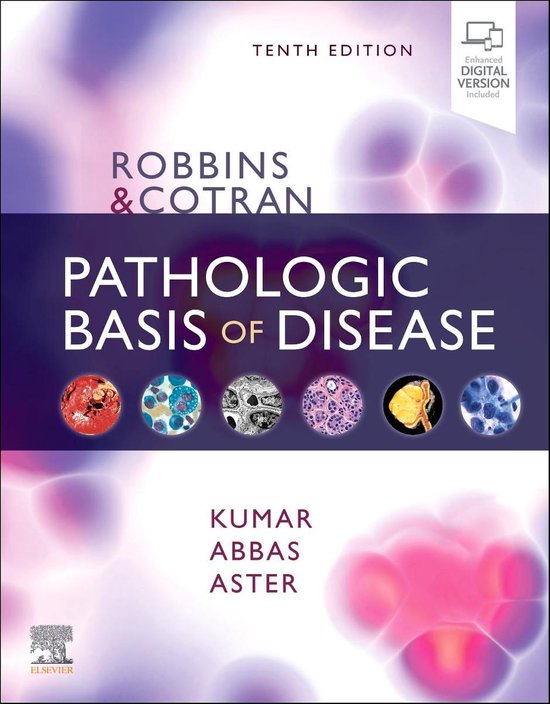
Robbins & Cotran Pathologic Basis of Disease
10th Edition
• Author(s)Vinay Kumar; Abul K. Abbas; Jon C. Aster
Question 1
• Chapter & Section: 1: The Cell as a Unit of Health and
Disease / The Genome
• Stem: A patient is diagnosed with a mitochondrial
myopathy caused by a mutation in mitochondrial DNA
(mtDNA). When educating the patient about the condition,
the nurse explains that mtDNA is unique because it:
• Options:
o A. Codes for all the proteins necessary for oxidative
phosphorylation.
o B. Is identical to nuclear DNA in its structure and
genetic code.
o C. Is inherited solely from the mother and has a
different genetic code.
, o D. Can be efficiently repaired by the same
mechanisms as nuclear DNA.
• Correct Answer: C
• Rationales:
o C (Correct): mtDNA is maternally inherited and has a
different genetic code; for example, the codon UGA
codes for tryptophan instead of being a stop codon.
o A (Incorrect): mtDNA only encodes 13 proteins
essential for the electron transport chain. The vast
majority of mitochondrial proteins are encoded by
nuclear DNA.
o B (Incorrect): mtDNA is a circular, double-stranded
molecule, unlike linear nuclear DNA, and its genetic
code differs.
o D (Incorrect): Mitochondria have limited DNA repair
capacity compared to the nucleus, contributing to a
higher mutation rate for mtDNA.
• Teaching Point: mtDNA is maternally inherited, has a
distinct genetic code, and encodes only a subset of
mitochondrial proteins.
• Citation: Robbins & Cotran Pathologic Basis of Disease,
10th Ed., Chapter 1.
Question 2
• Chapter & Section: 1: The Cell as a Unit of Health and
Disease / The Genome
,• Stem: A student is reviewing the human genome and notes
that only about 1.5% of it codes for proteins. Which of the
following best describes the primary functional role of the
remaining 98.5% of noncoding DNA?
• Options:
o A. It is largely junk DNA with no significant
biological function.
o B. It serves critical regulatory roles, such as in
epigenetics and long noncoding RNAs.
o C. It consists mainly of viral DNA sequences that are
no longer active.
o D. It functions as a structural scaffold for the
organization of chromosomes within the nucleus.
• Correct Answer: B
• Rationales:
o B (Correct): Noncoding DNA plays essential
regulatory roles, including controlling gene expression
through mechanisms like epigenetic modifications and
the action of long noncoding RNAs.
o A (Incorrect): The concept of "junk DNA" is
outdated; contemporary understanding attributes vast
regulatory and structural functions to noncoding
regions.
o C (Incorrect): While some noncoding DNA does
consist of viral remnants, these elements do not
, constitute the primary function of the entire noncoding
portion.
o D (Incorrect): Some noncoding regions (e.g.,
telomeres, centromeres) do have structural roles, but
this is not the primary function for the entire 98.5%.
• Teaching Point: Noncoding DNA is functionally crucial
for gene regulation, not passive.
• Citation: Robbins & Cotran Pathologic Basis of Disease,
10th Ed., Chapter 1.
Question 3
• Chapter & Section: 1: The Cell as a Unit of Health and
Disease / The Genome
• Stem: During a genetics lecture, the professor explains that
histone modifications can alter gene expression without
changing the DNA sequence. This is an example of:
• Options:
o A. A single nucleotide polymorphism (SNP).
o B. Epigenetic regulation.
o C. Copy number variation (CNV).
o D. Mitochondrial inheritance.
• Correct Answer: B
• Rationales:
o B (Correct): Epigenetic modifications, such as
methylation of DNA or acetylation of histones,
by-Chapter Questions & Verified Solutions
Robbins & Cotran Pathologic Basis of Disease
10th Edition
• Author(s)Vinay Kumar; Abul K. Abbas; Jon C. Aster
Question 1
• Chapter & Section: 1: The Cell as a Unit of Health and
Disease / The Genome
• Stem: A patient is diagnosed with a mitochondrial
myopathy caused by a mutation in mitochondrial DNA
(mtDNA). When educating the patient about the condition,
the nurse explains that mtDNA is unique because it:
• Options:
o A. Codes for all the proteins necessary for oxidative
phosphorylation.
o B. Is identical to nuclear DNA in its structure and
genetic code.
o C. Is inherited solely from the mother and has a
different genetic code.
, o D. Can be efficiently repaired by the same
mechanisms as nuclear DNA.
• Correct Answer: C
• Rationales:
o C (Correct): mtDNA is maternally inherited and has a
different genetic code; for example, the codon UGA
codes for tryptophan instead of being a stop codon.
o A (Incorrect): mtDNA only encodes 13 proteins
essential for the electron transport chain. The vast
majority of mitochondrial proteins are encoded by
nuclear DNA.
o B (Incorrect): mtDNA is a circular, double-stranded
molecule, unlike linear nuclear DNA, and its genetic
code differs.
o D (Incorrect): Mitochondria have limited DNA repair
capacity compared to the nucleus, contributing to a
higher mutation rate for mtDNA.
• Teaching Point: mtDNA is maternally inherited, has a
distinct genetic code, and encodes only a subset of
mitochondrial proteins.
• Citation: Robbins & Cotran Pathologic Basis of Disease,
10th Ed., Chapter 1.
Question 2
• Chapter & Section: 1: The Cell as a Unit of Health and
Disease / The Genome
,• Stem: A student is reviewing the human genome and notes
that only about 1.5% of it codes for proteins. Which of the
following best describes the primary functional role of the
remaining 98.5% of noncoding DNA?
• Options:
o A. It is largely junk DNA with no significant
biological function.
o B. It serves critical regulatory roles, such as in
epigenetics and long noncoding RNAs.
o C. It consists mainly of viral DNA sequences that are
no longer active.
o D. It functions as a structural scaffold for the
organization of chromosomes within the nucleus.
• Correct Answer: B
• Rationales:
o B (Correct): Noncoding DNA plays essential
regulatory roles, including controlling gene expression
through mechanisms like epigenetic modifications and
the action of long noncoding RNAs.
o A (Incorrect): The concept of "junk DNA" is
outdated; contemporary understanding attributes vast
regulatory and structural functions to noncoding
regions.
o C (Incorrect): While some noncoding DNA does
consist of viral remnants, these elements do not
, constitute the primary function of the entire noncoding
portion.
o D (Incorrect): Some noncoding regions (e.g.,
telomeres, centromeres) do have structural roles, but
this is not the primary function for the entire 98.5%.
• Teaching Point: Noncoding DNA is functionally crucial
for gene regulation, not passive.
• Citation: Robbins & Cotran Pathologic Basis of Disease,
10th Ed., Chapter 1.
Question 3
• Chapter & Section: 1: The Cell as a Unit of Health and
Disease / The Genome
• Stem: During a genetics lecture, the professor explains that
histone modifications can alter gene expression without
changing the DNA sequence. This is an example of:
• Options:
o A. A single nucleotide polymorphism (SNP).
o B. Epigenetic regulation.
o C. Copy number variation (CNV).
o D. Mitochondrial inheritance.
• Correct Answer: B
• Rationales:
o B (Correct): Epigenetic modifications, such as
methylation of DNA or acetylation of histones,