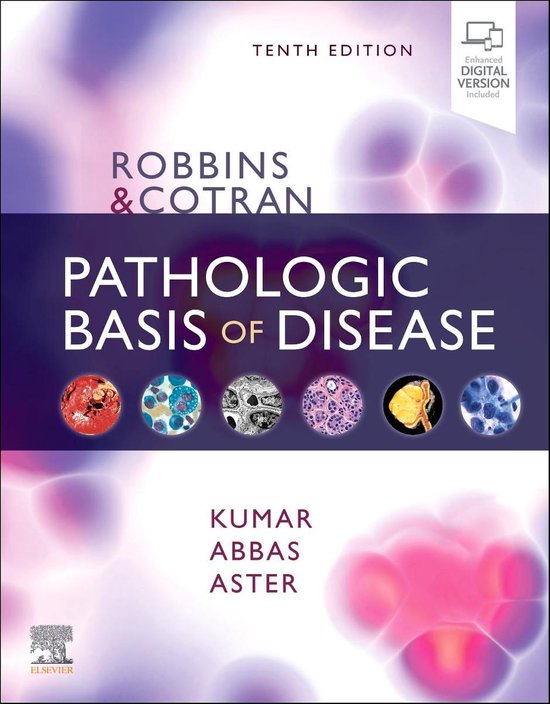
Robbins & Cotran 10th Ed. Pathology Test Bank | Chapter-
by-Chapter Questions & Verified Solutions
Robbins & Cotran Pathologic Basis of Disease
10th Edition
• Author(s)Vinay Kumar; Abul K. Abbas; Jon C. Aster
Multiple-Choice Questions: Robbins & Cotran Pathologic
Basis of Disease, 10th Edition – Chapter 1
1. Cellular Metabolism and Mitochondrial Function
A 45-year-old patient presents with progressive weakness and
neurological deterioration. A muscle biopsy reveals ragged-red
fibers, and genetic testing identifies a mutation in mitochondrial
DNA. This mutation would most directly impair the function of
which of the following cellular processes?
A. Synthesis of phospholipids for membrane integrity
B. Detoxification of reactive oxygen species in the cytosol
C. Oxidative phosphorylation and ATP generation
D. Regulation of nuclear gene expression for housekeeping
proteins
Correct Answer: C
Rationale: Mitochondrial DNA (mtDNA) encodes 13 essential
,subunits of the electron transport chain complexes involved in
oxidative phosphorylation . A mutation in mtDNA directly
disrupts the synthesis of these proteins, impairing ATP
generation. This is a hallmark of mitochondrial myopathies,
consistent with the clinical finding of ragged-red fibers.
• Incorrect A: While mitochondria are involved in
phospholipid synthesis (e.g., phosphatidylethanolamine),
this function is governed by nuclear-encoded proteins, not
mtDNA.
• Incorrect B: Although mitochondria produce ROS, their
detoxification involves both mitochondrial and cytosolic
systems (e.g., glutathione), which are not primarily
encoded by mtDNA.
• Incorrect D: mtDNA does not encode proteins that directly
regulate nuclear gene expression; communication is largely
through metabolic signals.
Teaching Point: mtDNA mutations directly disrupt
cellular energy production via oxidative phosphorylation.
2. The Genome
During a genetics lecture, a professor explains that only 1.5% of
the human genome directly codes for proteins. A student asks
about the primary function of the remaining noncoding DNA.
The professor's best response is that noncoding DNA is essential
for:
A. Providing structural support to the chromosome during cell
division.
B. Serving as a silent reservoir for potential future evolutionary
,genes.
C. Regulating gene expression through epigenetic mechanisms
and noncoding RNAs.
D. Protecting protein-coding genes from physical damage and
mutagenic agents.
Correct Answer: C
Rationale: The textbook emphasizes that the 98.5% of
noncoding DNA is not "junk" but plays critical regulatory roles,
including chromatin remodeling, histone modification, and the
production of long noncoding RNAs that control when and how
protein-coding genes are expressed .
• Incorrect A: Structural support is primarily provided by
proteins like histones and the centromere, which are coded
for by a tiny fraction of the genome.
• Incorrect B: While noncoding regions can evolve, this is
not their primary function; they are dynamically involved
in current cellular regulation.
• Incorrect D: While DNA packaging does offer some
protection, this is a secondary effect, not the primary
biological function of noncoding regions.
Teaching Point: Noncoding DNA primarily functions in
the sophisticated regulation of gene expression.
3. Cellular Housekeeping
A cell is exposed to a prolonged hypoxic environment. Which of
the following cellular responses is most likely to be activated to
remove damaged organelles and support survival?
, A. Activation of the ubiquitin-proteasome system
B. Initiation of mitophagy
C. Unfolded protein response in the endoplasmic reticulum
D. Increased activity of DNA repair enzymes
Correct Answer: B
Rationale: Mitophagy is a selective form of autophagy
responsible for degrading damaged mitochondria. Under stress
conditions like hypoxia, mitochondrial function is impaired, and
removing these damaged organelles via mitophagy is a key
housekeeping and survival mechanism .
• Incorrect A: The ubiquitin-proteasome system primarily
degrades individual misfolded proteins, not entire
organelles.
• Incorrect C: The UPR is specific to ER stress from an
accumulation of unfolded proteins, not directly to organelle
damage from hypoxia.
• Incorrect D: DNA repair enzymes address genetic damage,
which is not the primary immediate consequence of
hypoxia described here.
Teaching Point: Mitophagy is a vital quality-control
process for removing dysfunctional mitochondria.
4. Cellular Metabolism and Mitochondrial Function
A researcher is studying a cell line with a genetic defect that
prevents the import of nuclear-encoded proteins into the
mitochondria. This defect would most severely impact which of
the following?
by-Chapter Questions & Verified Solutions
Robbins & Cotran Pathologic Basis of Disease
10th Edition
• Author(s)Vinay Kumar; Abul K. Abbas; Jon C. Aster
Multiple-Choice Questions: Robbins & Cotran Pathologic
Basis of Disease, 10th Edition – Chapter 1
1. Cellular Metabolism and Mitochondrial Function
A 45-year-old patient presents with progressive weakness and
neurological deterioration. A muscle biopsy reveals ragged-red
fibers, and genetic testing identifies a mutation in mitochondrial
DNA. This mutation would most directly impair the function of
which of the following cellular processes?
A. Synthesis of phospholipids for membrane integrity
B. Detoxification of reactive oxygen species in the cytosol
C. Oxidative phosphorylation and ATP generation
D. Regulation of nuclear gene expression for housekeeping
proteins
Correct Answer: C
Rationale: Mitochondrial DNA (mtDNA) encodes 13 essential
,subunits of the electron transport chain complexes involved in
oxidative phosphorylation . A mutation in mtDNA directly
disrupts the synthesis of these proteins, impairing ATP
generation. This is a hallmark of mitochondrial myopathies,
consistent with the clinical finding of ragged-red fibers.
• Incorrect A: While mitochondria are involved in
phospholipid synthesis (e.g., phosphatidylethanolamine),
this function is governed by nuclear-encoded proteins, not
mtDNA.
• Incorrect B: Although mitochondria produce ROS, their
detoxification involves both mitochondrial and cytosolic
systems (e.g., glutathione), which are not primarily
encoded by mtDNA.
• Incorrect D: mtDNA does not encode proteins that directly
regulate nuclear gene expression; communication is largely
through metabolic signals.
Teaching Point: mtDNA mutations directly disrupt
cellular energy production via oxidative phosphorylation.
2. The Genome
During a genetics lecture, a professor explains that only 1.5% of
the human genome directly codes for proteins. A student asks
about the primary function of the remaining noncoding DNA.
The professor's best response is that noncoding DNA is essential
for:
A. Providing structural support to the chromosome during cell
division.
B. Serving as a silent reservoir for potential future evolutionary
,genes.
C. Regulating gene expression through epigenetic mechanisms
and noncoding RNAs.
D. Protecting protein-coding genes from physical damage and
mutagenic agents.
Correct Answer: C
Rationale: The textbook emphasizes that the 98.5% of
noncoding DNA is not "junk" but plays critical regulatory roles,
including chromatin remodeling, histone modification, and the
production of long noncoding RNAs that control when and how
protein-coding genes are expressed .
• Incorrect A: Structural support is primarily provided by
proteins like histones and the centromere, which are coded
for by a tiny fraction of the genome.
• Incorrect B: While noncoding regions can evolve, this is
not their primary function; they are dynamically involved
in current cellular regulation.
• Incorrect D: While DNA packaging does offer some
protection, this is a secondary effect, not the primary
biological function of noncoding regions.
Teaching Point: Noncoding DNA primarily functions in
the sophisticated regulation of gene expression.
3. Cellular Housekeeping
A cell is exposed to a prolonged hypoxic environment. Which of
the following cellular responses is most likely to be activated to
remove damaged organelles and support survival?
, A. Activation of the ubiquitin-proteasome system
B. Initiation of mitophagy
C. Unfolded protein response in the endoplasmic reticulum
D. Increased activity of DNA repair enzymes
Correct Answer: B
Rationale: Mitophagy is a selective form of autophagy
responsible for degrading damaged mitochondria. Under stress
conditions like hypoxia, mitochondrial function is impaired, and
removing these damaged organelles via mitophagy is a key
housekeeping and survival mechanism .
• Incorrect A: The ubiquitin-proteasome system primarily
degrades individual misfolded proteins, not entire
organelles.
• Incorrect C: The UPR is specific to ER stress from an
accumulation of unfolded proteins, not directly to organelle
damage from hypoxia.
• Incorrect D: DNA repair enzymes address genetic damage,
which is not the primary immediate consequence of
hypoxia described here.
Teaching Point: Mitophagy is a vital quality-control
process for removing dysfunctional mitochondria.
4. Cellular Metabolism and Mitochondrial Function
A researcher is studying a cell line with a genetic defect that
prevents the import of nuclear-encoded proteins into the
mitochondria. This defect would most severely impact which of
the following?