Robbins & Cotran 10th Ed. Pathology Test Bank | Chapter-
by-Chapter Questions & Verified Solutions
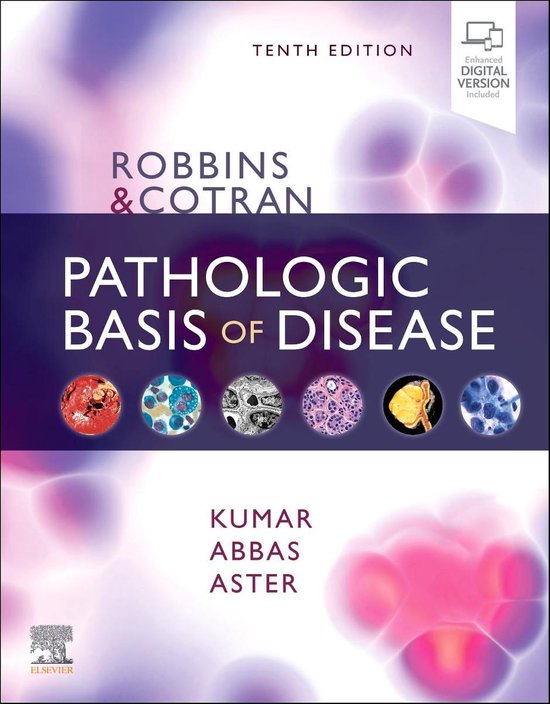
Robbins & Cotran Pathologic Basis of Disease
10th Edition
• Author(s)Vinay Kumar; Abul K. Abbas; Jon C. Aster
Chapter 1 — The Genome
Question: A 45-year-old man presents with progressive muscle
weakness. Genetic testing shows an expansion of a
trinucleotide repeat in a coding region causing an elongated,
aggregation-prone protein. Which mechanism best explains
how this mutation leads to cellular dysfunction?
A. Loss of enzymatic function due to truncated protein
B. Toxic gain-of-function from misfolded protein aggregates
interfering with proteostasis
C. Haploinsufficiency because one allele is deleted
D. Promoter hypermethylation causing transcriptional silencing
Correct Answer: B
Rationales:
, • Correct (B): Trinucleotide expansions in coding regions can
produce abnormally long proteins that misfold and
aggregate, disrupting proteostasis and causing toxicity;
Robbins describes toxic gain-of-function as a mechanism in
repeat-expansion disorders.
• A: Truncation is characteristic of nonsense or frameshift
mutations, not expansions that produce elongated
proteins.
• C: Haploinsufficiency implies insufficient normal protein
from one functional allele, not toxic aggregation from
expanded products.
• D: Promoter hypermethylation affects expression but is
not the primary mechanism for toxic protein produced by
coding repeat expansions.
Teaching Point: Coding repeat expansions often cause disease
by toxic protein aggregation.
Citation: Robbins & Cotran, Ch. 1 — The Genome.
2) Chapter 1 — The Genome
Question: A chemotherapy patient develops a secondary
leukemia months after treatment with a topoisomerase II
inhibitor. Which genomic event most likely underlies this
therapy-related leukemia?
A. Point mutation in tumor suppressor gene p53
B. Balanced translocation causing a fusion oncogene
,C. Mitochondrial DNA deletion producing metabolic failure
D. Global DNA hypermethylation of promoters
Correct Answer: B
Rationales:
• Correct (B): Topoisomerase II inhibitors are associated
with double-strand breaks that can promote chromosomal
translocations forming fusion oncogenes (e.g., MLL
rearrangements), a mechanism described in Robbins.
• A: While point mutations occur, therapy-related leukemias
often show chromosomal translocations rather than
isolated p53 point mutations.
• C: Mitochondrial DNA deletions cause metabolic disorders,
not classically therapy-related leukemias.
• D: Global promoter hypermethylation is an epigenetic
change, but not the hallmark of topoisomerase II–related
secondary leukemia.
Teaching Point: Topo II inhibitors predispose to chromosomal
translocations and fusion oncogenes.
Citation: Robbins & Cotran, Ch. 1 — The Genome.
3) Chapter 1 — Cellular Housekeeping
Question: A patient’s muscle biopsy shows accumulation of
lipofuscin within cardiomyocytes. Which cellular pathway
dysfunction is most consistent with this finding?
, A. Impaired mitochondrial oxidative phosphorylation
B. Excessive autophagy of organelles
C. Defective lysosomal degradation of oxidized lipids and
proteins
D. Upregulated ubiquitin–proteasome pathway
Correct Answer: C
Rationales:
• Correct (C): Lipofuscin is an “wear-and-tear” pigment
composed of oxidized lipid and protein residues that
accumulates when lysosomal degradation is incomplete,
described in Robbins under cellular housekeeping.
• A: Mitochondrial dysfunction may contribute to oxidative
damage but does not directly explain lipofuscin
accumulation without lysosomal failure.
• B: Excessive autophagy would reduce, not accumulate,
residual bodies; incomplete autophagic flux plus lysosomal
dysfunction leads to pigment deposition.
• D: Upregulated proteasomes would enhance degradation
of proteins, not cause pigment accumulation.
Teaching Point: Lipofuscin accumulates when lysosomal
degradation of oxidized materials is inadequate.
Citation: Robbins & Cotran, Ch. 1 — Cellular Housekeeping.
4) Chapter 1 — Cellular Housekeeping
by-Chapter Questions & Verified Solutions
Robbins & Cotran Pathologic Basis of Disease
10th Edition
• Author(s)Vinay Kumar; Abul K. Abbas; Jon C. Aster
Chapter 1 — The Genome
Question: A 45-year-old man presents with progressive muscle
weakness. Genetic testing shows an expansion of a
trinucleotide repeat in a coding region causing an elongated,
aggregation-prone protein. Which mechanism best explains
how this mutation leads to cellular dysfunction?
A. Loss of enzymatic function due to truncated protein
B. Toxic gain-of-function from misfolded protein aggregates
interfering with proteostasis
C. Haploinsufficiency because one allele is deleted
D. Promoter hypermethylation causing transcriptional silencing
Correct Answer: B
Rationales:
, • Correct (B): Trinucleotide expansions in coding regions can
produce abnormally long proteins that misfold and
aggregate, disrupting proteostasis and causing toxicity;
Robbins describes toxic gain-of-function as a mechanism in
repeat-expansion disorders.
• A: Truncation is characteristic of nonsense or frameshift
mutations, not expansions that produce elongated
proteins.
• C: Haploinsufficiency implies insufficient normal protein
from one functional allele, not toxic aggregation from
expanded products.
• D: Promoter hypermethylation affects expression but is
not the primary mechanism for toxic protein produced by
coding repeat expansions.
Teaching Point: Coding repeat expansions often cause disease
by toxic protein aggregation.
Citation: Robbins & Cotran, Ch. 1 — The Genome.
2) Chapter 1 — The Genome
Question: A chemotherapy patient develops a secondary
leukemia months after treatment with a topoisomerase II
inhibitor. Which genomic event most likely underlies this
therapy-related leukemia?
A. Point mutation in tumor suppressor gene p53
B. Balanced translocation causing a fusion oncogene
,C. Mitochondrial DNA deletion producing metabolic failure
D. Global DNA hypermethylation of promoters
Correct Answer: B
Rationales:
• Correct (B): Topoisomerase II inhibitors are associated
with double-strand breaks that can promote chromosomal
translocations forming fusion oncogenes (e.g., MLL
rearrangements), a mechanism described in Robbins.
• A: While point mutations occur, therapy-related leukemias
often show chromosomal translocations rather than
isolated p53 point mutations.
• C: Mitochondrial DNA deletions cause metabolic disorders,
not classically therapy-related leukemias.
• D: Global promoter hypermethylation is an epigenetic
change, but not the hallmark of topoisomerase II–related
secondary leukemia.
Teaching Point: Topo II inhibitors predispose to chromosomal
translocations and fusion oncogenes.
Citation: Robbins & Cotran, Ch. 1 — The Genome.
3) Chapter 1 — Cellular Housekeeping
Question: A patient’s muscle biopsy shows accumulation of
lipofuscin within cardiomyocytes. Which cellular pathway
dysfunction is most consistent with this finding?
, A. Impaired mitochondrial oxidative phosphorylation
B. Excessive autophagy of organelles
C. Defective lysosomal degradation of oxidized lipids and
proteins
D. Upregulated ubiquitin–proteasome pathway
Correct Answer: C
Rationales:
• Correct (C): Lipofuscin is an “wear-and-tear” pigment
composed of oxidized lipid and protein residues that
accumulates when lysosomal degradation is incomplete,
described in Robbins under cellular housekeeping.
• A: Mitochondrial dysfunction may contribute to oxidative
damage but does not directly explain lipofuscin
accumulation without lysosomal failure.
• B: Excessive autophagy would reduce, not accumulate,
residual bodies; incomplete autophagic flux plus lysosomal
dysfunction leads to pigment deposition.
• D: Upregulated proteasomes would enhance degradation
of proteins, not cause pigment accumulation.
Teaching Point: Lipofuscin accumulates when lysosomal
degradation of oxidized materials is inadequate.
Citation: Robbins & Cotran, Ch. 1 — Cellular Housekeeping.
4) Chapter 1 — Cellular Housekeeping