Robbins & Cotran 10th Ed. Pathology Test Bank | Chapter-
by-Chapter Questions & Verified Solutions
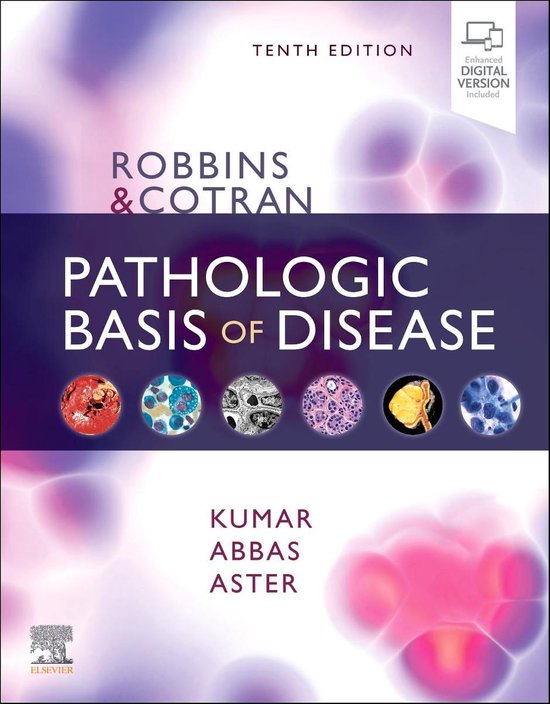
Robbins & Cotran Pathologic Basis of Disease
10th Edition
• Author(s)Vinay Kumar; Abul K. Abbas; Jon C. Aster
Chapter 1 — The Genome
Question: A 3-year-old child presents with recurrent infections.
Genetic testing reveals a single-nucleotide polymorphism (SNP)
in a noncoding region that alters transcription factor binding
near several immune genes. Which explanation best accounts
for how this noncoding SNP causes disease susceptibility?
A. It creates a new protein with toxic gain-of-function.
B. It alters chromatin structure or regulatory element activity,
changing gene expression.
C. It increases the rate of spontaneous DNA breakage in coding
sequences.
D. It leads to immediate mRNA degradation of multiple immune
genes.
Correct Answer: B
,Rationale — correct: Noncoding variants often affect
regulatory elements (enhancers/promoters) or chromatin,
altering transcription factor binding and gene expression
patterns that modulate disease susceptibility; Robbins
emphasizes regulatory noncoding DNA roles. ipokratis.gr+1
Rationale — A: Creation of a novel toxic protein requires a
coding change; a noncoding SNP doesn't produce a new
protein.
Rationale — C: SNPs in noncoding regions typically don't
directly increase DNA strand breakage in coding sequences.
Rationale — D: Immediate mRNA degradation (nonsense-
mediated decay) follows coding nonsense mutations, not
regulatory noncoding SNPs.
Teaching Point: Noncoding DNA variants commonly alter gene
expression via regulatory elements.
Citation: Robbins & Cotran, 10th Ed., Chap. 1 — The Genome.
ipokratis.gr
2. Chapter 1 — The Genome
Question: A researcher studying identical twins notes divergent
disease phenotypes despite identical DNA sequences. Which
mechanism in Robbins best explains this discordance?
A. Somatic point mutations occurring only in one twin’s
germline.
B. Epigenetic modifications that alter gene expression without
changing DNA sequence.
,C. Complete loss of the mitochondrial genome in one twin.
D. Differences in core transcriptional machinery (RNA
polymerase) primary sequence.
Correct Answer: B
Rationale — correct: Robbins describes epigenetic mechanisms
(DNA methylation, histone modifications) as central to
differential gene expression between cells or individuals with
identical genotypes, explaining phenotypic divergence.
ipokratis.gr
Rationale — A: Somatic mutations could contribute, but
identical twins typically have similar germline sequences;
somatic changes are less likely to fully explain common
discordant complex traits.
Rationale — C: Complete loss of mitochondrial genome is
catastrophic and extremely rare; not a common explanation for
twin discordance.
Rationale — D: Core transcriptional machinery is highly
conserved; primary-sequence differences between twins are
not expected.
Teaching Point: Epigenetic differences can drive phenotypic
divergence despite identical genomes.
Citation: Robbins & Cotran, 10th Ed., Chap. 1 — The Genome.
ipokratis.gr
3. Chapter 1 — Cellular Housekeeping
, Question: A patient’s muscle biopsy shows accumulation of
misfolded proteins within the endoplasmic reticulum (ER) and
activation of the unfolded protein response (UPR). Which
cellular mechanism is most relevant for preventing
accumulation of these proteins under normal conditions?
A. Mitochondrial biogenesis.
B. Ubiquitin–proteasome degradation of misfolded proteins.
C. Lysosomal exocytosis of newly synthesized proteins.
D. Increased transcription of mitochondrial DNA.
Correct Answer: B
Rationale — correct: Robbins explains that misfolded proteins
in the ER are retrotranslocated and degraded by the ubiquitin–
proteasome system; failure leads to ER stress and UPR
activation. pdfcoffee.com
Rationale — A: Mitochondrial biogenesis does not directly clear
ER misfolded proteins.
Rationale — C: Lysosomes degrade endocytosed or autophagic
cargo, but ER-localized misfolded proteins primarily use ERAD
and proteasomes.
Rationale — D: Transcription of mitochondrial DNA does not
address ER protein folding.
Teaching Point: ERAD + ubiquitin–proteasome system clears ER
misfolded proteins to prevent UPR.
Citation: Robbins & Cotran, 10th Ed., Chap. 1 — Cellular
Housekeeping; ER stress & proteasome. pdfcoffee.com
by-Chapter Questions & Verified Solutions
Robbins & Cotran Pathologic Basis of Disease
10th Edition
• Author(s)Vinay Kumar; Abul K. Abbas; Jon C. Aster
Chapter 1 — The Genome
Question: A 3-year-old child presents with recurrent infections.
Genetic testing reveals a single-nucleotide polymorphism (SNP)
in a noncoding region that alters transcription factor binding
near several immune genes. Which explanation best accounts
for how this noncoding SNP causes disease susceptibility?
A. It creates a new protein with toxic gain-of-function.
B. It alters chromatin structure or regulatory element activity,
changing gene expression.
C. It increases the rate of spontaneous DNA breakage in coding
sequences.
D. It leads to immediate mRNA degradation of multiple immune
genes.
Correct Answer: B
,Rationale — correct: Noncoding variants often affect
regulatory elements (enhancers/promoters) or chromatin,
altering transcription factor binding and gene expression
patterns that modulate disease susceptibility; Robbins
emphasizes regulatory noncoding DNA roles. ipokratis.gr+1
Rationale — A: Creation of a novel toxic protein requires a
coding change; a noncoding SNP doesn't produce a new
protein.
Rationale — C: SNPs in noncoding regions typically don't
directly increase DNA strand breakage in coding sequences.
Rationale — D: Immediate mRNA degradation (nonsense-
mediated decay) follows coding nonsense mutations, not
regulatory noncoding SNPs.
Teaching Point: Noncoding DNA variants commonly alter gene
expression via regulatory elements.
Citation: Robbins & Cotran, 10th Ed., Chap. 1 — The Genome.
ipokratis.gr
2. Chapter 1 — The Genome
Question: A researcher studying identical twins notes divergent
disease phenotypes despite identical DNA sequences. Which
mechanism in Robbins best explains this discordance?
A. Somatic point mutations occurring only in one twin’s
germline.
B. Epigenetic modifications that alter gene expression without
changing DNA sequence.
,C. Complete loss of the mitochondrial genome in one twin.
D. Differences in core transcriptional machinery (RNA
polymerase) primary sequence.
Correct Answer: B
Rationale — correct: Robbins describes epigenetic mechanisms
(DNA methylation, histone modifications) as central to
differential gene expression between cells or individuals with
identical genotypes, explaining phenotypic divergence.
ipokratis.gr
Rationale — A: Somatic mutations could contribute, but
identical twins typically have similar germline sequences;
somatic changes are less likely to fully explain common
discordant complex traits.
Rationale — C: Complete loss of mitochondrial genome is
catastrophic and extremely rare; not a common explanation for
twin discordance.
Rationale — D: Core transcriptional machinery is highly
conserved; primary-sequence differences between twins are
not expected.
Teaching Point: Epigenetic differences can drive phenotypic
divergence despite identical genomes.
Citation: Robbins & Cotran, 10th Ed., Chap. 1 — The Genome.
ipokratis.gr
3. Chapter 1 — Cellular Housekeeping
, Question: A patient’s muscle biopsy shows accumulation of
misfolded proteins within the endoplasmic reticulum (ER) and
activation of the unfolded protein response (UPR). Which
cellular mechanism is most relevant for preventing
accumulation of these proteins under normal conditions?
A. Mitochondrial biogenesis.
B. Ubiquitin–proteasome degradation of misfolded proteins.
C. Lysosomal exocytosis of newly synthesized proteins.
D. Increased transcription of mitochondrial DNA.
Correct Answer: B
Rationale — correct: Robbins explains that misfolded proteins
in the ER are retrotranslocated and degraded by the ubiquitin–
proteasome system; failure leads to ER stress and UPR
activation. pdfcoffee.com
Rationale — A: Mitochondrial biogenesis does not directly clear
ER misfolded proteins.
Rationale — C: Lysosomes degrade endocytosed or autophagic
cargo, but ER-localized misfolded proteins primarily use ERAD
and proteasomes.
Rationale — D: Transcription of mitochondrial DNA does not
address ER protein folding.
Teaching Point: ERAD + ubiquitin–proteasome system clears ER
misfolded proteins to prevent UPR.
Citation: Robbins & Cotran, 10th Ed., Chap. 1 — Cellular
Housekeeping; ER stress & proteasome. pdfcoffee.com