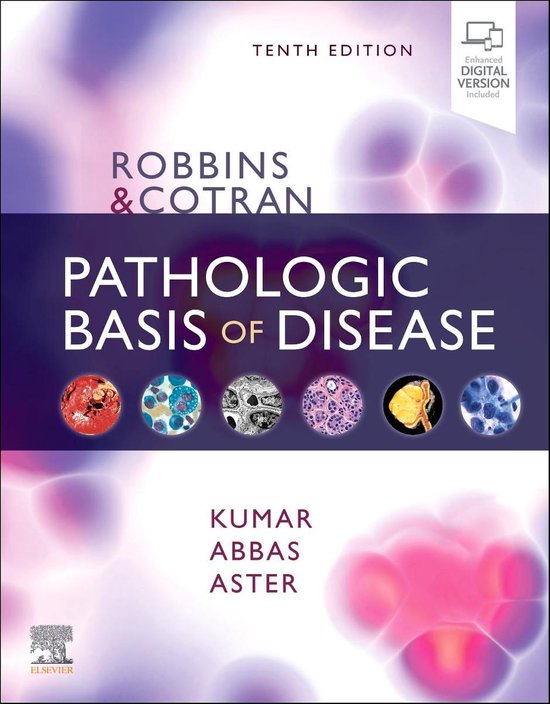
Robbins & Cotran 10th Ed. Pathology Test Bank | Chapter-
by-Chapter Questions & Verified Solutions
Robbins & Cotran Pathologic Basis of Disease
10th Edition
• Author(s)Vinay Kumar; Abul K. Abbas; Jon C. Aster
Chapter 1 — The Genome
Stem: A 45-year-old woman’s tumor shows microsatellite
instability (MSI). Which defect most likely underlies MSI in her
cancer?
A. BRCA1 mutation
B. Defective DNA mismatch repair (e.g., MLH1/PMS2)
C. Defective base-excision repair (e.g., OGG1)
D. DNA double-strand break repair deficiency (e.g., BRCA2)
Correct Answer: B
Rationales:
• B (Correct): Microsatellite instability results from defective
DNA mismatch repair proteins such as MLH1, MSH2,
MSH6, or PMS2, causing length variation in short
, repetitive sequences — a mechanism emphasized in
Robbins’ discussion of genome maintenance.
• A: BRCA1 mutations primarily impair homologous
recombination for double-strand break repair, not
mismatch repair, so they do not specifically cause MSI.
• C: Base-excision repair corrects small base alterations
(e.g., oxidative damage); its failure leads to point
mutations rather than microsatellite length changes.
• D: BRCA2 defects affect homologous recombination and
predispose to chromosomal instability rather than classic
MSI.
Teaching Point: Mismatch-repair defects cause microsatellite
instability in cancers.
Citation: Robbins & Cotran Pathologic Basis of Disease, 10th
Ed., Chap. 1, “The Genome” (DNA repair and genome stability).
2 — Chapter 1: The Genome
Stem: A neonate has lactic acidosis and hypoglycemia after
feeding; testing reveals a large-scale mitochondrial DNA
(mtDNA) deletion. Which feature best explains why symptoms
are variably expressed among family members?
A. Heteroplasmy of mtDNA
B. X-linked inheritance of mtDNA
C. Exclusive paternal inheritance of mtDNA
D. Mosaic loss of nuclear-encoded mitochondrial genes
,Correct Answer: A
Rationales:
• A (Correct): Heteroplasmy — coexistence of mutant and
wild-type mtDNA within cells — produces variable clinical
expression and threshold effects, a key concept in
Robbins’ section on mitochondrial genetics.
• B: mtDNA is not X-linked; it is present in mitochondria and
inherited through the maternal line, not the X
chromosome.
• C: mtDNA is typically inherited maternally, not paternally,
so exclusive paternal inheritance is incorrect.
• D: While nuclear gene defects can affect mitochondria, the
described variable family expression for an mtDNA
deletion is best explained by heteroplasmy.
Teaching Point: Heteroplasmy causes variable clinical severity
in mitochondrial disorders.
Citation: Robbins & Cotran, Chap. 1, “The Genome”
(mitochondrial genetics).
3 — Chapter 1: Cellular Housekeeping
Stem: A patient’s biopsy shows accumulation of ubiquitylated,
aggregated proteins in neurons. Which cellular pathway is
primarily responsible for clearing such misfolded proteins under
normal conditions?
, A. Autophagy–lysosomal pathway
B. Ubiquitin–proteasome system (UPS)
C. Mitochondrial unfolded protein response
D. Endoplasmic reticulum-associated degradation (ERAD)
exclusively
Correct Answer: B
Rationales:
• B (Correct): The ubiquitin–proteasome system tags soluble
misfolded or short-lived proteins for proteasomal
degradation; failure leads to accumulation of ubiquitylated
aggregates, as discussed under cellular housekeeping in
Robbins.
• A: Autophagy handles larger structures and organelles
(and aggregates when UPS is overwhelmed) but the UPS is
the primary route for ubiquitylated soluble proteins.
• C: The mitochondrial unfolded protein response is a stress
response within mitochondria, not the main pathway for
cytosolic ubiquitylated proteins.
• D: ERAD specifically targets misfolded proteins in the ER
for proteasomal degradation, but the UPS is the broader
system for ubiquitylated proteins.
Teaching Point: The ubiquitin–proteasome system degrades
most ubiquitylated soluble proteins.
Citation: Robbins & Cotran, Chap. 1, “Cellular Housekeeping”
(protein degradation systems).
by-Chapter Questions & Verified Solutions
Robbins & Cotran Pathologic Basis of Disease
10th Edition
• Author(s)Vinay Kumar; Abul K. Abbas; Jon C. Aster
Chapter 1 — The Genome
Stem: A 45-year-old woman’s tumor shows microsatellite
instability (MSI). Which defect most likely underlies MSI in her
cancer?
A. BRCA1 mutation
B. Defective DNA mismatch repair (e.g., MLH1/PMS2)
C. Defective base-excision repair (e.g., OGG1)
D. DNA double-strand break repair deficiency (e.g., BRCA2)
Correct Answer: B
Rationales:
• B (Correct): Microsatellite instability results from defective
DNA mismatch repair proteins such as MLH1, MSH2,
MSH6, or PMS2, causing length variation in short
, repetitive sequences — a mechanism emphasized in
Robbins’ discussion of genome maintenance.
• A: BRCA1 mutations primarily impair homologous
recombination for double-strand break repair, not
mismatch repair, so they do not specifically cause MSI.
• C: Base-excision repair corrects small base alterations
(e.g., oxidative damage); its failure leads to point
mutations rather than microsatellite length changes.
• D: BRCA2 defects affect homologous recombination and
predispose to chromosomal instability rather than classic
MSI.
Teaching Point: Mismatch-repair defects cause microsatellite
instability in cancers.
Citation: Robbins & Cotran Pathologic Basis of Disease, 10th
Ed., Chap. 1, “The Genome” (DNA repair and genome stability).
2 — Chapter 1: The Genome
Stem: A neonate has lactic acidosis and hypoglycemia after
feeding; testing reveals a large-scale mitochondrial DNA
(mtDNA) deletion. Which feature best explains why symptoms
are variably expressed among family members?
A. Heteroplasmy of mtDNA
B. X-linked inheritance of mtDNA
C. Exclusive paternal inheritance of mtDNA
D. Mosaic loss of nuclear-encoded mitochondrial genes
,Correct Answer: A
Rationales:
• A (Correct): Heteroplasmy — coexistence of mutant and
wild-type mtDNA within cells — produces variable clinical
expression and threshold effects, a key concept in
Robbins’ section on mitochondrial genetics.
• B: mtDNA is not X-linked; it is present in mitochondria and
inherited through the maternal line, not the X
chromosome.
• C: mtDNA is typically inherited maternally, not paternally,
so exclusive paternal inheritance is incorrect.
• D: While nuclear gene defects can affect mitochondria, the
described variable family expression for an mtDNA
deletion is best explained by heteroplasmy.
Teaching Point: Heteroplasmy causes variable clinical severity
in mitochondrial disorders.
Citation: Robbins & Cotran, Chap. 1, “The Genome”
(mitochondrial genetics).
3 — Chapter 1: Cellular Housekeeping
Stem: A patient’s biopsy shows accumulation of ubiquitylated,
aggregated proteins in neurons. Which cellular pathway is
primarily responsible for clearing such misfolded proteins under
normal conditions?
, A. Autophagy–lysosomal pathway
B. Ubiquitin–proteasome system (UPS)
C. Mitochondrial unfolded protein response
D. Endoplasmic reticulum-associated degradation (ERAD)
exclusively
Correct Answer: B
Rationales:
• B (Correct): The ubiquitin–proteasome system tags soluble
misfolded or short-lived proteins for proteasomal
degradation; failure leads to accumulation of ubiquitylated
aggregates, as discussed under cellular housekeeping in
Robbins.
• A: Autophagy handles larger structures and organelles
(and aggregates when UPS is overwhelmed) but the UPS is
the primary route for ubiquitylated soluble proteins.
• C: The mitochondrial unfolded protein response is a stress
response within mitochondria, not the main pathway for
cytosolic ubiquitylated proteins.
• D: ERAD specifically targets misfolded proteins in the ER
for proteasomal degradation, but the UPS is the broader
system for ubiquitylated proteins.
Teaching Point: The ubiquitin–proteasome system degrades
most ubiquitylated soluble proteins.
Citation: Robbins & Cotran, Chap. 1, “Cellular Housekeeping”
(protein degradation systems).