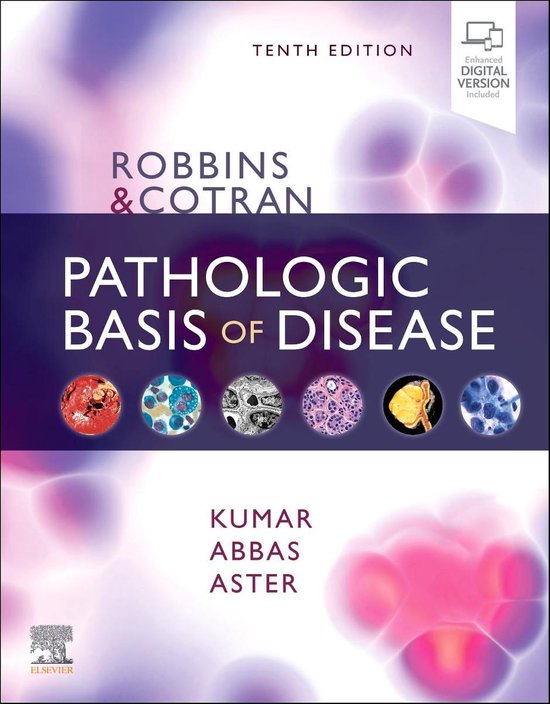
Robbins & Cotran 10th Ed. Pathology Test Bank | Chapter-
by-Chapter Questions & Verified Solutions
Robbins & Cotran Pathologic Basis of Disease
10th Edition
• Author(s)Vinay Kumar; Abul K. Abbas; Jon C. Aster
Chapter 1 — The Genome
Question: A 45-year-old man’s tumor shows loss of
heterozygosity at a locus encoding a DNA repair protein; his
tumor rapidly accumulates mutations. Which genomic
mechanism best explains the accelerated mutation rate?
A. Somatic activation of telomerase
B. Inactivation of mismatch repair genes
C. Overexpression of histone deacetylases
D. Increased microRNA-mediated silencing of oncogenes
Correct Answer: B
Rationales:
• B (Correct): Inactivation of DNA mismatch repair (MMR)
genes causes failure to correct replication errors,
, producing a high mutation rate (microsatellite instability)
and rapid tumor evolution, as described in Robbins.
• A: Telomerase activation preserves telomeres and enables
immortalization but does not directly increase mutation
accumulation.
• C: Histone deacetylase overexpression alters chromatin
and gene expression but is not the primary cause of
widespread replication errors.
• D: Increased microRNA silencing would reduce expression
of target genes; silencing oncogenes would not explain
increased mutation burden.
Teaching Point: Loss of mismatch repair leads to high mutation
rates and microsatellite instability.
Citation: Robbins & Cotran, Ch. 1 — The Genome
2. Chapter 1 — The Genome
Question: A newborn is diagnosed with an inherited defect in a
mitochondrial tRNA gene. Which feature best predicts tissue-
specific clinical severity?
A. Degree of heteroplasmy (proportion of mutant
mitochondria) in affected tissues
B. Parental age at conception
C. Number of nuclear-encoded mitochondrial proteins mutated
D. Presence of X-linked carrier status
,Correct Answer: A
Rationales:
• A (Correct): Mitochondrial diseases vary with
heteroplasmy—the proportion of mutant mitochondria
differs among tissues, determining severity in energy-
demanding organs, per Robbins.
• B: Parental age influences nuclear mutation risk but is not
the main determinant of mitochondrial tRNA disease
severity.
• C: Nuclear-encoded mutations affect mitochondria but are
distinct from mtDNA tRNA defects and have different
inheritance.
• D: X-linked status is irrelevant for strictly mitochondrial
DNA–encoded tRNA mutations.
Teaching Point: Heteroplasmy determines phenotype severity
in mitochondrial genetic diseases.
Citation: Robbins & Cotran, Ch. 1 — The Genome
3. Chapter 1 — The Genome
Question: A patient’s cancer sequencing shows a single-base
substitution that replaces a glycine with a valine in a critical
protein, disrupting its function. What type of mutation is most
consistent with this finding?
A. Nonsense mutation
, B. Missense mutation
C. Frameshift mutation
D. Silent mutation
Correct Answer: B
Rationales:
• B (Correct): A missense mutation is a base substitution
that changes one amino acid to another, which can alter
protein function as described in Robbins.
• A: A nonsense mutation changes a codon to a stop codon,
truncating the protein rather than substituting a residue.
• C: Frameshift results from insertions/deletions altering the
reading frame, not a single amino acid swap.
• D: A silent mutation does not change the encoded amino
acid and thus wouldn’t substitute glycine for valine.
Teaching Point: Missense mutations substitute one amino acid
for another, potentially altering protein function.
Citation: Robbins & Cotran, Ch. 1 — The Genome
4. Chapter 1 — Cellular Housekeeping
Question: A patient presents with progressive
neurodegeneration due to accumulation of ubiquitinated
proteins in neurons. Which intracellular system is most likely
defective?
A. Autophagy–lysosomal pathway
by-Chapter Questions & Verified Solutions
Robbins & Cotran Pathologic Basis of Disease
10th Edition
• Author(s)Vinay Kumar; Abul K. Abbas; Jon C. Aster
Chapter 1 — The Genome
Question: A 45-year-old man’s tumor shows loss of
heterozygosity at a locus encoding a DNA repair protein; his
tumor rapidly accumulates mutations. Which genomic
mechanism best explains the accelerated mutation rate?
A. Somatic activation of telomerase
B. Inactivation of mismatch repair genes
C. Overexpression of histone deacetylases
D. Increased microRNA-mediated silencing of oncogenes
Correct Answer: B
Rationales:
• B (Correct): Inactivation of DNA mismatch repair (MMR)
genes causes failure to correct replication errors,
, producing a high mutation rate (microsatellite instability)
and rapid tumor evolution, as described in Robbins.
• A: Telomerase activation preserves telomeres and enables
immortalization but does not directly increase mutation
accumulation.
• C: Histone deacetylase overexpression alters chromatin
and gene expression but is not the primary cause of
widespread replication errors.
• D: Increased microRNA silencing would reduce expression
of target genes; silencing oncogenes would not explain
increased mutation burden.
Teaching Point: Loss of mismatch repair leads to high mutation
rates and microsatellite instability.
Citation: Robbins & Cotran, Ch. 1 — The Genome
2. Chapter 1 — The Genome
Question: A newborn is diagnosed with an inherited defect in a
mitochondrial tRNA gene. Which feature best predicts tissue-
specific clinical severity?
A. Degree of heteroplasmy (proportion of mutant
mitochondria) in affected tissues
B. Parental age at conception
C. Number of nuclear-encoded mitochondrial proteins mutated
D. Presence of X-linked carrier status
,Correct Answer: A
Rationales:
• A (Correct): Mitochondrial diseases vary with
heteroplasmy—the proportion of mutant mitochondria
differs among tissues, determining severity in energy-
demanding organs, per Robbins.
• B: Parental age influences nuclear mutation risk but is not
the main determinant of mitochondrial tRNA disease
severity.
• C: Nuclear-encoded mutations affect mitochondria but are
distinct from mtDNA tRNA defects and have different
inheritance.
• D: X-linked status is irrelevant for strictly mitochondrial
DNA–encoded tRNA mutations.
Teaching Point: Heteroplasmy determines phenotype severity
in mitochondrial genetic diseases.
Citation: Robbins & Cotran, Ch. 1 — The Genome
3. Chapter 1 — The Genome
Question: A patient’s cancer sequencing shows a single-base
substitution that replaces a glycine with a valine in a critical
protein, disrupting its function. What type of mutation is most
consistent with this finding?
A. Nonsense mutation
, B. Missense mutation
C. Frameshift mutation
D. Silent mutation
Correct Answer: B
Rationales:
• B (Correct): A missense mutation is a base substitution
that changes one amino acid to another, which can alter
protein function as described in Robbins.
• A: A nonsense mutation changes a codon to a stop codon,
truncating the protein rather than substituting a residue.
• C: Frameshift results from insertions/deletions altering the
reading frame, not a single amino acid swap.
• D: A silent mutation does not change the encoded amino
acid and thus wouldn’t substitute glycine for valine.
Teaching Point: Missense mutations substitute one amino acid
for another, potentially altering protein function.
Citation: Robbins & Cotran, Ch. 1 — The Genome
4. Chapter 1 — Cellular Housekeeping
Question: A patient presents with progressive
neurodegeneration due to accumulation of ubiquitinated
proteins in neurons. Which intracellular system is most likely
defective?
A. Autophagy–lysosomal pathway