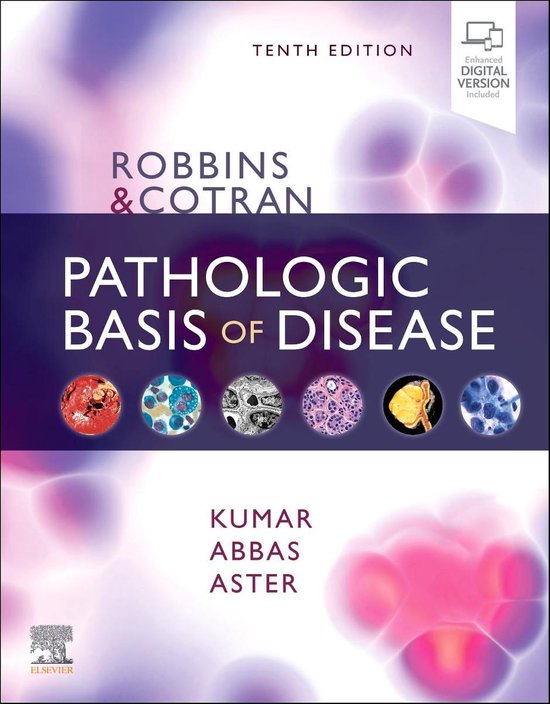
Robbins & Cotran 10th Ed. Pathology Test Bank | Chapter-
by-Chapter Questions & Verified Solutions
Robbins & Cotran Pathologic Basis of Disease
10th Edition
• Author(s)Vinay Kumar; Abul K. Abbas; Jon C. Aster
• Chapter 1 — The Genome
A 35-year-old woman undergoes genetic testing after several
family members are diagnosed with early-onset breast cancer. A
variant is found that alters a DNA base but does not change the
encoded amino acid. Which term best describes this variant?
A. Missense mutation
B. Nonsense mutation
C. Silent mutation
D. Frameshift mutation
Correct Answer: C
Rationales:
• C (Correct): A silent mutation changes a nucleotide but
not the encoded amino acid due to redundancy in the
genetic code; Robbins describes this as a nucleotide
substitution that does not alter protein sequence.
, • A: Missense mutations change one amino acid to another
and can alter protein function, so this is incorrect.
• B: Nonsense mutations create a premature stop codon,
truncating proteins; the described variant does not do so.
• D: Frameshift mutations are insertions/deletions altering
the reading frame, not single-base substitutions that leave
amino acids unchanged.
Teaching Point: Silent substitutions change DNA sequence
without altering amino acid sequence.
Citation: Robbins & Cotran, 10th ed., Chapter 1 — The
Genome (point mutations and consequences)
2. Chapter 1 — The Genome
A patient’s tumor shows loss of heterozygosity at a locus
harboring a tumor suppressor gene. Which mechanism most
commonly explains how this promotes tumorigenesis?
A. Activation of a proto-oncogene via point mutation
B. Loss of the remaining functional allele of the tumor
suppressor
C. Increased gene dosage of the tumor suppressor by
amplification
D. Gain of a dominant negative mutant allele
Correct Answer: B
Rationales:
, • B (Correct): Loss of heterozygosity typically eliminates
the remaining functional allele of a tumor suppressor,
removing growth restraints; Robbins emphasizes this as a
common step in tumorigenesis.
• A: Activation of proto-oncogenes is oncogenic but is not
the consequence of LOH at a tumor suppressor locus.
• C: Gene amplification increases dosage (usually of
oncogenes), not LOH of tumor suppressors.
• D: Dominant negative alleles can inhibit function, but LOH
refers to physical loss of the functional allele, not gain of a
dominant negative.
Teaching Point: LOH removes the remaining functional tumor
suppressor allele, facilitating cancer progression.
Citation: Robbins & Cotran, 10th ed., Chapter 1 — The
Genome (tumor suppressor genes and LOH)
3. Chapter 1 — The Genome
A neonate is diagnosed with a mitochondrial disorder
characterized by poor oxidative phosphorylation and lactic
acidosis. Which inheritance pattern is most consistent with
primary mitochondrial DNA mutations?
A. Autosomal dominant
B. Autosomal recessive
C. Maternal (maternally inherited)
D. X-linked recessive
Correct Answer: C
, Rationales:
• C (Correct): Mitochondrial DNA is inherited maternally
because mitochondria in the zygote are derived from the
egg; Robbins covers maternal inheritance of mtDNA
mutations.
• A/B: Nuclear gene mutations affecting mitochondrial
function can be autosomal, but primary mtDNA mutations
classically show maternal inheritance.
• D: X-linked inheritance involves genes on the X
chromosome in the nucleus, not mitochondrial genome
transmission.
Teaching Point: Primary mitochondrial DNA mutations are
transmitted maternally.
Citation: Robbins & Cotran, 10th ed., Chapter 1 — The
Genome (mitochondrial genetics)
4. Chapter 1 — Cellular Housekeeping
A biopsy of neurodegenerative tissue shows intracellular
aggregates of misfolded proteins resistant to degradation.
Impairment of which pathway best explains this accumulation?
A. Ubiquitin–proteasome pathway
B. Lysosomal turnover of organelles (autophagy)
C. Mitochondrial oxidative phosphorylation
D. Endoplasmic reticulum–Golgi secretory pathway
Correct Answer: A
by-Chapter Questions & Verified Solutions
Robbins & Cotran Pathologic Basis of Disease
10th Edition
• Author(s)Vinay Kumar; Abul K. Abbas; Jon C. Aster
• Chapter 1 — The Genome
A 35-year-old woman undergoes genetic testing after several
family members are diagnosed with early-onset breast cancer. A
variant is found that alters a DNA base but does not change the
encoded amino acid. Which term best describes this variant?
A. Missense mutation
B. Nonsense mutation
C. Silent mutation
D. Frameshift mutation
Correct Answer: C
Rationales:
• C (Correct): A silent mutation changes a nucleotide but
not the encoded amino acid due to redundancy in the
genetic code; Robbins describes this as a nucleotide
substitution that does not alter protein sequence.
, • A: Missense mutations change one amino acid to another
and can alter protein function, so this is incorrect.
• B: Nonsense mutations create a premature stop codon,
truncating proteins; the described variant does not do so.
• D: Frameshift mutations are insertions/deletions altering
the reading frame, not single-base substitutions that leave
amino acids unchanged.
Teaching Point: Silent substitutions change DNA sequence
without altering amino acid sequence.
Citation: Robbins & Cotran, 10th ed., Chapter 1 — The
Genome (point mutations and consequences)
2. Chapter 1 — The Genome
A patient’s tumor shows loss of heterozygosity at a locus
harboring a tumor suppressor gene. Which mechanism most
commonly explains how this promotes tumorigenesis?
A. Activation of a proto-oncogene via point mutation
B. Loss of the remaining functional allele of the tumor
suppressor
C. Increased gene dosage of the tumor suppressor by
amplification
D. Gain of a dominant negative mutant allele
Correct Answer: B
Rationales:
, • B (Correct): Loss of heterozygosity typically eliminates
the remaining functional allele of a tumor suppressor,
removing growth restraints; Robbins emphasizes this as a
common step in tumorigenesis.
• A: Activation of proto-oncogenes is oncogenic but is not
the consequence of LOH at a tumor suppressor locus.
• C: Gene amplification increases dosage (usually of
oncogenes), not LOH of tumor suppressors.
• D: Dominant negative alleles can inhibit function, but LOH
refers to physical loss of the functional allele, not gain of a
dominant negative.
Teaching Point: LOH removes the remaining functional tumor
suppressor allele, facilitating cancer progression.
Citation: Robbins & Cotran, 10th ed., Chapter 1 — The
Genome (tumor suppressor genes and LOH)
3. Chapter 1 — The Genome
A neonate is diagnosed with a mitochondrial disorder
characterized by poor oxidative phosphorylation and lactic
acidosis. Which inheritance pattern is most consistent with
primary mitochondrial DNA mutations?
A. Autosomal dominant
B. Autosomal recessive
C. Maternal (maternally inherited)
D. X-linked recessive
Correct Answer: C
, Rationales:
• C (Correct): Mitochondrial DNA is inherited maternally
because mitochondria in the zygote are derived from the
egg; Robbins covers maternal inheritance of mtDNA
mutations.
• A/B: Nuclear gene mutations affecting mitochondrial
function can be autosomal, but primary mtDNA mutations
classically show maternal inheritance.
• D: X-linked inheritance involves genes on the X
chromosome in the nucleus, not mitochondrial genome
transmission.
Teaching Point: Primary mitochondrial DNA mutations are
transmitted maternally.
Citation: Robbins & Cotran, 10th ed., Chapter 1 — The
Genome (mitochondrial genetics)
4. Chapter 1 — Cellular Housekeeping
A biopsy of neurodegenerative tissue shows intracellular
aggregates of misfolded proteins resistant to degradation.
Impairment of which pathway best explains this accumulation?
A. Ubiquitin–proteasome pathway
B. Lysosomal turnover of organelles (autophagy)
C. Mitochondrial oxidative phosphorylation
D. Endoplasmic reticulum–Golgi secretory pathway
Correct Answer: A