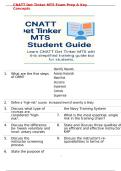
CNATT Det Tinker MTS Exam Prep & Key
Concepts
Identify Hazards
1. What are the five steps Assess Hazards
of ORM? Make Risk
Decisions
Implement
Controls
Supervise
2. Define a "high-risk" course. Increased level of severity is likely.
3. Discuss what type of the Navy Training System
courses are
considered "high- 7. What is the most essential, single
risk". link in the training chain?
4. Discuss the difference 8. State and Discuss three qualities of
be- tween voluntary and an efficient and effective instructor.
invol- untary courses KAP
5. Discuss the 9. Discuss the instructor's re-
instructor screening sponsibilities in terms of
process
6. State the purpose of
1/
25
, CNATT Det Tinker MTS Exam Prep & Key
Concepts
Courses like Aircrew and BUDS. )bility
(P)ersonality
Student
Voluntary - Has the ability to Drop-on- Training Safety
Request (DOR). Involuntary - Follow-
on training of specialty school.
Form 1306/92
To ensure a systematic approach for
determining what to train and how best to
accomplish that training.
The Instructor.
(
K
)
n
o
w
l
e
d
g
e
(
A
2/
25
, CNATT Det Tinker MTS Exam Prep & Key
Concepts
NAVETRA 134 (Navy In- Security
structor Manual) Curriculum
10. What are the Four (C)onfidence
princi- ples of John
Keller's Mod- el of (A)ttention
Motivational Theory? (R)elevance
CARS (S)atisfaction
11. What are the key
principles of applying the (N)eeds &
Motivation- al Theory in a Drives
training situ- ation? (A)ttitudes
NAAVII
(A)chievements
(V)alue
(I)nterest
12. State the ultimate goal
of instruction. (I)ncentives
13. What are the six Laws To cause students to remain motivated beyond the instructor's
of Learning? RIPEER influence, and apply what they have learned on the job.
(R)ecency
(I)ntensity
(P)rimacy
14. What are the five ways
of learning? ATITI (E)ttect
(E)exercise
(R)eadiness
(A)ssociatio
n (T)rial &
Error
(I)mitation
(T)ransfer
(I)nsight
3/
25
Concepts
Identify Hazards
1. What are the five steps Assess Hazards
of ORM? Make Risk
Decisions
Implement
Controls
Supervise
2. Define a "high-risk" course. Increased level of severity is likely.
3. Discuss what type of the Navy Training System
courses are
considered "high- 7. What is the most essential, single
risk". link in the training chain?
4. Discuss the difference 8. State and Discuss three qualities of
be- tween voluntary and an efficient and effective instructor.
invol- untary courses KAP
5. Discuss the 9. Discuss the instructor's re-
instructor screening sponsibilities in terms of
process
6. State the purpose of
1/
25
, CNATT Det Tinker MTS Exam Prep & Key
Concepts
Courses like Aircrew and BUDS. )bility
(P)ersonality
Student
Voluntary - Has the ability to Drop-on- Training Safety
Request (DOR). Involuntary - Follow-
on training of specialty school.
Form 1306/92
To ensure a systematic approach for
determining what to train and how best to
accomplish that training.
The Instructor.
(
K
)
n
o
w
l
e
d
g
e
(
A
2/
25
, CNATT Det Tinker MTS Exam Prep & Key
Concepts
NAVETRA 134 (Navy In- Security
structor Manual) Curriculum
10. What are the Four (C)onfidence
princi- ples of John
Keller's Mod- el of (A)ttention
Motivational Theory? (R)elevance
CARS (S)atisfaction
11. What are the key
principles of applying the (N)eeds &
Motivation- al Theory in a Drives
training situ- ation? (A)ttitudes
NAAVII
(A)chievements
(V)alue
(I)nterest
12. State the ultimate goal
of instruction. (I)ncentives
13. What are the six Laws To cause students to remain motivated beyond the instructor's
of Learning? RIPEER influence, and apply what they have learned on the job.
(R)ecency
(I)ntensity
(P)rimacy
14. What are the five ways
of learning? ATITI (E)ttect
(E)exercise
(R)eadiness
(A)ssociatio
n (T)rial &
Error
(I)mitation
(T)ransfer
(I)nsight
3/
25