
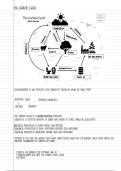
The carbon cycle
& ---
Atmospher
fai
/ 38M$414/ I
or Photoune a
,
Anima - - -
feeding plants
I
Cars and factories
&
- - S
-
-
-
I decomposition Slow
I
&
death and waste Crude Oil
- - - S
Sequestration is the process that carbon is stored in liquid or solid form
Anthropo Genic (Positive feedback)
↓ t
Humans Creation
The carbon cycle is a biogeochemical process
Carbon is a common element of earth and exists in a gas, liquid or solid form
Biological processes in living plants and animals
Geological processes in rock formation erosion and deposition
Chemical process in reactions under heat and pressure
Humans in the last 200 years have been using fossil fuels for combustion which have upset the
dynamic equilibrium of carbon on earth
China is the biggest co2 emmiter due to
manufacturing but also the middle class wave
because
,Types of greenhouse Gases
81% carbon dioxide > Energy supply, industry, transportation, forestry
-
10% methane >
-
Waste and water, livestock
7% nitrous oxide Agriculture, pesticides
>
-
3% fluoridated gases Commercial buildings, residential buildings
>
-
1, water vapour L
IPCC state 70% of the natural greenhouse effect is due to water. It forms
clouds, main source is the ocean but humans produce it too to add to the
E-GHE
2, carbon dioxide -
Most modern human activity releases carbon dioxide meaning a greater
abundance in the atmosphere
3, methane -
80x the warming power of carbon dioxide but only spends around 20 years in the
atmosphere- agriculture is the main source
4, nitrous oxide 300x more effective at trapping heat then carbon dioxide over a 100 year
-
period. Main source is agriculture but is also used in rocket fuel, aerosols,
anaesthetic and recreational drug abuse
1 pentagram (pg) is the same as 1 gigatonne (Gt)
1 Gigatonne is 1000 megatonnes
1 Gigatonne is 1,000,000,000 tonnes
So my carbon footprint is 17.4 tonnes which in Gt/Pg
0.00000000174 Of CO2
, Carbon store
Carbon sink An area where large amounts of carbon is kept for
A natural area that removes carbon long periods of time
directly out of the atmosphere than it Most of the earths carbon is stored in the
releases lithosphere (over 100 million PgC)
The ocean is the biggest carbon sink Rocks therefore store the most carbon
Some carbon sinks can also be A lot of what is stored in the lithosphere is stored
carbon stores but not all carbon in the form of fossil fuels such as coal and oil
stores can be carbon sinks Carbon can be stored in the hydrosphere (oceans)
Soil is perhaps the key carbon sink/ atmosphere, biosphere (living things) and cryosphere
store that gets ignored often (permafrost)
When carbon shifts from one store to another store
it is called a flux
Carbon sinks contribute to the process of a flux
Best carbon stores
Boreal forests
Coniferous forests made up of pine, firs and spruce trees
73% are in Russia (Serbia)
Temperate forests
Also called deciduous forests, these are made up of trees that respond to changes in the
seasons
Oak, birch, ash and maple trees
North America has 3 of the largest temperate forests crossing the borders of the USA and
Canada
Temperate grasslands
The largest is the prairies in north America home of the bison
Tropical Rainforest
Are the oldest biomes on earth most of which haven’t been fully explored yet
Largest is the Amazon Rainforest which stretches across 9 countries of south America (Brazil,
Bolivia, Columbia, Ecuador, Guyana, Peru, Suriname, Venezuela and French Guiana
Wetlands
Wetlands are unique and far reaching. They are often referred to as floodplains or marshes and
so coexist alongside rivers that are prone to annual floods
The largest wetland and by far the most biodiversity and biggest store of carbon is the Pantanal
in Brazil along the Amazon river. Home to the Capybara
, Stores, Sinks and Processes
The carbon cycle is a Biogeochemical cycle whereby carbon is stored and moved between the
reservoirs called the biosphere, lithosphere, cryosphere, pedosphere, hydrosphere and
atmosphere. These movements are called fluxes. It is a closed system which means that there are
no external inputs or outputs it is just what exists here on earth. Most of Earth’s carbon is stored
in the lithosphere (over 100 million). Around 38,000 PgC is stored in earth’s biggest carbon sink the
oceans. Stores of carbon have sequestered carbon for millions of years as part of the long-
term carbon cycle. Human actions (Anthropogenic) have altered the equilibrium of the carbon
cycle mainly through processes such as combustion of fossil fuels which is all part of the fast
or short term carbon cycle
Whilst deforestation is of course a source of CO2 release, the Industrial Revolution of the
early 1800s was the major acceleration Turing point of human impact on the carbon cycle
1750- 280ppm CO2 concentration balanced (the same every year pretty much either side of 1750s)
1900- 301ppm CO2 concentration and rising
2000- 370Ppm CO2 concentration and still rising
2023- 410ppm co2 concentration and predicted to keep rising
Volcanic Out Gassing produces 0.1Pgc per year on average
Anthropogenic factors produces 4.0PgC per year on average
Wetlands/Peatlands Boreal Forests Tropical Rainforest
646Pgc absorbed on 408Pgc absorbed on 243Pgc absorbed on
average per year by average per year by average per year by
soils and vegetation soils and vegetation soils and vegetation
(The Pantanal, Brazil) (The Taiga, North America) (Amazon Rainforest)
& ---
Atmospher
fai
/ 38M$414/ I
or Photoune a
,
Anima - - -
feeding plants
I
Cars and factories
&
- - S
-
-
-
I decomposition Slow
I
&
death and waste Crude Oil
- - - S
Sequestration is the process that carbon is stored in liquid or solid form
Anthropo Genic (Positive feedback)
↓ t
Humans Creation
The carbon cycle is a biogeochemical process
Carbon is a common element of earth and exists in a gas, liquid or solid form
Biological processes in living plants and animals
Geological processes in rock formation erosion and deposition
Chemical process in reactions under heat and pressure
Humans in the last 200 years have been using fossil fuels for combustion which have upset the
dynamic equilibrium of carbon on earth
China is the biggest co2 emmiter due to
manufacturing but also the middle class wave
because
,Types of greenhouse Gases
81% carbon dioxide > Energy supply, industry, transportation, forestry
-
10% methane >
-
Waste and water, livestock
7% nitrous oxide Agriculture, pesticides
>
-
3% fluoridated gases Commercial buildings, residential buildings
>
-
1, water vapour L
IPCC state 70% of the natural greenhouse effect is due to water. It forms
clouds, main source is the ocean but humans produce it too to add to the
E-GHE
2, carbon dioxide -
Most modern human activity releases carbon dioxide meaning a greater
abundance in the atmosphere
3, methane -
80x the warming power of carbon dioxide but only spends around 20 years in the
atmosphere- agriculture is the main source
4, nitrous oxide 300x more effective at trapping heat then carbon dioxide over a 100 year
-
period. Main source is agriculture but is also used in rocket fuel, aerosols,
anaesthetic and recreational drug abuse
1 pentagram (pg) is the same as 1 gigatonne (Gt)
1 Gigatonne is 1000 megatonnes
1 Gigatonne is 1,000,000,000 tonnes
So my carbon footprint is 17.4 tonnes which in Gt/Pg
0.00000000174 Of CO2
, Carbon store
Carbon sink An area where large amounts of carbon is kept for
A natural area that removes carbon long periods of time
directly out of the atmosphere than it Most of the earths carbon is stored in the
releases lithosphere (over 100 million PgC)
The ocean is the biggest carbon sink Rocks therefore store the most carbon
Some carbon sinks can also be A lot of what is stored in the lithosphere is stored
carbon stores but not all carbon in the form of fossil fuels such as coal and oil
stores can be carbon sinks Carbon can be stored in the hydrosphere (oceans)
Soil is perhaps the key carbon sink/ atmosphere, biosphere (living things) and cryosphere
store that gets ignored often (permafrost)
When carbon shifts from one store to another store
it is called a flux
Carbon sinks contribute to the process of a flux
Best carbon stores
Boreal forests
Coniferous forests made up of pine, firs and spruce trees
73% are in Russia (Serbia)
Temperate forests
Also called deciduous forests, these are made up of trees that respond to changes in the
seasons
Oak, birch, ash and maple trees
North America has 3 of the largest temperate forests crossing the borders of the USA and
Canada
Temperate grasslands
The largest is the prairies in north America home of the bison
Tropical Rainforest
Are the oldest biomes on earth most of which haven’t been fully explored yet
Largest is the Amazon Rainforest which stretches across 9 countries of south America (Brazil,
Bolivia, Columbia, Ecuador, Guyana, Peru, Suriname, Venezuela and French Guiana
Wetlands
Wetlands are unique and far reaching. They are often referred to as floodplains or marshes and
so coexist alongside rivers that are prone to annual floods
The largest wetland and by far the most biodiversity and biggest store of carbon is the Pantanal
in Brazil along the Amazon river. Home to the Capybara
, Stores, Sinks and Processes
The carbon cycle is a Biogeochemical cycle whereby carbon is stored and moved between the
reservoirs called the biosphere, lithosphere, cryosphere, pedosphere, hydrosphere and
atmosphere. These movements are called fluxes. It is a closed system which means that there are
no external inputs or outputs it is just what exists here on earth. Most of Earth’s carbon is stored
in the lithosphere (over 100 million). Around 38,000 PgC is stored in earth’s biggest carbon sink the
oceans. Stores of carbon have sequestered carbon for millions of years as part of the long-
term carbon cycle. Human actions (Anthropogenic) have altered the equilibrium of the carbon
cycle mainly through processes such as combustion of fossil fuels which is all part of the fast
or short term carbon cycle
Whilst deforestation is of course a source of CO2 release, the Industrial Revolution of the
early 1800s was the major acceleration Turing point of human impact on the carbon cycle
1750- 280ppm CO2 concentration balanced (the same every year pretty much either side of 1750s)
1900- 301ppm CO2 concentration and rising
2000- 370Ppm CO2 concentration and still rising
2023- 410ppm co2 concentration and predicted to keep rising
Volcanic Out Gassing produces 0.1Pgc per year on average
Anthropogenic factors produces 4.0PgC per year on average
Wetlands/Peatlands Boreal Forests Tropical Rainforest
646Pgc absorbed on 408Pgc absorbed on 243Pgc absorbed on
average per year by average per year by average per year by
soils and vegetation soils and vegetation soils and vegetation
(The Pantanal, Brazil) (The Taiga, North America) (Amazon Rainforest)


