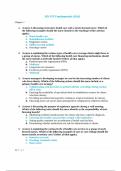
SCI 131
Introduction to Nutrition
Final Exam Review
(With Solutions)
2025
1. A 45-year-old patient with 40% total body surface area burns has a resting
energy expenditure (REE) measured by indirect calorimetry of 2,800 kcal/day.
Which prescription most accurately meets his protein needs to support wound
healing?
a. 0.8 g/kg/day
b. 1.0 g/kg/day
c. 1.5 g/kg/day
d. 2.5 g/kg/day
ANS: d. 2.5 g/kg/day
Rationale: Severe burns induce a hypermetabolic, catabolic state. Guidelines
recommend 2.0–2.5 g/kg protein to maintain lean mass and support tissue
repair.
2. A 60-year-old man with end-stage renal disease on thrice-weekly hemodialysis
requires adjusted protein intake. His dry weight is 70 kg. Which daily protein
target is most appropriate?
a. 0.6 g/kg
b. 0.8 g/kg
c. 1.0 g/kg
d. 1.2 g/kg
ANS: d. 1.2 g/kg
Rationale: Dialysis removes amino acids and accelerates catabolism. Protein
needs increase to 1.2 g/kg to prevent protein–energy wasting.
3. A 28-year-old woman with phenylketonuria (PKU) presents for dietary
counseling. Which artificial sweetener should she avoid?
a. Aspartame
b. Sucralose
c. Saccharin
d. Stevia
ANS: a. Aspartame
Rationale: Aspartame metabolizes to phenylalanine, exacerbating PKU. She
should choose non–phenylalanine–containing sweeteners.
,4. A 55-year-old obese patient begins a very-low-calorie ketogenic diet. Which
metabolic adaptation primarily provides energy after glycogen depletion?
a. β-oxidation of fatty acids and ketogenesis
b. Gluconeogenesis from amino acids only
c. Muscle glycolysis with lactate production
d. Protein synthesis via mTOR activation
ANS: a. β-oxidation of fatty acids and ketogenesis
Rationale: After 24–48 hours of fasting or VLCD, the liver shifts to fatty acid
oxidation and produces ketone bodies as alternative fuels.
5. A critically ill patient in septic shock is started on enteral nutrition. Which
formula characteristic is most beneficial for modulating the inflammatory
response?
a. High osmolarity (600 mOsm/kg)
b. High sucrose content
c. Enriched with arginine, omega-3 fatty acids, and nucleotides
d. High glutamine-free protein
ANS: c. Enriched with arginine, omega-3 fatty acids, and nucleotides
Rationale: Immunonutrition formulas containing arginine, EPA/DHA, and
nucleotides improve immune function, attenuate inflammation, and support
gut integrity.
6. A 32-year-old woman with anorexia nervosa is admitted for refeeding. Which
laboratory finding is the earliest indicator of refeeding syndrome?
a. Hyperkalemia
b. Hypermagnesemia
c. Hypophosphatemia
d. Hyponatremia
ANS: c. Hypophosphatemia
Rationale: Refeeding shifts phosphate intracellularly for ATP synthesis, causing
rapid serum phosphate drop and risking muscle weakness and
cardiopulmonary compromise.
7. A 70-year-old man screened in the hospital scores 3 on the Malnutrition
Universal Screening Tool (MUST). What does this indicate?
a. Low risk; routine care
b. Medium risk; dietetic referral
c. High risk; immediate nutritional intervention
d. Not at risk; no action required
ANS: c. High risk; immediate nutritional intervention
Rationale: MUST score ≥2 signals high malnutrition risk, necessitating urgent
assessment and tailored nutritional support.
8. A patient with newly diagnosed celiac disease presents with easy bruising and
prolonged prothrombin time. Which deficiency explains this?
a. Vitamin A
b. Vitamin D
, c. Vitamin E
d. Vitamin K
ANS: d. Vitamin K
Rationale: Fat malabsorption in celiac disease impairs vitamin K uptake,
reducing clotting factor γ-carboxylation and prolonging clotting times.
9. A chronic alcoholic with cirrhosis develops confusion and ophthalmoplegia.
Which nutrient deficiency is most likely responsible?
a. Niacin
b. Riboflavin
c. Thiamine
d. Pyridoxine
ANS: c. Thiamine
Rationale: Thiamine deficiency causes Wernicke’s encephalopathy, marked by
confusion, ocular motor dysfunction, and ataxia.
10. A patient on total parenteral nutrition has persistent anemia despite normal
iron stores and erythropoietin therapy. Which trace element deficiency should
be evaluated?
a. Zinc
b. Copper
c. Selenium
d. Chromium
ANS: b. Copper
Rationale: Copper is a cofactor for ceruloplasmin and hephaestin in iron
mobilization. Copper deficiency leads to anemia resistant to iron therapy.
11. A 30-year-old pregnant woman asks about folate requirements. Which daily
intake best prevents neural tube defects?
a. 200 mcg
b. 400 mcg
c. 600 mcg
d. 800 mcg
ANS: c. 600 mcg
Rationale: The RDA for pregnant women is 600 mcg DFE of folate to support
fetal neural development and prevent neural tube defects.
12. A 65-year-old man with type 2 diabetes and hypercholesterolemia asks about
dietary fiber. Which fiber type most effectively lowers LDL cholesterol?
a. Insoluble wheat bran
b. Soluble viscous fiber (e.g., psyllium)
c. Resistant starch
d. Lignin
ANS: b. Soluble viscous fiber (e.g., psyllium)
Rationale: Soluble viscous fibers bind bile acids, increase their excretion, and
reduce LDL cholesterol via upregulated hepatic LDL receptors.
, ---
Fill-in-the-Blank (6 Questions)
13. The energy requirement estimated as 25 kcal per kilogram of body weight per
day under stress-free conditions is known as __________.
ANS: basal metabolic rate (BMR)
Rationale: BMR reflects the minimal energy for basic physiological functions at
rest in a thermoneutral environment.
14. Indirect calorimetry measures oxygen consumption and carbon dioxide
production to calculate energy expenditure and derive the __________.
ANS: respiratory quotient (RQ)
Rationale: RQ (CO₂ produced / O₂ consumed) indicates substrate utilization
(e.g., carbohydrate vs fat oxidation).
15. The nutrient-sensing pathway in muscle that regulates protein synthesis in
response to amino acids, especially leucine, is called the __________ pathway.
ANS: mTOR
Rationale: The mammalian target of rapamycin (mTOR) integrates signals from
nutrients and growth factors to control protein translation.
16. Standard polymeric enteral formulas typically have an osmolality of
approximately __________ mOsm/kg water.
ANS: 300–500
Rationale: Osmolality within this range minimizes gastrointestinal intolerance
when delivered via feeding tube.
17. Serum prealbumin (transthyretin) has a half-life of approximately __________
days, making it useful for monitoring acute changes in nutritional status.
ANS: 2–3
Rationale: Prealbumin’s short half-life allows rapid reflection of changes in
protein–energy status and response to nutrition support.
18. The hallmark electrolyte disturbance of refeeding syndrome is __________.
ANS: hypophosphatemia
Rationale: Insulin surge during refeeding drives phosphate into cells for ATP
production, causing severe serum phosphate depletion.
---
True/False (6 Questions)
19. Serum albumin concentration is an accurate indicator of acute changes in
nutritional status.
Introduction to Nutrition
Final Exam Review
(With Solutions)
2025
1. A 45-year-old patient with 40% total body surface area burns has a resting
energy expenditure (REE) measured by indirect calorimetry of 2,800 kcal/day.
Which prescription most accurately meets his protein needs to support wound
healing?
a. 0.8 g/kg/day
b. 1.0 g/kg/day
c. 1.5 g/kg/day
d. 2.5 g/kg/day
ANS: d. 2.5 g/kg/day
Rationale: Severe burns induce a hypermetabolic, catabolic state. Guidelines
recommend 2.0–2.5 g/kg protein to maintain lean mass and support tissue
repair.
2. A 60-year-old man with end-stage renal disease on thrice-weekly hemodialysis
requires adjusted protein intake. His dry weight is 70 kg. Which daily protein
target is most appropriate?
a. 0.6 g/kg
b. 0.8 g/kg
c. 1.0 g/kg
d. 1.2 g/kg
ANS: d. 1.2 g/kg
Rationale: Dialysis removes amino acids and accelerates catabolism. Protein
needs increase to 1.2 g/kg to prevent protein–energy wasting.
3. A 28-year-old woman with phenylketonuria (PKU) presents for dietary
counseling. Which artificial sweetener should she avoid?
a. Aspartame
b. Sucralose
c. Saccharin
d. Stevia
ANS: a. Aspartame
Rationale: Aspartame metabolizes to phenylalanine, exacerbating PKU. She
should choose non–phenylalanine–containing sweeteners.
,4. A 55-year-old obese patient begins a very-low-calorie ketogenic diet. Which
metabolic adaptation primarily provides energy after glycogen depletion?
a. β-oxidation of fatty acids and ketogenesis
b. Gluconeogenesis from amino acids only
c. Muscle glycolysis with lactate production
d. Protein synthesis via mTOR activation
ANS: a. β-oxidation of fatty acids and ketogenesis
Rationale: After 24–48 hours of fasting or VLCD, the liver shifts to fatty acid
oxidation and produces ketone bodies as alternative fuels.
5. A critically ill patient in septic shock is started on enteral nutrition. Which
formula characteristic is most beneficial for modulating the inflammatory
response?
a. High osmolarity (600 mOsm/kg)
b. High sucrose content
c. Enriched with arginine, omega-3 fatty acids, and nucleotides
d. High glutamine-free protein
ANS: c. Enriched with arginine, omega-3 fatty acids, and nucleotides
Rationale: Immunonutrition formulas containing arginine, EPA/DHA, and
nucleotides improve immune function, attenuate inflammation, and support
gut integrity.
6. A 32-year-old woman with anorexia nervosa is admitted for refeeding. Which
laboratory finding is the earliest indicator of refeeding syndrome?
a. Hyperkalemia
b. Hypermagnesemia
c. Hypophosphatemia
d. Hyponatremia
ANS: c. Hypophosphatemia
Rationale: Refeeding shifts phosphate intracellularly for ATP synthesis, causing
rapid serum phosphate drop and risking muscle weakness and
cardiopulmonary compromise.
7. A 70-year-old man screened in the hospital scores 3 on the Malnutrition
Universal Screening Tool (MUST). What does this indicate?
a. Low risk; routine care
b. Medium risk; dietetic referral
c. High risk; immediate nutritional intervention
d. Not at risk; no action required
ANS: c. High risk; immediate nutritional intervention
Rationale: MUST score ≥2 signals high malnutrition risk, necessitating urgent
assessment and tailored nutritional support.
8. A patient with newly diagnosed celiac disease presents with easy bruising and
prolonged prothrombin time. Which deficiency explains this?
a. Vitamin A
b. Vitamin D
, c. Vitamin E
d. Vitamin K
ANS: d. Vitamin K
Rationale: Fat malabsorption in celiac disease impairs vitamin K uptake,
reducing clotting factor γ-carboxylation and prolonging clotting times.
9. A chronic alcoholic with cirrhosis develops confusion and ophthalmoplegia.
Which nutrient deficiency is most likely responsible?
a. Niacin
b. Riboflavin
c. Thiamine
d. Pyridoxine
ANS: c. Thiamine
Rationale: Thiamine deficiency causes Wernicke’s encephalopathy, marked by
confusion, ocular motor dysfunction, and ataxia.
10. A patient on total parenteral nutrition has persistent anemia despite normal
iron stores and erythropoietin therapy. Which trace element deficiency should
be evaluated?
a. Zinc
b. Copper
c. Selenium
d. Chromium
ANS: b. Copper
Rationale: Copper is a cofactor for ceruloplasmin and hephaestin in iron
mobilization. Copper deficiency leads to anemia resistant to iron therapy.
11. A 30-year-old pregnant woman asks about folate requirements. Which daily
intake best prevents neural tube defects?
a. 200 mcg
b. 400 mcg
c. 600 mcg
d. 800 mcg
ANS: c. 600 mcg
Rationale: The RDA for pregnant women is 600 mcg DFE of folate to support
fetal neural development and prevent neural tube defects.
12. A 65-year-old man with type 2 diabetes and hypercholesterolemia asks about
dietary fiber. Which fiber type most effectively lowers LDL cholesterol?
a. Insoluble wheat bran
b. Soluble viscous fiber (e.g., psyllium)
c. Resistant starch
d. Lignin
ANS: b. Soluble viscous fiber (e.g., psyllium)
Rationale: Soluble viscous fibers bind bile acids, increase their excretion, and
reduce LDL cholesterol via upregulated hepatic LDL receptors.
, ---
Fill-in-the-Blank (6 Questions)
13. The energy requirement estimated as 25 kcal per kilogram of body weight per
day under stress-free conditions is known as __________.
ANS: basal metabolic rate (BMR)
Rationale: BMR reflects the minimal energy for basic physiological functions at
rest in a thermoneutral environment.
14. Indirect calorimetry measures oxygen consumption and carbon dioxide
production to calculate energy expenditure and derive the __________.
ANS: respiratory quotient (RQ)
Rationale: RQ (CO₂ produced / O₂ consumed) indicates substrate utilization
(e.g., carbohydrate vs fat oxidation).
15. The nutrient-sensing pathway in muscle that regulates protein synthesis in
response to amino acids, especially leucine, is called the __________ pathway.
ANS: mTOR
Rationale: The mammalian target of rapamycin (mTOR) integrates signals from
nutrients and growth factors to control protein translation.
16. Standard polymeric enteral formulas typically have an osmolality of
approximately __________ mOsm/kg water.
ANS: 300–500
Rationale: Osmolality within this range minimizes gastrointestinal intolerance
when delivered via feeding tube.
17. Serum prealbumin (transthyretin) has a half-life of approximately __________
days, making it useful for monitoring acute changes in nutritional status.
ANS: 2–3
Rationale: Prealbumin’s short half-life allows rapid reflection of changes in
protein–energy status and response to nutrition support.
18. The hallmark electrolyte disturbance of refeeding syndrome is __________.
ANS: hypophosphatemia
Rationale: Insulin surge during refeeding drives phosphate into cells for ATP
production, causing severe serum phosphate depletion.
---
True/False (6 Questions)
19. Serum albumin concentration is an accurate indicator of acute changes in
nutritional status.