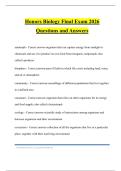
Honors Biology Final Exam 2026
Questions and Answers
autotroph - Correct answer-organism that can capture energy from sunlight or
chemicals and use it to produce its own food from inorganic compounds; also
called a producer
biosphere - Correct answer-part of Earth in which life exists including land, water,
and air or atmosphere
community - Correct answer-assemblage of different populations that live together
in a defined area
consumer - Correct answer-organism that relies on other organisms for its energy
and food supply; also called a heterotroph
ecology - Correct answer-scientific study of interactions among organisms and
between organisms and their environment
ecosystem - Correct answer-collection of all the organisms that live in a particular
place, together with their nonliving environment
©COPYRIGHT 2025, ALL RIGHTS RESERVED 1
,food chain - Correct answer-series of steps in an ecosystem in which organisms
transfer energy by eating and being eaten
food web - Correct answer-network of complex interactions formed by the feeding
relationships among the various organisms in an ecosystem
heterotroph - Correct answer-organism that obtains energy from the foods it
consumes; also called a consumer
population - Correct answer-group of individuals of the same species that live in
the same area
producer - Correct answer-organism that can capture energy from sunlight or
chemicals and use it to produce food from inorganic compounds; also called an
autotroph
species - Correct answer-group of similar organisms that can breed and produce
fertile offspring
trophic level - Correct answer-step in a food chain or food web
abiotic factors - Correct answer-physical, or nonliving, factor that shapes an
ecosystem
biotic factors - Correct answer-biological influence on organisms within an
ecosystem
©COPYRIGHT 2025, ALL RIGHTS RESERVED 2
, commensalisms - Correct answer-symbiotic relationship in which one member of
the association benefits and the other is neither helped nor harmed
mutalism - Correct answer-symbiotic relationship in which both species benefit
from the relationship
niche - Correct answer-full range of physical and biological conditions in which an
organism lives and the way in which the organism uses those conditions
predation - Correct answer-interaction in which one organism captures and feeds
on another organism
parasitism - Correct answer-symbiotic relationship in which one organism lives in
or on another organism (the host) and consequently harms it
pioneer species - Correct answer-first species to populate an area during primary
succession
primary succession - Correct answer-succession that occurs on surfaces where no
soil exists
symbiosis - Correct answer-relationship in which two species live closely together
carrying capacity - Correct answer-largest number of individuals of a population
that a given environment can support
emigration - Correct answer-movement of individuals out of an area
©COPYRIGHT 2025, ALL RIGHTS RESERVED 3
Questions and Answers
autotroph - Correct answer-organism that can capture energy from sunlight or
chemicals and use it to produce its own food from inorganic compounds; also
called a producer
biosphere - Correct answer-part of Earth in which life exists including land, water,
and air or atmosphere
community - Correct answer-assemblage of different populations that live together
in a defined area
consumer - Correct answer-organism that relies on other organisms for its energy
and food supply; also called a heterotroph
ecology - Correct answer-scientific study of interactions among organisms and
between organisms and their environment
ecosystem - Correct answer-collection of all the organisms that live in a particular
place, together with their nonliving environment
©COPYRIGHT 2025, ALL RIGHTS RESERVED 1
,food chain - Correct answer-series of steps in an ecosystem in which organisms
transfer energy by eating and being eaten
food web - Correct answer-network of complex interactions formed by the feeding
relationships among the various organisms in an ecosystem
heterotroph - Correct answer-organism that obtains energy from the foods it
consumes; also called a consumer
population - Correct answer-group of individuals of the same species that live in
the same area
producer - Correct answer-organism that can capture energy from sunlight or
chemicals and use it to produce food from inorganic compounds; also called an
autotroph
species - Correct answer-group of similar organisms that can breed and produce
fertile offspring
trophic level - Correct answer-step in a food chain or food web
abiotic factors - Correct answer-physical, or nonliving, factor that shapes an
ecosystem
biotic factors - Correct answer-biological influence on organisms within an
ecosystem
©COPYRIGHT 2025, ALL RIGHTS RESERVED 2
, commensalisms - Correct answer-symbiotic relationship in which one member of
the association benefits and the other is neither helped nor harmed
mutalism - Correct answer-symbiotic relationship in which both species benefit
from the relationship
niche - Correct answer-full range of physical and biological conditions in which an
organism lives and the way in which the organism uses those conditions
predation - Correct answer-interaction in which one organism captures and feeds
on another organism
parasitism - Correct answer-symbiotic relationship in which one organism lives in
or on another organism (the host) and consequently harms it
pioneer species - Correct answer-first species to populate an area during primary
succession
primary succession - Correct answer-succession that occurs on surfaces where no
soil exists
symbiosis - Correct answer-relationship in which two species live closely together
carrying capacity - Correct answer-largest number of individuals of a population
that a given environment can support
emigration - Correct answer-movement of individuals out of an area
©COPYRIGHT 2025, ALL RIGHTS RESERVED 3