Part 2: advanced MRI
Flow effects, flow imaging, angiography
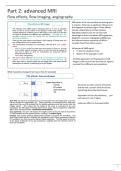
MRI seems to be very sensitive to moving spins
in arteries. They have a significant influence on
the magnetic resonance signal. These effects
may be undesirable since they produce
degrading artefacts but we can also take
advantage of them to produce MR angiograms.
Magnetic resonance angiography (MRA) uses
the inherent motion sensitivity of MRI to
visualize blood flow within vessels.
Influences of NMR signal:
• T1 and T2 relaxation times
• Motion of the hydrogen nuclei
Variable appearance of flowing spins in MR
images is the result of the fact that the signal is
received from different spin population.
What if positions change (if we have a flow for example)
We excite a certain volume of interest,
and we wait a certain amount of time.
Everything above the blood vessel
Dependent on the slice thickness, … you
will measure a lot of signal
enhanced effect or decreased effect
1
, we assume blood flow; the velocity is the same
over the tube
we apply a second RF pulse and within the
slice are 2 spin populations --> freen already
had an RF pulse and only V2 will get a second
RF puls.
fresh spins = don't have had an RF pulse
GE sequence: pulse acquire and repeat.
second RF pulse happens after the TR --> what is the intensity of each of the spin populations.
very long TR then the first spins are back at equilibrium and both spins are the same but now the saturated spins have a
higher intensity
𝑣 𝑟2
= 𝑣𝑚𝑎𝑥 (1 − 2 )
𝑟 𝑅
2
,SE sequence has 2 RF pulses.
blue part expierenced the 90 and 180°pulse so
only this will contribute to the measuring
signal.
velocity increased further the isgnal will
decrease and vice versa.
3
, ghosting: on the image all the bright spots should be blood vessels but sometimes you see other spots that can give
problems with the calculations.
in the scanner is a small object. blue = magnitude data; green =
real part of the k-space datat
what happens if i repeat my scan and put the object on a
slightky different place?
magnitude remains the same but on the green box there are
other thing seen.
let’s assume that during the acquition there is a replacement
of the object
both k-spaces gets combined and then if we do FT there is an extra signal along the phase encoding gradient
Now picture the same example except that halfway through the acquisition of phase encoding steps the object moves to a
new location in the phase encoding direction.
the same calculation but the object in placed in the other direction.
combine bith k-paces and FT --> there is som ghosting effects, there is more signal then only at the object.
this is because of time because it is a very small time interval.
4
Flow effects, flow imaging, angiography
MRI seems to be very sensitive to moving spins
in arteries. They have a significant influence on
the magnetic resonance signal. These effects
may be undesirable since they produce
degrading artefacts but we can also take
advantage of them to produce MR angiograms.
Magnetic resonance angiography (MRA) uses
the inherent motion sensitivity of MRI to
visualize blood flow within vessels.
Influences of NMR signal:
• T1 and T2 relaxation times
• Motion of the hydrogen nuclei
Variable appearance of flowing spins in MR
images is the result of the fact that the signal is
received from different spin population.
What if positions change (if we have a flow for example)
We excite a certain volume of interest,
and we wait a certain amount of time.
Everything above the blood vessel
Dependent on the slice thickness, … you
will measure a lot of signal
enhanced effect or decreased effect
1
, we assume blood flow; the velocity is the same
over the tube
we apply a second RF pulse and within the
slice are 2 spin populations --> freen already
had an RF pulse and only V2 will get a second
RF puls.
fresh spins = don't have had an RF pulse
GE sequence: pulse acquire and repeat.
second RF pulse happens after the TR --> what is the intensity of each of the spin populations.
very long TR then the first spins are back at equilibrium and both spins are the same but now the saturated spins have a
higher intensity
𝑣 𝑟2
= 𝑣𝑚𝑎𝑥 (1 − 2 )
𝑟 𝑅
2
,SE sequence has 2 RF pulses.
blue part expierenced the 90 and 180°pulse so
only this will contribute to the measuring
signal.
velocity increased further the isgnal will
decrease and vice versa.
3
, ghosting: on the image all the bright spots should be blood vessels but sometimes you see other spots that can give
problems with the calculations.
in the scanner is a small object. blue = magnitude data; green =
real part of the k-space datat
what happens if i repeat my scan and put the object on a
slightky different place?
magnitude remains the same but on the green box there are
other thing seen.
let’s assume that during the acquition there is a replacement
of the object
both k-spaces gets combined and then if we do FT there is an extra signal along the phase encoding gradient
Now picture the same example except that halfway through the acquisition of phase encoding steps the object moves to a
new location in the phase encoding direction.
the same calculation but the object in placed in the other direction.
combine bith k-paces and FT --> there is som ghosting effects, there is more signal then only at the object.
this is because of time because it is a very small time interval.
4