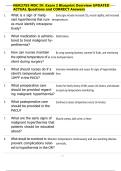
NUR2755 MDC IV: Exam 2 Blueprint Overview UPDATED
ACTUAL Questions and CORRECT Answers
1. What is a sign of malig- Early signs include increased CO₂, muscle rigidity, and increased
nant hyperthermia that nurs- temperature.
es must identify intraopera-
tively?
2. What medication is adminis- Dantrolene.
tered to treat malignant hy-
perthermia?
3. How can nurses maintain By using warming blankets, warmed IV fluids, and monitoring
the optimal temperature of a core temperature.
client during surgery?
4. What should nurses do if a Intervene immediately and assess for signs of hypermetabo-
client's temperature exceeds lism.
104°F in the PACU?
5. What preoperative care Screen for family history of MH, assess risk factors, and educate
should be provided regard- on post-op temperature monitoring.
ing malignant hyperthermia?
6. What postoperative care Continue to assess temperature every 15 minutes.
should be provided in the
PACU?
7. What are the early signs of Muscle cramps, dark urine, or fever.
malignant hyperthermia that
patients should be educated
about?
8. What should be monitored to Monitor temperature continuously and use warming devices
prevent complications relat- correctly.
ed to hypothermia in the OR?
, NUR2755 MDC IV: Exam 2 Blueprint Overview UPDATED
ACTUAL Questions and CORRECT Answers
9. What is the risk associat- Hypothermia (temperature < 36°C) can lead to delayed healing
ed with cold temperatures in and cardiac events.
the OR?
10. How should a nurse manage Warm them up, provide oxygen, and closely monitor their
a client with impaired ventila- breathing.
tion/oxygenation who is hy-
pothermic?
11. What preoperative care Pre-warm patients, especially older adults or those undergoing
should be provided to pa- long surgeries.
tients at risk for hypother-
mia?
12. What should be done if a Intervene early and consider lab tests if hypothermia persists.
patient shows cold, clammy
skin and decreased tempera-
ture?
13. What is the purpose of using To manage pain effectively through patient-controlled analge-
a PCA pump postoperatively? sia.
14. What should nurses assess Use a validated pain scale and reassess after administering pain
to evaluate a client's pain re- medication.
sponse?
15. What are the potential com- Decreased mobility, increased risk of DVT, and pulmonary is-
plications of unmanaged sues.
acute post-op pain?
16. What is the importance of ed- Patients should understand that pain control does not mean
ucating patients about pain experiencing zero pain.
control expectations?
, NUR2755 MDC IV: Exam 2 Blueprint Overview
Study online at https://quizlet.com/_hmpm4b
17. What is a key nursing ac- Position patients laterally and ensure proper NPO adherence.
tion to prevent aspiration in
post-op patients?
18. What should be monitored to Level of consciousness (LOC) and sedation levels.
ensure the effectiveness of
pain management?
19. What interventions can help Use multimodal analgesia, assess pain levels, and support mo-
manage acute post-op pain? bility.
20. What should nurses do if Reassess pain management and medicate as necessary.
they notice restlessness and
shallow breathing in a pa-
tient?
21. What is a common risk factor Stress response and the risk of bleeding.
for peptic ulcer disease relat-
ed to surgery?
22. How can nurses prevent Apply the warming protocol according to unit policy.
complications related to
low temperatures during
surgery?
23. What should be monitored if Assess GI symptoms.
stress ulcer prophylaxis is or-
dered post-operatively?
24. Why is it important to main- To prevent shivering-induced stress that could trigger ulcers or
tain temperature in post-op- increase bleeding risk.
erative care?
ACTUAL Questions and CORRECT Answers
1. What is a sign of malig- Early signs include increased CO₂, muscle rigidity, and increased
nant hyperthermia that nurs- temperature.
es must identify intraopera-
tively?
2. What medication is adminis- Dantrolene.
tered to treat malignant hy-
perthermia?
3. How can nurses maintain By using warming blankets, warmed IV fluids, and monitoring
the optimal temperature of a core temperature.
client during surgery?
4. What should nurses do if a Intervene immediately and assess for signs of hypermetabo-
client's temperature exceeds lism.
104°F in the PACU?
5. What preoperative care Screen for family history of MH, assess risk factors, and educate
should be provided regard- on post-op temperature monitoring.
ing malignant hyperthermia?
6. What postoperative care Continue to assess temperature every 15 minutes.
should be provided in the
PACU?
7. What are the early signs of Muscle cramps, dark urine, or fever.
malignant hyperthermia that
patients should be educated
about?
8. What should be monitored to Monitor temperature continuously and use warming devices
prevent complications relat- correctly.
ed to hypothermia in the OR?
, NUR2755 MDC IV: Exam 2 Blueprint Overview UPDATED
ACTUAL Questions and CORRECT Answers
9. What is the risk associat- Hypothermia (temperature < 36°C) can lead to delayed healing
ed with cold temperatures in and cardiac events.
the OR?
10. How should a nurse manage Warm them up, provide oxygen, and closely monitor their
a client with impaired ventila- breathing.
tion/oxygenation who is hy-
pothermic?
11. What preoperative care Pre-warm patients, especially older adults or those undergoing
should be provided to pa- long surgeries.
tients at risk for hypother-
mia?
12. What should be done if a Intervene early and consider lab tests if hypothermia persists.
patient shows cold, clammy
skin and decreased tempera-
ture?
13. What is the purpose of using To manage pain effectively through patient-controlled analge-
a PCA pump postoperatively? sia.
14. What should nurses assess Use a validated pain scale and reassess after administering pain
to evaluate a client's pain re- medication.
sponse?
15. What are the potential com- Decreased mobility, increased risk of DVT, and pulmonary is-
plications of unmanaged sues.
acute post-op pain?
16. What is the importance of ed- Patients should understand that pain control does not mean
ucating patients about pain experiencing zero pain.
control expectations?
, NUR2755 MDC IV: Exam 2 Blueprint Overview
Study online at https://quizlet.com/_hmpm4b
17. What is a key nursing ac- Position patients laterally and ensure proper NPO adherence.
tion to prevent aspiration in
post-op patients?
18. What should be monitored to Level of consciousness (LOC) and sedation levels.
ensure the effectiveness of
pain management?
19. What interventions can help Use multimodal analgesia, assess pain levels, and support mo-
manage acute post-op pain? bility.
20. What should nurses do if Reassess pain management and medicate as necessary.
they notice restlessness and
shallow breathing in a pa-
tient?
21. What is a common risk factor Stress response and the risk of bleeding.
for peptic ulcer disease relat-
ed to surgery?
22. How can nurses prevent Apply the warming protocol according to unit policy.
complications related to
low temperatures during
surgery?
23. What should be monitored if Assess GI symptoms.
stress ulcer prophylaxis is or-
dered post-operatively?
24. Why is it important to main- To prevent shivering-induced stress that could trigger ulcers or
tain temperature in post-op- increase bleeding risk.
erative care?