TF-CBT: Trauma Narrative Processing UPDATED ACTUAL Questions
and CORRECT Answers
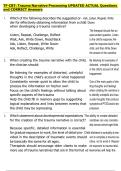
1. Which of the following describes the suggested or- Ask, Listen, Repeat, Write
der for effectively obtaining information from a child Down
when developing a trauma narrative?
The therapist should Ask an
Listen, Repeat, Challenge, Reflect open-ended question, Listen
Wait, Ask, Write Down, Read Back to the child's response; Re-
Ask, Listen, Repeat, Write Down peat the response back to the
Ask, Reflect, Challenge, Write child, and then Write Down
the answer in the narrative
2. When creating the trauma narrative with the child, Be listening for examples of
the clinician should: distorted, unhelpful thoughts
in the child's account of what
Be listening for examples of distorted, unhelpful happened
thoughts in the child's account of what happened
Consistently remain quiet to allow the child to One of the main goals of elic-
process the information on his/her own iting thoughts and feelings
Focus on the child's feelings without talking about when creating the narrative is
specific aspects of the trauma to identify unhelpful and inac-
Help the child fill in memory gaps by suggesting curate thoughts that produce
logical explanations and links between events that symptoms of PTSD and/or de-
the child may be repressing pression.
3. Which statement about developmental expectations The ability to create detailed
for the creation of the trauma narrative is correct? narratives can vary consider-
ably across school-aged kids.
Because specific, detailed information is essential
for gradual exposure to work, the level of detail pro- Child distress is actually a rea-
vided in the description of traumatic events should son to complete a trauma nar-
be basically the same for all ages. rative, not to avoid it. Repeat-
Therapists should encourage older clients to make ed exposure to trauma-relat-
more use of trauma narratives that are in the format ed memories will help the
, of a book (as opposed to a poem, song, or other child learn to manage trau-
medium). ma-related distress.
The ability to create detailed narratives can vary con-
siderably across school-aged kids.
Because younger children are more familiar with
"make believe" stories, therapists can incorporate
imaginary characters and events into trauma narra-
tives among this group.
4. When a child has more than one type of traumat- FALSE
ic event (e.g., sexual abuse and physical abuse), to
avoid overwhelming the child it is recommended to Trauma narratives for youth
do the trauma narrative on only one of these events. with multiple trauma expo-
sures should include ele-
TRUE ments from all the traumas
FALSE that most significantly con-
tribute to children's symp-
tom presentation (i.e., intru-
sive thoughts, avoidance).
5. Which of the following is NOT a therapeutic purpose Learning which people,
of creating a Trauma Narrative? places, or situations to avoid
so that trauma reactions won't
Helping to minimize intrusive and upsetting trau- be triggered
ma-related imagery
Helping to reduce avoidance of cues, situations, and Avoidance of trauma re-
feelings associated with trauma exposure minders is not a goal of
Identifying helpful and unhelpful cognitions about TF-CBT; all the other options
traumatic events are key reasons for engaging
Learning which people, places, or situations to avoid in trauma narrative develop-
so that trauma reactions won't be triggered ment
Gain a sense of mastery over traumatic memories.
2/7
and CORRECT Answers
1. Which of the following describes the suggested or- Ask, Listen, Repeat, Write
der for effectively obtaining information from a child Down
when developing a trauma narrative?
The therapist should Ask an
Listen, Repeat, Challenge, Reflect open-ended question, Listen
Wait, Ask, Write Down, Read Back to the child's response; Re-
Ask, Listen, Repeat, Write Down peat the response back to the
Ask, Reflect, Challenge, Write child, and then Write Down
the answer in the narrative
2. When creating the trauma narrative with the child, Be listening for examples of
the clinician should: distorted, unhelpful thoughts
in the child's account of what
Be listening for examples of distorted, unhelpful happened
thoughts in the child's account of what happened
Consistently remain quiet to allow the child to One of the main goals of elic-
process the information on his/her own iting thoughts and feelings
Focus on the child's feelings without talking about when creating the narrative is
specific aspects of the trauma to identify unhelpful and inac-
Help the child fill in memory gaps by suggesting curate thoughts that produce
logical explanations and links between events that symptoms of PTSD and/or de-
the child may be repressing pression.
3. Which statement about developmental expectations The ability to create detailed
for the creation of the trauma narrative is correct? narratives can vary consider-
ably across school-aged kids.
Because specific, detailed information is essential
for gradual exposure to work, the level of detail pro- Child distress is actually a rea-
vided in the description of traumatic events should son to complete a trauma nar-
be basically the same for all ages. rative, not to avoid it. Repeat-
Therapists should encourage older clients to make ed exposure to trauma-relat-
more use of trauma narratives that are in the format ed memories will help the
, of a book (as opposed to a poem, song, or other child learn to manage trau-
medium). ma-related distress.
The ability to create detailed narratives can vary con-
siderably across school-aged kids.
Because younger children are more familiar with
"make believe" stories, therapists can incorporate
imaginary characters and events into trauma narra-
tives among this group.
4. When a child has more than one type of traumat- FALSE
ic event (e.g., sexual abuse and physical abuse), to
avoid overwhelming the child it is recommended to Trauma narratives for youth
do the trauma narrative on only one of these events. with multiple trauma expo-
sures should include ele-
TRUE ments from all the traumas
FALSE that most significantly con-
tribute to children's symp-
tom presentation (i.e., intru-
sive thoughts, avoidance).
5. Which of the following is NOT a therapeutic purpose Learning which people,
of creating a Trauma Narrative? places, or situations to avoid
so that trauma reactions won't
Helping to minimize intrusive and upsetting trau- be triggered
ma-related imagery
Helping to reduce avoidance of cues, situations, and Avoidance of trauma re-
feelings associated with trauma exposure minders is not a goal of
Identifying helpful and unhelpful cognitions about TF-CBT; all the other options
traumatic events are key reasons for engaging
Learning which people, places, or situations to avoid in trauma narrative develop-
so that trauma reactions won't be triggered ment
Gain a sense of mastery over traumatic memories.
2/7