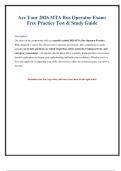
Ace Your 2026 MTA Bus Operator Exam:
Free Practice Test & Study Guide
Description:
Get ahead of the competition with our expertly crafted 2026 MTA Bus Operator Practice
Test, designed to mirror the official exam’s structure and content. This comprehensive guide
includes up-to-date questions on vehicle inspection, safety protocols, braking systems, and
emergency procedures—all aligned with the latest MTA standards. Each question comes with a
detailed explanation to deepen your understanding and build your confidence. Whether you’re a
first-time applicant or upgrading your skills, this resource offers the realistic practice you need to
succeed.
Download your free copy today and start your career on the right route!
, MTA Bus Operator Exam 2026: Practice Test & Study Guide
1. Which of the following is true about speed management and braking?
a) Stopping distance doubles when speed doubles
b) The stopping distance required for vehicles at 40 mph is four times greater than that required
at 20 mph
c) Braking distance is the same at all speeds
d) Speed has no effect on stopping distance
Answer: b) The stopping distance required for vehicles at 40 mph is four times greater than that
required at 20 mph
Explanation: Kinetic energy increases with the square of speed, meaning stopping distance
increases dramatically at higher speeds.
2. Which statement is true for the anti-lock braking system (ABS) in buses?
a) It increases braking distance
b) It prevents the brakes from locking up
c) It is only used in manual transmission buses
d) It requires manual activation
Answer: b) It prevents the brakes from locking up
Explanation: ABS helps maintain steering control during hard braking by preventing wheel
lock-up.
3. When is it acceptable to use recapped or regrooved tires on buses?
a) Only on the front wheels
b) Only on the rear wheels
c) On any wheel
d) Never
Answer: b) Only on the rear wheels
Explanation: Recapped or regrooved tires are permitted only on rear wheels to reduce risk of
blowouts affecting steering.
Free Practice Test & Study Guide
Description:
Get ahead of the competition with our expertly crafted 2026 MTA Bus Operator Practice
Test, designed to mirror the official exam’s structure and content. This comprehensive guide
includes up-to-date questions on vehicle inspection, safety protocols, braking systems, and
emergency procedures—all aligned with the latest MTA standards. Each question comes with a
detailed explanation to deepen your understanding and build your confidence. Whether you’re a
first-time applicant or upgrading your skills, this resource offers the realistic practice you need to
succeed.
Download your free copy today and start your career on the right route!
, MTA Bus Operator Exam 2026: Practice Test & Study Guide
1. Which of the following is true about speed management and braking?
a) Stopping distance doubles when speed doubles
b) The stopping distance required for vehicles at 40 mph is four times greater than that required
at 20 mph
c) Braking distance is the same at all speeds
d) Speed has no effect on stopping distance
Answer: b) The stopping distance required for vehicles at 40 mph is four times greater than that
required at 20 mph
Explanation: Kinetic energy increases with the square of speed, meaning stopping distance
increases dramatically at higher speeds.
2. Which statement is true for the anti-lock braking system (ABS) in buses?
a) It increases braking distance
b) It prevents the brakes from locking up
c) It is only used in manual transmission buses
d) It requires manual activation
Answer: b) It prevents the brakes from locking up
Explanation: ABS helps maintain steering control during hard braking by preventing wheel
lock-up.
3. When is it acceptable to use recapped or regrooved tires on buses?
a) Only on the front wheels
b) Only on the rear wheels
c) On any wheel
d) Never
Answer: b) Only on the rear wheels
Explanation: Recapped or regrooved tires are permitted only on rear wheels to reduce risk of
blowouts affecting steering.