GAME DESIGN 101 GMU QUESTIONS & ANSWERS
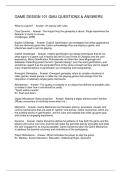
What is a game? - Answer -An activity with rules
Core Dynamic - Answer -The single thing the gameplay is about. Single experience the
designer is trying to convey.
(Challenges, 2008)
Explicit Challenge - Answer -Explicit Gamification are strategies that utilize applications
that are obviously game-like. Users acknowledge they are playing a game, and
oftentimes need to opt into playing.
Implicit Challenges - Answer -implicit gamification are design techniques that do not
show signs of a game, but it heavily ties the 8 Core Drives of Octalysis into the user
experience. Many Gamification Professionals out there like Jane Mcgonigal and
Sebastian Deterding prefer the term "gameful design" over the word gamification, and
sometimes regard it as the ascended form of the same concept (as they start to regard
many implementations of gamification as uninspiring and manipulative).
Emergent Gameplay - Answer -Emergent gameplay refers to complex situations in
video games, board games, or table top role-playing games that emerge from the
interaction of relatively simple game mechanics.
Affordances - Answer -The quality or property of an object that defines its possible uses
(it makes it clear how it can/should be used).
"Teach without words"
Ex: Push pull doors
Digital Affordance/ Skeuomorphism - Answer -Making a digital element seem familiar.
(Allows consumers to intuitively know what it is.)
Mechanic - Answer -Game Mechanics are the basic actions, processes, visuals, and
control mechanisms that are used to "gamify" and activity. Game mechanics, which are
the building blocks of gamification, are the rules and rewards that make up game play
and create an engaging experience.
Dynamic - Answer -Game Dynamics define the patterns of how both the game and the
players will evolve over time and that will make the gamified activity enjoyable and keep
the user engaged for as long as possible. Game Dynamics tailor the Game Mechanics
to address the desired outcomes and motivations of the participants.
Player Motivations - Answer -What motivates the player to play the game.
Ex: Mastery, Social Interaction, Education, Intellectual Rigor, Seclusion
, Slow Boil (Game development approach) - Answer -Assumes a design will "boil" out of
a theme.
Blue-sky
(Game development approach) - Answer -Game development approach that assumes
no constraints as the designer.
Mechanic Driven (Game development approach) - Answer -Assumes design will come
from mechanics.
Story
(Game development approach) - Answer -Assumes design will come from a story.
Research (Game development approach) - Answer -Assumes design will arise from
research questions.
Intellectual Property (IP)
(Game development approach) - Answer -Assumes design based on licensed
intellectual property.
Mechanic-Dynamic-Aesthetics (MDA)
(Game development approach) - Answer -A model in itself. Its own take on a game
The MDA framework formalizes the consumption of games by breaking them into their
distinct components
Rules -> System -> "Fun"
and establishing their design counterparts:
Mechanics -> Dynamics -> Aesthetics
Aesthetic
Aesthetic cont. - Answer -What makes a game "fun"? How do we know a specific type
of fun when we see it?
Discovery: Game as uncharted territory
Expression: Game as self discovery
Sensation: Game sense as pleasure
Fantasy: Game as make believe
Narrative: Game as drama
Fellowship: Game as social framework
Submission: Game as pastime
Challenge: Game as obstacle course
Iterative Design - Answer -Prototyping, testing, analyzing, and refining a product
(Wikipedia).
What is a game? - Answer -An activity with rules
Core Dynamic - Answer -The single thing the gameplay is about. Single experience the
designer is trying to convey.
(Challenges, 2008)
Explicit Challenge - Answer -Explicit Gamification are strategies that utilize applications
that are obviously game-like. Users acknowledge they are playing a game, and
oftentimes need to opt into playing.
Implicit Challenges - Answer -implicit gamification are design techniques that do not
show signs of a game, but it heavily ties the 8 Core Drives of Octalysis into the user
experience. Many Gamification Professionals out there like Jane Mcgonigal and
Sebastian Deterding prefer the term "gameful design" over the word gamification, and
sometimes regard it as the ascended form of the same concept (as they start to regard
many implementations of gamification as uninspiring and manipulative).
Emergent Gameplay - Answer -Emergent gameplay refers to complex situations in
video games, board games, or table top role-playing games that emerge from the
interaction of relatively simple game mechanics.
Affordances - Answer -The quality or property of an object that defines its possible uses
(it makes it clear how it can/should be used).
"Teach without words"
Ex: Push pull doors
Digital Affordance/ Skeuomorphism - Answer -Making a digital element seem familiar.
(Allows consumers to intuitively know what it is.)
Mechanic - Answer -Game Mechanics are the basic actions, processes, visuals, and
control mechanisms that are used to "gamify" and activity. Game mechanics, which are
the building blocks of gamification, are the rules and rewards that make up game play
and create an engaging experience.
Dynamic - Answer -Game Dynamics define the patterns of how both the game and the
players will evolve over time and that will make the gamified activity enjoyable and keep
the user engaged for as long as possible. Game Dynamics tailor the Game Mechanics
to address the desired outcomes and motivations of the participants.
Player Motivations - Answer -What motivates the player to play the game.
Ex: Mastery, Social Interaction, Education, Intellectual Rigor, Seclusion
, Slow Boil (Game development approach) - Answer -Assumes a design will "boil" out of
a theme.
Blue-sky
(Game development approach) - Answer -Game development approach that assumes
no constraints as the designer.
Mechanic Driven (Game development approach) - Answer -Assumes design will come
from mechanics.
Story
(Game development approach) - Answer -Assumes design will come from a story.
Research (Game development approach) - Answer -Assumes design will arise from
research questions.
Intellectual Property (IP)
(Game development approach) - Answer -Assumes design based on licensed
intellectual property.
Mechanic-Dynamic-Aesthetics (MDA)
(Game development approach) - Answer -A model in itself. Its own take on a game
The MDA framework formalizes the consumption of games by breaking them into their
distinct components
Rules -> System -> "Fun"
and establishing their design counterparts:
Mechanics -> Dynamics -> Aesthetics
Aesthetic
Aesthetic cont. - Answer -What makes a game "fun"? How do we know a specific type
of fun when we see it?
Discovery: Game as uncharted territory
Expression: Game as self discovery
Sensation: Game sense as pleasure
Fantasy: Game as make believe
Narrative: Game as drama
Fellowship: Game as social framework
Submission: Game as pastime
Challenge: Game as obstacle course
Iterative Design - Answer -Prototyping, testing, analyzing, and refining a product
(Wikipedia).