
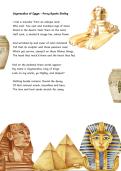
Ozymandias of Egypt - Percy Bysshe Shelley
I met a traveller from an antique land
Who said: Two vast and trunkless legs of stone
Stand in the desert. Near them on the sand,
Half sunk, a shatter'd visage lies, whose frown
And wrinkled lip and sneer of cold command
Tell that its sculptor well those passions read
Which yet survive, stamp'd on these lifeless things,
The hand that mock'd them and the heart that fed;
And on the pedestal these words appear:
My name is Ozymandias, king of kings:
Look on my works, ye Mighty, and despair!'
Nothing beside remains. Round the decay
Of that colossal wreck, boundless and bare,
The lone and level sands stretch far away.
, - The title identifies a powerful ruler and situates the poem in
ancient Egypt, evoking grandeur and authority.
Ozymandias of Egypt
- It hints at themes of pride, legacy, and the impermanence of
human power, preparing the reader for the contrast between
Ozymandias’s ambition and the ruin that follows.
- This opening line immediately establishes a sense of distance and
mystery, framing the poem as a story told second-hand rather
than a direct account.
- By introducing a “traveller,” the speaker positions themselves as a
conduit for ancient knowledge, lending credibility to the narrative
I met a traveller from an while also creating a layer of narrative distance that emphasizes
antique land the passage of time.
- The phrase “antique land” evokes an exotic, almost mythical
setting, suggesting civilizations long vanished and already
consigned to history.
- This line sets the tone for the poem’s meditation on
impermanence, pride, and the eventual decay of human
achievements, while also inviting the reader to visualize a world
far removed from their own experience.
- The subtle choice of “met” rather than “heard of” or “saw”
conveys immediacy and personal encounter, yet the reliance on
the traveller’s account keeps the story filtered through layers of
perception, highlighting the theme that history is often
reconstructed from fragments.
This line immediately evokes a sense of ruin and scale, presenting
-
a powerful visual of a once-mighty statue now reduced to
fragments.
By focusing on the “two vast and trunkless legs,” the poem
-
emphasizes both the enormity of the original monument and the
incompleteness of what survives, suggesting the inevitable decay
of human achievement.
The absence of the torso or head highlights the passage of time
-
Who said: Two vast and and the fragility of even the most imposing creations, while the
trunkless legs of stone word “trunkless” adds a stark, almost shocking quality, forcing
the reader to imagine a colossal form rendered hollow and
impotent.
The traveller’s narration creates a layer of distance, framing the
-
scene as a story of the past, which reinforces the themes of
historical perspective and the fleeting nature of power.
Additionally, the visual of isolated legs standing in the desert
-
conveys a lonely, desolate atmosphere, intensifying the irony that
what was once a symbol of absolute authority now survives only
as a fragment, stripped of its intended grandeur.
I met a traveller from an antique land
Who said: Two vast and trunkless legs of stone
Stand in the desert. Near them on the sand,
Half sunk, a shatter'd visage lies, whose frown
And wrinkled lip and sneer of cold command
Tell that its sculptor well those passions read
Which yet survive, stamp'd on these lifeless things,
The hand that mock'd them and the heart that fed;
And on the pedestal these words appear:
My name is Ozymandias, king of kings:
Look on my works, ye Mighty, and despair!'
Nothing beside remains. Round the decay
Of that colossal wreck, boundless and bare,
The lone and level sands stretch far away.
, - The title identifies a powerful ruler and situates the poem in
ancient Egypt, evoking grandeur and authority.
Ozymandias of Egypt
- It hints at themes of pride, legacy, and the impermanence of
human power, preparing the reader for the contrast between
Ozymandias’s ambition and the ruin that follows.
- This opening line immediately establishes a sense of distance and
mystery, framing the poem as a story told second-hand rather
than a direct account.
- By introducing a “traveller,” the speaker positions themselves as a
conduit for ancient knowledge, lending credibility to the narrative
I met a traveller from an while also creating a layer of narrative distance that emphasizes
antique land the passage of time.
- The phrase “antique land” evokes an exotic, almost mythical
setting, suggesting civilizations long vanished and already
consigned to history.
- This line sets the tone for the poem’s meditation on
impermanence, pride, and the eventual decay of human
achievements, while also inviting the reader to visualize a world
far removed from their own experience.
- The subtle choice of “met” rather than “heard of” or “saw”
conveys immediacy and personal encounter, yet the reliance on
the traveller’s account keeps the story filtered through layers of
perception, highlighting the theme that history is often
reconstructed from fragments.
This line immediately evokes a sense of ruin and scale, presenting
-
a powerful visual of a once-mighty statue now reduced to
fragments.
By focusing on the “two vast and trunkless legs,” the poem
-
emphasizes both the enormity of the original monument and the
incompleteness of what survives, suggesting the inevitable decay
of human achievement.
The absence of the torso or head highlights the passage of time
-
Who said: Two vast and and the fragility of even the most imposing creations, while the
trunkless legs of stone word “trunkless” adds a stark, almost shocking quality, forcing
the reader to imagine a colossal form rendered hollow and
impotent.
The traveller’s narration creates a layer of distance, framing the
-
scene as a story of the past, which reinforces the themes of
historical perspective and the fleeting nature of power.
Additionally, the visual of isolated legs standing in the desert
-
conveys a lonely, desolate atmosphere, intensifying the irony that
what was once a symbol of absolute authority now survives only
as a fragment, stripped of its intended grandeur.



