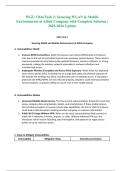
WGU C844 Task 2: Securing WLAN & Mobile
Environments at Alliah Company with Complete Solution |
2025-2026 Update
GRP1 Task 2
Securing WLAN and Mobile Environments at Alliah Company
A. Vulnerabilities: WLAN
1. Insecure BYOD Connections: Alliah's bring-your-own-device (BYOD) policy introduces
risks due to the lack of centralized control over employee-owned devices. These devices
may lack essential security features like updated firmware, antivirus software, or strong
passwords, making the wireless network vulnerable to malware infections and
unauthorized access.
2. Inadequate Wireless Encryption and Access Point Exposure: While Alliah has deployed
seven access points (APs), including one on a large back patio, the physical exposure of
APs outside the building may allow unauthorized users to attempt access. If encryption
protocols like WPA2/WPA3 are not enforced properly, attackers could intercept sensitive
communications via packet sniffing or launch man-in-the-middle attacks.
B. Vulnerabilities: Mobile
1. Unsecured Mobile Device Access: The five account representatives frequently travel and
access company data using laptops, tablets, and smartphones. If these mobile devices
lack full-disk encryption or secure remote-wipe capabilities, the loss or theft of a device
could lead to data breaches involving sensitive company or customer information.
2. Public Wi-Fi Usage Without VPN: When on the road, representatives likely connect to
public Wi-Fi networks in hotels, airports, or cafes. Without enforced VPN use, this
introduces risk of session hijacking, data interception, and exposure to rogue access
points set up by malicious actors.
C. Steps to Mitigate Vulnerabilities
Vulnerability Mitigation Steps Tools/Documentation
Environments at Alliah Company with Complete Solution |
2025-2026 Update
GRP1 Task 2
Securing WLAN and Mobile Environments at Alliah Company
A. Vulnerabilities: WLAN
1. Insecure BYOD Connections: Alliah's bring-your-own-device (BYOD) policy introduces
risks due to the lack of centralized control over employee-owned devices. These devices
may lack essential security features like updated firmware, antivirus software, or strong
passwords, making the wireless network vulnerable to malware infections and
unauthorized access.
2. Inadequate Wireless Encryption and Access Point Exposure: While Alliah has deployed
seven access points (APs), including one on a large back patio, the physical exposure of
APs outside the building may allow unauthorized users to attempt access. If encryption
protocols like WPA2/WPA3 are not enforced properly, attackers could intercept sensitive
communications via packet sniffing or launch man-in-the-middle attacks.
B. Vulnerabilities: Mobile
1. Unsecured Mobile Device Access: The five account representatives frequently travel and
access company data using laptops, tablets, and smartphones. If these mobile devices
lack full-disk encryption or secure remote-wipe capabilities, the loss or theft of a device
could lead to data breaches involving sensitive company or customer information.
2. Public Wi-Fi Usage Without VPN: When on the road, representatives likely connect to
public Wi-Fi networks in hotels, airports, or cafes. Without enforced VPN use, this
introduces risk of session hijacking, data interception, and exposure to rogue access
points set up by malicious actors.
C. Steps to Mitigate Vulnerabilities
Vulnerability Mitigation Steps Tools/Documentation