Exam 2 Form 2
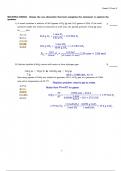
MULTIPLE CHOICE. Choose the one alternative that best completes the statement or answers the
question.
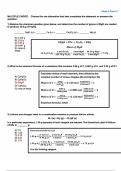
1) Balance the chemical equation given below, and determine the humber of grams of MgO are needed
to produce 10.0 g of Fe203.
MgO(s)+ ~ Fe(s)»__ Fe203(s) + Mg (s)
A)0.312¢g
B)2.52 g
C)7.57¢g 3MgO + 2Fe —» Fe,03; + 3Mg
D) 0.841 g
E) none of Mass of MgOo
10.0 g Fe,05 * 159.70 g Fe, 03 * 1mol
Fe, 04 *
=7.57g
1molMgO
2) What is the empirical formula of a substance that contains 2.64 g of C, 0.887 g of H, and 3.52 g of O?
Calculate moles of each element, then divide by the
A) C2H402 smallest number of moles: Oxygen (O) and Carbon (C)
B) CoH403
C) CH40 Moles of € = 20~ 0.220 mol S0 ™% — 1
D) C3H404 "+ mol |
E) none of these
Molesof H __0887g
= 1008 g/mot = - 880 mol &0880molH
zomelo ~
_
_ 352g . 0.220mol 0 _
Moles of 0 = 16.00 g/mol 0.220mol & moto —
Empirical formula: CH,O
3) Lithium and nitrogen react in a combination reaction to produce lithium nitride:
6Li (s) + N3 (g) — 2Li3N (s)
In a particular experiment, 1.50-g samples of each reagent are reacted. The theoretical yield of lithium
nitride is g.
A)7.5 Theoretical yield of Li;N
B) 1.25 L L _
C)3.70 ] (1 mo Ll) 2molLizN 34.83 gLizN _ .
D) 2.51 L0 gL\ oa g i) X 6molLi < 1molLi,N _ >>141LisN
E)1.51 150 a N (1mol Nz) 2 mol LizN ><34-.83,gLi3N 373 g Li.N
P IN2\28 029N,/ " 1molN, . 1molLi;N 9%
Li is the limiting reagent
, 4) How many moles of BCI3 are needed to produce 10.0 g of HCI(aq) in the following reaction?
BCI3 (g) + 3 H20 (1) — 3 HCI (aq) + B(OH)3 (aq)
A) 0.823 mol
g; g.ggrmrglol 10.0 g HCI 1molHCL 1 mol BCL 0.0914 mol BCl
D) 10.9 mol g 36.46 g HCl 3 mol HCI mot 5
. . % %k —_— .
E) none of these
5) How many grams of CaCl2 are formed when 35.00 mL of 0.00237 M Ca(OH)2 reacts with excess Cl2
gas?
2 Ca(OH)2(aq) + 2 Cl2(g) — Ca(OCl)2(aq) + CaCl2(s) + 2 H20(l)
A)0.0217 g
B) 0.00460 g
C)0.0184 g
D) 0.00921 g
E) none of these
Mass of CacCl,
1L Ca(OH), 0.00237 moles Ca(OH), 1 mol CaCl, 110.98 g CacCl,
35.00 mL Ca(OH), * =.00460 g CacCl,
1000 mL Ca(OH); 1L Ca(OH), * 2mol Ca(OH); _1mol CaCl,
6) What are the respective concentrations (M) of Cu2+ and CI- afforded by dissolving 0.666 mol CuCl2
in water and diluting to 522mL?
A) 0.00128 and 1.28
B) 1.28 and 1.28
C)0.784 and 0.174
D) 1.28 and 2.55
E) 0.00128 and 0.00128
Dissociation equation for CuCl,: CuCl,(s) - Cu®*(aq) + 2Cl (aq)
For every 1 mole of CuCl,that dissolves 1 mole of Cu?** and 2 moles Cl are produced.
moles of solute
Molarity (M) = volume
of solution (L)
247 — 0.666 mol CuCl, 1mol Cu?**
=1.28 M Cu?**
[Cu™] 0.522L 1mol CuCl,
(cl] 0.666 mol CuCl, 2mol Cl”
= * =2.55M CI”
0.522 L 1 mol CucCl,
MULTIPLE CHOICE. Choose the one alternative that best completes the statement or answers the
question.
1) Balance the chemical equation given below, and determine the humber of grams of MgO are needed
to produce 10.0 g of Fe203.
MgO(s)+ ~ Fe(s)»__ Fe203(s) + Mg (s)
A)0.312¢g
B)2.52 g
C)7.57¢g 3MgO + 2Fe —» Fe,03; + 3Mg
D) 0.841 g
E) none of Mass of MgOo
10.0 g Fe,05 * 159.70 g Fe, 03 * 1mol
Fe, 04 *
=7.57g
1molMgO
2) What is the empirical formula of a substance that contains 2.64 g of C, 0.887 g of H, and 3.52 g of O?
Calculate moles of each element, then divide by the
A) C2H402 smallest number of moles: Oxygen (O) and Carbon (C)
B) CoH403
C) CH40 Moles of € = 20~ 0.220 mol S0 ™% — 1
D) C3H404 "+ mol |
E) none of these
Molesof H __0887g
= 1008 g/mot = - 880 mol &0880molH
zomelo ~
_
_ 352g . 0.220mol 0 _
Moles of 0 = 16.00 g/mol 0.220mol & moto —
Empirical formula: CH,O
3) Lithium and nitrogen react in a combination reaction to produce lithium nitride:
6Li (s) + N3 (g) — 2Li3N (s)
In a particular experiment, 1.50-g samples of each reagent are reacted. The theoretical yield of lithium
nitride is g.
A)7.5 Theoretical yield of Li;N
B) 1.25 L L _
C)3.70 ] (1 mo Ll) 2molLizN 34.83 gLizN _ .
D) 2.51 L0 gL\ oa g i) X 6molLi < 1molLi,N _ >>141LisN
E)1.51 150 a N (1mol Nz) 2 mol LizN ><34-.83,gLi3N 373 g Li.N
P IN2\28 029N,/ " 1molN, . 1molLi;N 9%
Li is the limiting reagent
, 4) How many moles of BCI3 are needed to produce 10.0 g of HCI(aq) in the following reaction?
BCI3 (g) + 3 H20 (1) — 3 HCI (aq) + B(OH)3 (aq)
A) 0.823 mol
g; g.ggrmrglol 10.0 g HCI 1molHCL 1 mol BCL 0.0914 mol BCl
D) 10.9 mol g 36.46 g HCl 3 mol HCI mot 5
. . % %k —_— .
E) none of these
5) How many grams of CaCl2 are formed when 35.00 mL of 0.00237 M Ca(OH)2 reacts with excess Cl2
gas?
2 Ca(OH)2(aq) + 2 Cl2(g) — Ca(OCl)2(aq) + CaCl2(s) + 2 H20(l)
A)0.0217 g
B) 0.00460 g
C)0.0184 g
D) 0.00921 g
E) none of these
Mass of CacCl,
1L Ca(OH), 0.00237 moles Ca(OH), 1 mol CaCl, 110.98 g CacCl,
35.00 mL Ca(OH), * =.00460 g CacCl,
1000 mL Ca(OH); 1L Ca(OH), * 2mol Ca(OH); _1mol CaCl,
6) What are the respective concentrations (M) of Cu2+ and CI- afforded by dissolving 0.666 mol CuCl2
in water and diluting to 522mL?
A) 0.00128 and 1.28
B) 1.28 and 1.28
C)0.784 and 0.174
D) 1.28 and 2.55
E) 0.00128 and 0.00128
Dissociation equation for CuCl,: CuCl,(s) - Cu®*(aq) + 2Cl (aq)
For every 1 mole of CuCl,that dissolves 1 mole of Cu?** and 2 moles Cl are produced.
moles of solute
Molarity (M) = volume
of solution (L)
247 — 0.666 mol CuCl, 1mol Cu?**
=1.28 M Cu?**
[Cu™] 0.522L 1mol CuCl,
(cl] 0.666 mol CuCl, 2mol Cl”
= * =2.55M CI”
0.522 L 1 mol CucCl,